
South Korea is investing heavily in attracting international talent. Foreign professionals are entering startups, SMEs, research labs, and global-facing technology companies at growing scale. Yet many still discover the hardest barrier only after getting hired: the invisible workplace systems that shape influence, trust, and decision-making inside Korean organizations.
Korea’s Global Talent Push Is Expanding Faster Than Organizational Adaptation
International talent has been increasingly growing as part of the long-term economic and innovation strategy in South Korea.
The Ministry of SMEs and Startups recently expanded programs designed to connect international students and foreign professionals with Korean SMEs through employment support channels and visa-linked workforce initiatives.
At the same time, Korean startups and SMEs are becoming more open to foreign hiring. A Korea SMEs and Startups Agency (KOSME)-linked survey reported by Yonhap found that 78.4% of surveyed SMEs expressed willingness to hire international employees, while 63.7% believed foreign talent could help address labor shortages.
Yet recruitment alone is not solving workplace integration.
Research published by the Software Policy & Research Institute (SPRi) in 2025 found that companies hiring overseas digital talent still identified communication problems and adaptation to Korean corporate culture as major difficulties during employment. The same report also noted that cultural maladjustment and communication friction remained connected to employee departure and retention issues.
Previous KoreaTechDesk discussion with professional career strategist Monica Jung also highlighted that despite the expanding pipeline, actual hiring for global talents still follow a narrow path in South Korea as these talents are still selectively absorbed and facing massive challenges in communication and cultural fit.
This suggests that Korea’s internationalization challenge is no longer only about attracting talent. It increasingly involves how organizations themselves operate after hiring takes place.

Why Formal Inclusion Often Fails Inside Korean Organizations
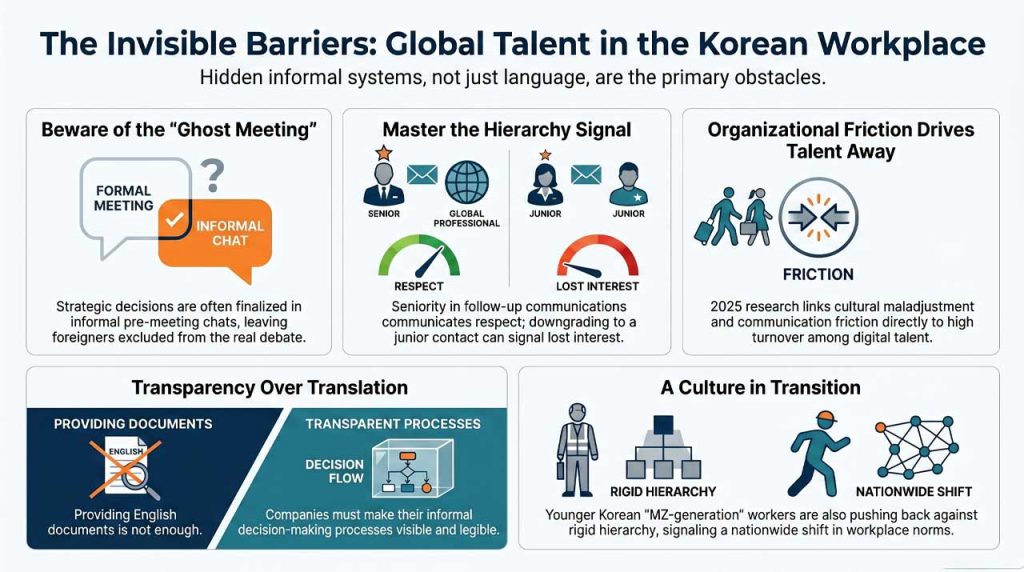
Many Korean companies already provide English documentation, translated onboarding materials, or bilingual meetings for international employees. On paper, foreign professionals may appear fully included.
In practice, however, workplace access inside Korean organizations is often shaped by informal communication structures that remain difficult for outsiders to see.
Jinseong Kim, founder of AI communication platform Noonchi.ai, has been examining these communication gaps through her work involving Korean workplace hierarchy, contextual signaling, and AI-assisted communication systems.
As KoreaTechDesk continued the discussion on Korean workplace communication and AI translation limitations, Kim argued that many foreign professionals struggle not because of grammar itself, but because important organizational decisions often depend on informal contextual systems that remain difficult to see from the outside.
“In Korean organizations, official meetings are often a performance — an announcement of what has already been decided,”
Kim told KoreaTechDesk.
“The real decision-making happens through informal channels: a smoke break, a quick coffee chat, a brief word in the hallway.”
Kim’s observation reflects a broader characteristic discussed in Korean management research.
Studies examining Korean organizational structures have noted that formal and informal systems frequently operate together rather than separately. Alignment, trust, and internal consensus may develop through side conversations, hallway discussions, meal gatherings, or pre-meeting exchanges long before a formal presentation begins.
As a result, foreign professionals may technically attend meetings while remaining disconnected from the earlier conversations where strategic direction was already shaped.

The “Ghost Meeting” Problem and Strategic Powerlessness
Kim describes one recurring pattern as the “Ghost Meeting.”
An international employee prepares carefully for a formal meeting, contributes thoughtful analysis, and assumes the discussion itself will influence the outcome. Yet the core alignment may already have been finalized informally beforehand.
Without visibility into these pre-meeting consensus loops, the foreign professional can become functionally excluded from decision-making despite appearing operationally involved.
“Without access to these informal loops…they remain functionally absent from the core strategy.”
And the issue becomes even more difficult because exclusion is not always intentional.
“When a company says ‘that meeting is in Korean, you don’t have to join,’ they genuinely believe they’re being considerate.”
Kim further explained a common pattern.
“What they’re actually doing is cutting that person out of the informal consensus loops where real decisions get made.”
This creates a form of workplace exclusion that is subtle rather than openly discriminatory. Employees remain physically included inside the organization while losing access to the contextual conversations that shape influence, trust, and long-term advancement.
The challenge is particularly important for startups and fast-moving companies, where informal coordination often moves faster than documented processes.

Hierarchy Signals Still Shape Business Relationships
Another invisible layer involves hierarchy signaling.
Kim shared one example involving international teams working with Korean business counterparts after a successful first meeting, an occurrence of which she refers as “Follow-Up Downgrade”.
According to Kim, some foreign companies unintentionally damage momentum when a senior executive attends the initial discussion, but a junior employee later handles follow-up communication.
In many Korean business environments, the seniority of the person continuing the relationship can itself communicate seriousness, priority, and organizational respect.
This mismatch in hierarchy signaling may not trigger open conflict. Instead, communication simply becomes slower or less responsive over time.
“In the Korean hierarchy, the seniority of whoever follows up is a signal — it communicates how seriously you’re taking the relationship.
A downgrade in seniority often reads as lost interest, causing the Korean side to quietly disengage with no explanation offered.”
This dynamic reflects a broader issue within Korean workplace systems. Access to decision-making is often influenced not only by official role descriptions, but also by social positioning, perceived commitment, and relationship continuity.
For foreign professionals unfamiliar with these signals, the rules can remain invisible until opportunities quietly disappear.
Korea’s Workplace Culture Is Also Changing Internally
At the same time, these workplace expectations are no longer stable even inside Korea itself. Recent Korean studies examining organizational culture and younger workers have, in fact, found growing tension around hierarchical structures.
A 2024 study involving more than 9,500 Korean workers found that hierarchical culture negatively affected organizational commitment among many MZ-generation employees. Another 2025 study analyzing over 9,000 employees across Korean companies linked hierarchical culture to higher turnover intention, particularly among younger workers.
This generational transition matters because many foreign professionals encounter Korean workplace systems during a period when Korean organizations themselves are renegotiating hierarchy, communication style, and expectations around commitment.
The issue also extends into work-life balance.
The Ministry of Employment and Labor recently announced a long-term roadmap aimed at reducing working hours toward OECD averages, while public discussions around “right to disconnect” policies continue expanding inside Korea.
These debates highlight how expectations around availability, loyalty, and workplace participation are increasingly being questioned domestically as well.
Foreign professionals entering Korean organizations are therefore not simply adapting to a static culture. They are entering a workplace environment already undergoing internal transformation.
Why This Matters Beyond HR and Hiring
And so, the implications extend far beyond onboarding.
OECD research has increasingly emphasized the role firms themselves play in immigrant integration and long-term workforce outcomes. Workplace systems influence not only retention, but also career mobility, participation, and organizational contribution.
For Korea’s startup ecosystem, this then creates a strategic question.
As startups scale internationally and recruit cross-border talent, operational competitiveness may increasingly depend on how effectively organizations make informal systems visible to people outside traditional insider networks.
Internal communication also directly affects innovation capacity. Research using Korea’s Workplace Panel Survey has found positive links between workplace communication quality and innovation performance in Korean companies.
Therefore, when foreign professionals lose access to informal communication loops, organizations may also lose access to alternative perspectives, external market understanding, and global execution insight.
Korea’s Next Global Talent Challenge May Be Organizational Transparency
Finally, South Korea has already made significant progress expanding international hiring pipelines. But the next challenge may involve making workplace systems themselves more legible.
Many Korean organizational practices evolved in environments that prioritized speed, hierarchy, collective coordination, and dense contextual understanding among insiders. Those systems can still operate efficiently for people who already understand the unwritten logic.
The difficulty emerges when global organizations attempt to integrate professionals who do not automatically share those assumptions.
Kim believes future progress will require more intentional transparency around how communication, authority, and decision-making actually function inside organizations.
“Organizations need to stop expecting talent to ‘just figure it out,’”
As Korea continues positioning itself as a global startup and innovation hub, attracting foreign talent may no longer be the hardest step. The more difficult challenge may be determining how much real organizational access international professionals receive after they arrive.
Key Takeaway
- South Korea is expanding international hiring pipelines, especially across startups and SMEs, but workplace integration challenges continue after recruitment.
- Research from SPRi identified communication friction and adaptation to Korean corporate culture as ongoing issues affecting foreign employee retention.
- Many Korean organizations operate through informal consensus loops, where strategic alignment may happen before formal meetings begin.
- Jinseong Kim of Noonchi.ai describes this as the “Ghost Meeting” problem, where foreign professionals attend official discussions while remaining excluded from earlier decision-making conversations.
- Hidden hierarchy signals can also affect business outcomes, including how companies interpret seniority, follow-up communication, and relationship seriousness.
- Korean workplace expectations are evolving as younger Korean workers increasingly challenge rigid hierarchical culture and commitment-heavy norms.
- Korea’s next global talent challenge may involve organizational transparency, not only hiring expansion or language support.
🤝 Looking to connect with verified Korean companies building globally?
Explore curated company profiles and request direct introductions through beSUCCESS Connect.
– Stay Ahead in Korea’s Startup Scene –
Get real-time insights, funding updates, and policy shifts shaping Korea’s innovation ecosystem.
➡️ Follow KoreaTechDesk on LinkedIn, X (Twitter), Threads, Bluesky, Telegram, Facebook, and WhatsApp Channel.