
Brazil is often introduced through numbers. More than 210 million consumers, the largest economy in Latin America, and a market that continues to attract global tech companies. But even with these appealing numbers, many expansion plans begin to unravel after the first customer meeting.
Now, the problem is rarely in the demand. Because the harder challenge today is learning how to operate inside an environment where regulation, institutions, credibility, and long-term commitment shape market access long before commercial scale arrives.
Brazil’s Market Size Can Hide a More Important Reality
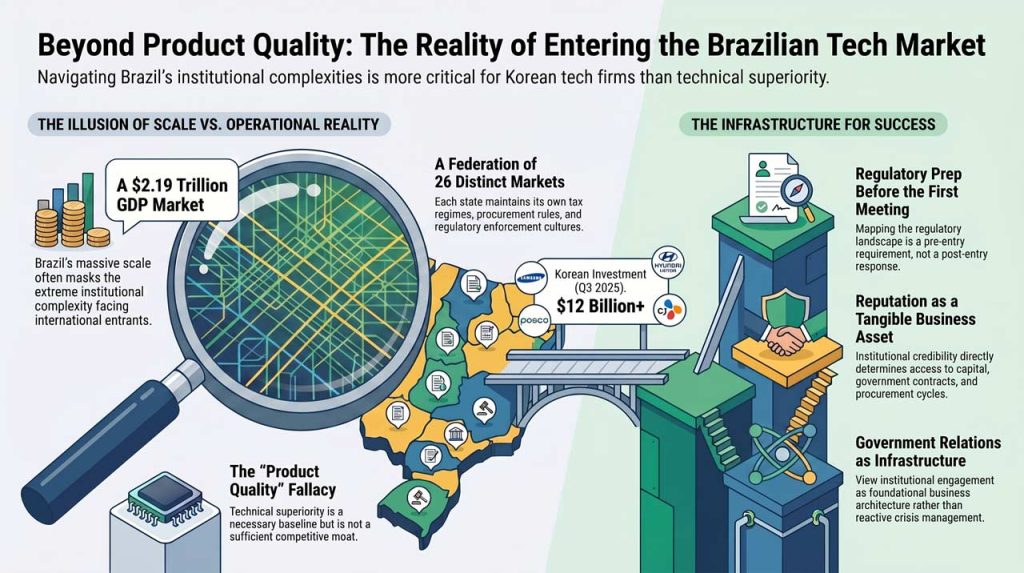
Brazil remains one of the most attractive markets for international expansion. According to the World Bank, the country has a population of nearly 212 million people and generated approximately USD 2.19 trillion in GDP in 2024.
South Korea’s Ministry of Foreign Affairs estimates Korean cumulative investment in Brazil exceeded USD 12 billion by the third quarter of 2025, with major Korean companies including Samsung Electronics, LG Electronics, Hyundai Motor, CJ, and POSCO maintaining local operations.
Those numbers help explain why Brazil consistently appears on expansion roadmaps. According to Mario Laffitte, however, they can also create a dangerous illusion.
Laffitte, a public policy advisor, Brazil market entry specialist, former Samsung Electronics Latin America vice president, and current Official Delegate of the Korean Valley Project for São Paulo and the Manaus Free Trade Zone, told KoreaTechDesk that many foreign companies confuse Brazil’s scale with operational readiness.
“The most persistent misunderstanding is the gap between Brazil as a headline number and Brazil as an operational environment.”

Companies often arrive with assumptions built around market size, purchasing power, and growth potential. But what they frequently underestimate is the institutional complexity that determines how business is actually conducted.
Brazil Is Not Just One Market
One of the most common mistakes foreign companies make is treating Brazil as a single operating environment.
Laffitte argues that Brazil functions less like one unified market and more like a federation of distinct economic and institutional systems.
“It is a federation of 26 states, each with its own tax regime, procurement rules, regulatory enforcement culture, and political dynamics.”
That complexity is not merely anecdotal. A World Bank study comparing business regulations across Brazil’s states found significant variation in administrative procedures, timelines, and operating requirements depending on location. Processes that may be relatively simple in one state can become considerably more complex elsewhere.
For Korean startups and tech companies used to operating in more standardized environments, this can come as a surprise. Market entry strategies that work in one Brazilian state may require substantial adaptation in another.
The result is that expansion planning cannot stop at national-level opportunity assessments. Companies must understand the institutional realities of the specific regions where they intend to operate.

Why Product Quality Alone Does Not Win
Technology companies naturally focus on product strength. But Laffitte believes many international entrants overestimate the power of technology alone.
“The third error, the one I consider the most dangerous, is assuming that product quality and technology superiority are sufficient competitive moats.”
Brazil’s technology market operates through multiple layers of evaluation. Product performance matters, but so do regulatory approvals, channel development, stakeholder relationships, after-sales support, procurement requirements, and long-term operational credibility.
This dynamic becomes even more critical in sectors influenced by government agencies, public procurement systems, regulated industries, and strategic technology initiatives.
According to the U.S. International Trade Administration, foreign companies entering Brazil frequently face regulatory requirements, certification processes, customs procedures, tax obligations, and compliance obligations that can significantly influence market access.
Laffitte argues that companies often discover these realities too late.
“Companies that arrive product-first and regulation-second typically face compliance restructuring at the worst possible moment,”
he said.
“When they already have operational commitments and commercial expectations.”
Regulatory Preparation Must Begin Before Market Entry
Companies often treat regulatory engagement as something that can wait until after operations begin.
According to Laffitte, that assumption frequently creates challenges that should have been avoidable. That’s because regulatory positioning actually shapes market access, compliance expectations, and institutional relationships long before a company reaches commercial scale.
“The answer is uncomfortable but unambiguous: before the first market-entry meeting.”
According to Laffitte, government relations and regulatory engagement should be treated as part of a company’s market-entry infrastructure rather than a response mechanism after difficulties emerge.
“The cost of building this infrastructure in the pre-entry phase, engaging the right advisors, mapping the regulatory landscape, identifying relevant institutional contacts, is a fraction of the cost of managing a crisis after the company is operational.”
This becomes particularly important in sectors subject to licensing requirements, public procurement processes, regulatory oversight, and industry-specific compliance frameworks.
Companies that postpone regulatory preparation often find themselves responding to licensing delays, procurement obstacles, audits, or compliance challenges after significant investments have already been committed.
“Reactive government relations is the equivalent of building flood defenses during a flood.”
In his view, the most effective approach is to begin preparing well before regulatory issues become urgent. Companies should identify the regulatory authorities relevant to their sector, understand compliance obligations before deployment, participate in industry associations, and establish institutional relationships before operational pressure begins.

Reputation Functions as a Business Asset in Brazil
The final layer is one that many technology companies underestimate: reputation.
Yet in Brazil’s strategic sectors, reputation extends far beyond public relations.
Laffitte argues that government agencies, development banks, institutional investors, procurement officials, industry associations, and major buyers often evaluate a company’s credibility long before formal engagements occur.
“In these sectors, reputation is not a communications concern,”
he noted.
“It is a competitive asset that directly affects access to capital, contracts, procurement, partnerships, and consumer base.”
The most important signals, however, are often revealed through day-to-day operations rather than through public announcements, making close observation of routine activity just as valuable as tracking official statements.
Local leadership with real authority, visible long-term investment, participation in industry organizations, and a consistent track record of honoring commitments all contribute to institutional credibility.
That is why companies that appear only when they need approvals, incentives, or market access often struggle to establish trust.
Meanwhile, those that demonstrate sustained commitment tend to build relationships that remain valuable across procurement cycles, regulatory changes, and shifts in government priorities.

The Real Competitive Advantage for Korean Tech Startups
Many Korean technology companies enter global markets with genuine strengths. Technical excellence, manufacturing discipline, operational consistency, and long-term investment capabilities have helped Korean firms build successful positions across multiple regions.
Brazil does not diminish those advantages.
But what Brazil does require is a broader definition of competition.
Success is not determined solely by product quality or technological superiority. It is shaped by how effectively companies navigate regulation, establish credibility, build institutional relationships, and demonstrate commitment before large-scale commercial opportunities emerge.
Companies that take this preparatory approach are often better positioned to navigate Brazil’s regulatory environment and capture the opportunities available in one of the world’s most attractive long-term markets.
By contrast, companies that prioritize speed over preparation frequently encounter the country’s regulatory complexity only after significant investments have already been made. As a result, adjustments will be far more costly and difficult.
Brazil: A Market That Rewards Commitment
The lesson from Brazil is not simply that expansion is difficult. After all, most international expansion efforts come with challenges.
But what Brazil demonstrates is that success often depends on understanding what kind of market you are entering. Some markets allow companies to move quickly and adapt along the way. Others require a deeper understanding of the regulatory environment before meaningful progress can be made.
By Laffitte’s assessment, Brazil falls firmly into the latter category.
Companies that view market entry as a commercial exercise often discover unexpected barriers. Alternatively, those that approach it as an institutional exercise supported by commercial execution are more likely to find durable growth.
And for Korean technology firms evaluating Latin America, understanding this distinction early can determine whether Brazil becomes merely a market they enter or a market where they achieve lasting commercial success.
Key Takeaway
- Brazil’s market opportunity is substantial, but market size alone does not translate into successful execution.
- Brazil operates through distinct state-level institutional environments, requiring localized market-entry planning.
- Product quality and technology superiority are necessary but not sufficient for long-term success.
- Regulatory preparation should begin before market entry, not after operational challenges emerge.
- Government relations function as business infrastructure, according to Mario Laffitte, former Samsung Electronics Latin America vice president.
- Corporate reputation directly influences access to procurement, partnerships, financing, and institutional trust.
- Korean technology companies entering Brazil must invest in credibility, local presence, and stakeholder engagement alongside commercial strategy.
- The core challenge is not demand generation but institutional execution inside one of Latin America’s most complex business environments.
– Stay Ahead in Korea’s Startup Scene –
Get real-time insights, funding updates, and policy shifts shaping Korea’s innovation ecosystem.
➡️ Follow KoreaTechDesk on LinkedIn, X (Twitter), Threads, Bluesky, Telegram, Facebook, and WhatsApp Channel.
🤝 Looking to connect with verified Korean companies building globally?
Explore curated company profiles and request direct introductions through beSUCCESS Connect.