
Foreign founders often assume the hardest part of entering Korea is getting through the door. They spend months applying to accelerator programs, attending startup events, and securing meetings with potential partners. Yet many discover a different reality after arriving. The first meetings are often easy. Keeping those conversations moving is where things become difficult. As Korea attracts a growing number of international startups, execution is emerging as the factor that separates market entry from market traction.
Korea Is Attracting More Foreign Startups Than Ever
South Korea has spent years building infrastructure to attract international founders. Programs such as the K-Startup Grand Challenge, Global Startup Center, and other government-backed initiatives have expanded access to office space, mentorship, visa support, business matching, and commercialization opportunities.
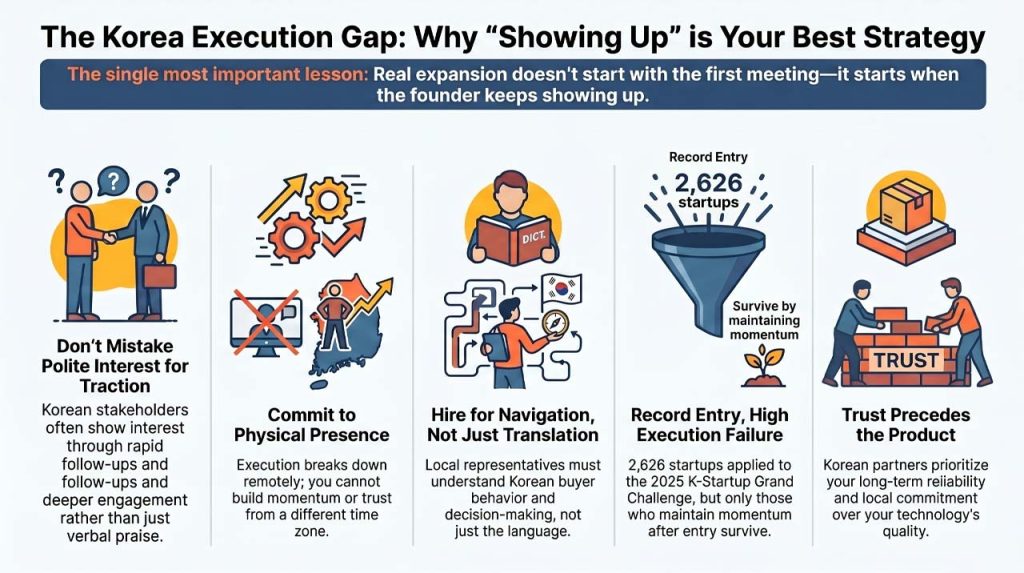
The Ministry of SMEs and Startups (MSS) reported that the 2025 K-Startup Grand Challenge received 2,626 applications from 97 countries, the highest participation level in the program’s history. More than 61% of applicants had already secured investment, while over 70% had recorded sales before applying.
The figures suggest that Korea is no longer attracting only early-stage entrepreneurs exploring overseas markets. Increasingly, established startups are evaluating the country as a serious destination for expansion.
Yet access alone does not guarantee execution.
According to Pidchayanin Chutipattana, CEO and Founder of ELKXA, many founders misunderstand where the real challenge begins.
“Execution breaks down when you’re not here. It’s that simple.”
Chutipattana works at the intersection of Korea’s startup ecosystem and international founders seeking market entry. Her experience spans partner sourcing, market-entry execution, government program navigation, and business development support for foreign startups entering Korea, giving her direct exposure to common challenges faced after initial market access.

Why Early Interest Often Creates False Confidence
In an exclusive interview with KoreaTechDesk, Chutipattana revealed that many foreign founders leave Korea with a belief that they have successfully built the right momentum.
“Many foreign startup CEOs visit Korea.
They attend a program, attend a demo day, and have a few meetings. They get warm signals, encouraging conversations, and a verbal expression of interest.
Then they fly home and expect the momentum to continue remotely.It doesn’t,”
Chutipattana said.
One of the most common mistakes involves interpreting Korean business signals through the lens of another market.
A polite conversation may be mistaken for commercial intent. A friendly meeting may be viewed as the beginning of a partnership. But in practice, Korean stakeholders often reveal their level of interest through actions rather than words.
Chutipattana further explained that companies genuinely interested in moving forward typically follow up quickly, seek additional meetings, make introductions, and actively create opportunities for deeper engagement.
Without those signals, founders may be building expectations around relationships that are not progressing. For example, a previous KoreaTechDesk interview with 2025 KSGC founder Hendriansyah described moments where startup deals stalled in Korea even after strong interest.
The Cost of Treating Korea as a Side Project
The challenge becomes even greater when startups attempt expansion before fully committing resources.
According to Chutipattana, some companies approach Korea as an experiment rather than a strategic priority. They add Korea to an existing list of target markets, hoping to evaluate opportunities without making meaningful investments in local presence.
Unfortunately, that approach rarely works.
“That’s not market entry — that’s tourism.”
Her observation reflects a broader reality of cross-border expansion. Korea is a highly competitive market where local companies move quickly, and decision-making cycles can evolve rapidly. Founders who remain hesitant often struggle to build the knowledge and relationships needed to make informed decisions.
As a result, they become trapped in a cycle of uncertainty. Limited commitment leads to limited learning, which reduces confidence and delays further commitment.
Meanwhile, local opportunities continue moving forward without them.
The Wrong First Hire Can Stall an Entire Expansion Strategy
Physical presence does not necessarily require a founder to relocate permanently. However, it does require credible local representation.
Many foreign startups assume that hiring a bilingual Korean employee solves the problem. Chutipattana argues that this assumption frequently creates new challenges.
“The hire needs to understand both the foreign company’s product and how Korean buyers actually make decisions.”
So the issue is not the language capability. It is market navigation instead.
A representative responsible for Korea must understand local buyer behavior, industry networks, partnership dynamics, and commercial expectations. They must also have enough authority and credibility to represent the company effectively.

When founders remain overseas while second-guessing local recommendations, progress often slows. Opportunities are missed because decisions are delayed or trust is weakened.
And for Korean stakeholders evaluating foreign startups, responsiveness and commitment have actually become significant factors for consideration. A representative who lacks decision-making authority can create uncertainty about the company’s seriousness.
Why Trust Often Matters Before Product
Korea’s startup ecosystem is increasingly global, but relationships remain important.
The International Trade Administration’s market guide for South Korea notes that maintaining strong local relationships and frequent in-market engagement remains critical for business success. Local presence continues to play a significant role in developing commercial opportunities.
For foreign founders, this creates a challenge beyond product quality.
A startup may have strong technology, proven traction, and successful deployments elsewhere. Korean stakeholders still need confidence that the company will remain engaged long enough to execute successfully.
Chutipattana believes many founders underestimate this dynamic.
“If the CEO isn’t present in Korea and there’s no one credible representing the company here, it’s like wanting to win a championship but never showing up to training.”

Korea’s Opportunity Is Real, but Execution Decides the Outcome
The growth in foreign startup participation suggests Korea’s global appeal continues to strengthen. Government support programs, startup infrastructure, and market opportunities have become increasingly accessible to international founders.
At the same time, Korea’s openness has not eliminated the need for execution discipline.
The founders who succeed are often not the ones with the most meetings, the most program logos, or the largest number of initial introductions. They are the ones who remain present, continue building relationships, and maintain momentum even after the excitement of market entry fades.
Korea Has Lowered Entry Barriers: Execution Remains the Real Challenge
At the end of the day, it is undeniable that entrance to the Korean market has become easier than it was a decade ago.
However, staying engaged long enough to convert interest into partnerships, partnerships into revenue, and revenue into sustainable growth remains a different challenge altogether.
So, for foreign startups evaluating Korea, the lesson may actually be simpler than expected.
Because market entry indeed starts when the meetings begin. But real expansion only starts when the founder keeps showing up.
Key Takeaways
- Korea is attracting record levels of foreign startup interest, with 2,626 startups from 97 countries applying to the 2025 K-Startup Grand Challenge.
- Initial interest does not equal commercial commitment. Foreign founders often misinterpret positive meetings as evidence of traction.
- Physical presence remains a major advantage because relationships, trust, and follow-up activities are difficult to sustain remotely.
- Hiring a bilingual employee is not enough. Effective local representatives must understand both the product and Korean business decision-making.
- Trust remains a critical business asset because Korean stakeholders evaluate the long-term reliability and commitment of foreign companies.
- The biggest barrier is often not access to Korea but execution after entry, when startups must maintain momentum and convert opportunities into measurable outcomes.
🤝 Looking to connect with verified Korean companies building globally?
Explore curated company profiles and request direct introductions through beSUCCESS Connect.
– Stay Ahead in Korea’s Startup Scene –
Get real-time insights, funding updates, and policy shifts shaping Korea’s innovation ecosystem.
➡️ Follow KoreaTechDesk on LinkedIn, X (Twitter), Threads, Bluesky, Telegram, Facebook, and WhatsApp Channel.