
Global founders are increasingly looking to South Korea as a serious market for expansion, backed by strong programs, infrastructure, and corporate demand. Yet beyond the early momentum, a different pattern begins to emerge. Yes, deals rarely collapse outright in Korea, but they slow, stretch, and stall instead. That is why understanding where and why this happens is becoming essential for anyone navigating Korea’s startup ecosystem.
Korea Is Opening Up to Global Startups — But Deals Tell a Different Story
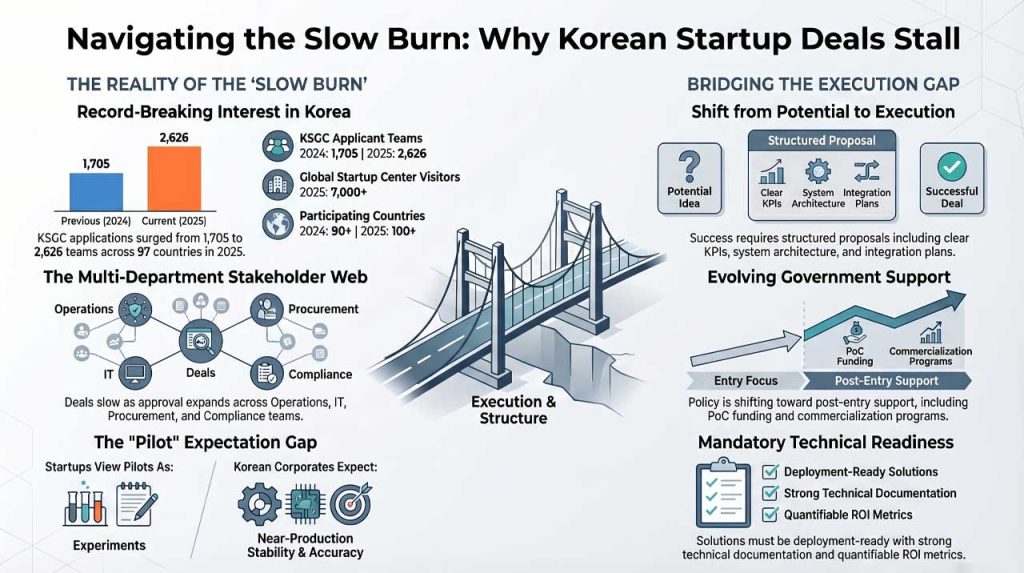
South Korea is actively expanding its reach as a global startup destination. The government has scaled inbound startup programs such as the K-Startup Grand Challenge (KSGC), which attracted 2,626 teams from 97 countries in 2025, up from 1,705 during the year before.
At the same time, new initiatives like the Global Startup Center are designed to reduce entry barriers for foreign founders, offering visa support, workspace, and business services. MSS reports that the center welcomed more than 7,000 visitors from over 100 countries in its first year.
This shows clear direction that South Korea has been highly investing access for inbound startups. And yet, for many founders the real challenge begins after the entry process.
Because once startups successfully enter the Korean market, even when early conversations move quickly, translating that momentum into actual deals proves far more difficult.
When Interest Turns into Evaluation
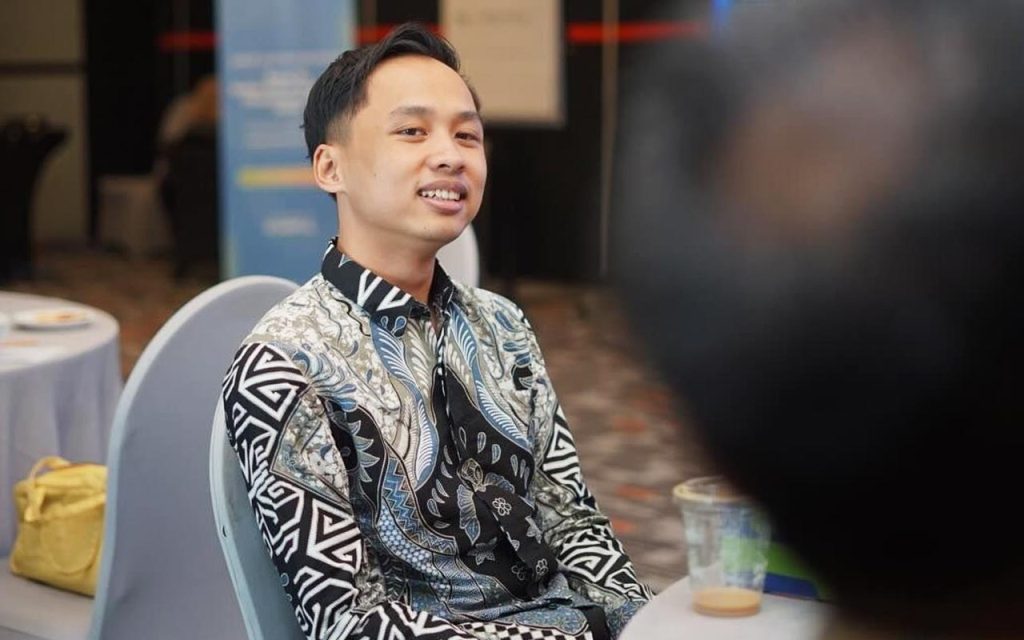
The shift is subtle but decisive. In an interview with KoreaTechDesk, Hendriansyah, Founder and CEO of TaggIoT, a Top 40 startup at KSGC 2025, described a moment that captures this transition:
“There was a moment when we thought—this is it.”
At that stage, discussions had already progressed beyond introductions. Use cases were clear, and deployment scenarios were being considered.
But then, the focus changed.
Instead of asking what the technology does, Korean partners began asking how it performs under real conditions. Questions moved toward data accuracy, system scalability, and integration with existing operations.
The conversation was no longer about potential. It became about execution.
Deals Rarely Fail — They Slow Down
One pattern appears consistently across founder experiences. Deals in Korea rarely collapse outright. They tend to slow down as more stakeholders become involved.
Hendriansyah explained that progress often expands beyond the initial team. What begins as alignment with an innovation or strategy unit quickly extends to operations, IT, procurement, and compliance.
“There was no rejection—it just slowed down.”
Each group evaluates the proposal from a different perspective. Operations look at workflow impact. IT examines integration and data reliability. Procurement assesses cost and risk.
While this layered process is not unusual, what makes it unique is that in Korea, it is particularly structured and thorough.
Similar experience was echoed by Konnect founder/CEO Ravi Shankar Pandit in previous KoreaTechDesk coverage. He noted that moving from discussion to execution often requires internal alignment, budget approval, and risk evaluation across multiple departments.
While this may not result in resistance, it certainly highlights the complexity of the process.
The “Pilot” Gap That Delays Execution
One of the most interesting and most overlooked sources of friction appears in one single word: pilot.
Hendriansyah described a recurring misunderstanding:
“We realized we were using the same word—‘pilot’—but meaning very different things.”
Usually, for many startups, a pilot is a testing phase. It is designed to validate performance, refine integration, and iterate before scaling.
But in South Korea, expectations are often different. A pilot is frequently treated as a near-production deployment, with high standards for data accuracy, system stability, and operational readiness from the outset.
“In Korea, a pilot is often seen as a preview of the final system—not an experiment.”
Therefore, this gap in expectations can significantly slow progress. Because what one side views as a step toward validation, the other may see as an early stage of deployment.
It takes time to reach an alignment in understanding. But until that alignment is reached, deals remain in motion but do not close.
KSGC Opens Doors — Execution Shapes the Outcome
Programs like KSGC play a critical role in bringing global founders into Korea’s ecosystem. They provide visibility, credibility, and access to corporate partners. MSS has positioned KSGC as a key entry point, supported by follow-up initiatives such as open innovation programs and commercialization funding.
But access alone does not immediately convert into business.
Hendriansyah directly explained:
“KSGC opened the door—but it didn’t move the deal.”
What made a difference came after entry. Structured proposals with clear KPIs, defined system architecture, and detailed integration plans shifted conversations forward. Each discussion became more concrete. And each iteration made it easier for internal teams to evaluate the opportunity.
“It’s not one breakthrough moment—it’s a series of small alignments that eventually turn into a real project.”
This case reflects a broader pattern, showing that Korea’s ecosystem is indeed effective at initiating conversations. But the harder phase is sustaining them through execution.
Policy Is Catching Up to Execution Reality
Recent policy developments suggest that this gap is being recognized. Beyond KSGC, the government has expanded support through the Global Startup Center and foreign startup commercialization programs. These initiatives offer funding, infrastructure, and structured support for market entry.
Public-private open innovation programs are also growing. Managed by organizations such as KISED, these programs connect startups with large companies and support proof-of-concept projects, with funding available for pilot and prototype development.
The shift is subtle but important. Korea is moving its focus from access toward execution.
What This Means for Global Founders
So, for founders considering entering the South Korean startup market, the case offers practical implications.
Strong initial interest is not a reliable signal of deal readiness. Progress depends on how well a solution fits into existing systems, how clearly it demonstrates measurable outcomes, and how easily it can be evaluated by multiple internal stakeholders.
That is why meticulous preparation is mandatory for founders, including:
- deployment-ready solutions
- clear and quantifiable ROI metrics
- strong technical documentation
- integration readiness with enterprise systems
Without these, conversations may advance, but they are unlikely to convert.
A Market That Filters Through Execution
In the end, South Korea may not be a closed market, but it is certainly one of the most structured.
The country continues to attract global startups, supported by expanding programs and strong infrastructure. Interest is real, and opportunities exist across sectors such as logistics, manufacturing, and digital services.
But the market operates with a clear filter. Deals move forward only when alignment is achieved across technical, operational, and organizational layers.
This layered process takes time. And for many startups, it is where momentum slows.
Key Takeaway
- Korea is expanding foreign startup access through programs like KSGC and the Global Startup Center (MSS)
- Strong early interest does not guarantee deal conversion in the Korean market
- Deals often stall due to multi-department alignment across operations, IT, procurement, and compliance
- “Pilot” expectations differ: startups see testing, Korean companies expect near-production readiness
- Execution requires structured proposals with KPIs, integration plans, and measurable outcomes
- Government policy is shifting toward supporting post-entry execution, including PoC and open innovation programs
- For global founders, success in Korea depends on operational readiness, not just innovation or traction
– Stay Ahead in Korea’s Startup Scene –
Get real-time insights, funding updates, and policy shifts shaping Korea’s innovation ecosystem.
➡️ Follow KoreaTechDesk on LinkedIn, X (Twitter), Threads, Bluesky, Telegram, Facebook, and WhatsApp Channel.
🤝 Looking to connect with verified Korean companies building globally?
Explore curated company profiles and request direct introductions through beSUCCESS Connect.