
Tax systems rarely appear in conversations about climate intelligence. Carbon accounting discussions usually revolve around emissions targets, sustainability disclosures, and reporting frameworks. Still, one of the most intriguing developments may be emerging from a place where few people associate with environmental governance. Brazil’s highly complex tax infrastructure has quietly produced a vast ecosystem of transactional data that could eventually become an unexpected foundation for more auditable sustainability intelligence.
Why Sustainability Data Still Struggles With Trust
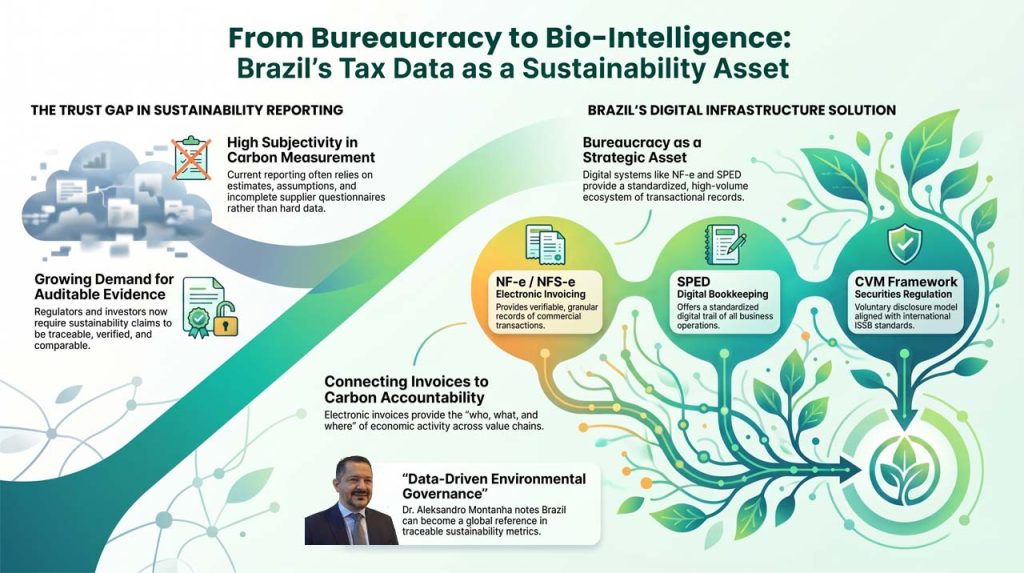
Global sustainability reporting is entering a new phase. The challenge is no longer simply encouraging companies to publish ESG disclosures. Investors, regulators, and assurance providers increasingly want evidence that sustainability claims can be traced, verified, and compared across organizations.
The Commission on Sustainability Data at Kellogg College, University of Oxford was established partly in response to this problem. The commission argues that sustainability decisions depend on accurate, reliable, and comparable information capable of supporting better economic and environmental choices.
Dr. Aleksandro Montanha, a member of the Commission on Sustainability Data at Kellogg College, University of Oxford, and founder of the Korean Valley initiative in Brazil, has spent years working at the intersection of innovation ecosystems, public policy, and data-driven sustainability.
Drawing on his experience connecting academia, government, and technology communities across Brazil and South Korea, he believes one weakness remains particularly difficult to overcome.
“One of the greatest challenges surrounding carbon footprint measurement models is the high degree of subjectivity that still characterizes much of the process,”
he told KoreaTechDesk as discussion on Brazil’s market entry challenges continue.
That subjectivity has become increasingly important as sustainability assurance standards mature and companies face growing expectations to support environmental claims with credible evidence.

Brazil’s Bureaucracy Produced Something Valuable
Brazil is frequently described as one of the world’s more complicated business environments. The Organisation for Economic Co-operation and Development (OECD) has long noted that the country’s fragmented tax system created additional costs and operational complexity for businesses.
Yet the same complexity also generated an extensive digital fiscal infrastructure.
Brazil’s tax administration relies heavily on electronic invoicing and digital bookkeeping systems, including the Nota Fiscal Eletrônica (NF-e), Nota Fiscal de Serviço Eletrônica (NFS-e), and the Public Digital Bookkeeping System (SPED). These systems record and validate enormous volumes of commercial transactions through standardized digital processes.
For Montanha, this creates an opportunity that extends beyond taxation itself.
“What is often perceived as bureaucratic complexity can therefore be transformed into a powerful strategic advantage.”
This shift carries important implications because it means that a digital transaction trail that was originally built to support taxation may also provide structured evidence that can strengthen sustainability measurement.
Why Electronic Invoices Could Matter for Carbon Accountability
Sustainability reporting often depends on estimates, assumptions, supplier questionnaires, and incomplete operational information.
Brazil’s digital fiscal ecosystem offers a different possibility.
“The existence of verifiable electronic invoice systems, structured tax documentation, and highly granular economic transaction data fundamentally changes the sustainability data landscape,”
Montanha explained.
Electronic invoices cannot automatically calculate carbon footprints. A transaction record does not immediately reveal emissions intensity, energy sources, production methods, or supply-chain conditions.
However, transaction data can provide an auditable foundation for understanding what was purchased, who supplied it, where transactions occurred, and how economic activities connect across value chains.
When combined with emissions methodologies, sector-specific assumptions, and verified activity data, these records could reduce some of the uncertainty that still surrounds sustainability reporting.

Environmental Intelligence May Depend on Evidence Infrastructure
The idea is particularly relevant because sustainability regulation is also evolving.
Brazil’s Securities and Exchange Commission (CVM) recently revised its sustainability disclosure framework by removing mandatory sustainability-related financial reporting requirements while maintaining an ISSB and CBPS-based voluntary framework. Companies choosing to disclose sustainability information must still follow internationally recognized reporting standards.
In practice, voluntary disclosure does not reduce the need for trustworthy information. It may actually increase it.
Organizations that publish sustainability data must convince investors, customers, and regulators that their information deserves confidence.
Montanha and colleagues involved in sustainability initiatives connected to Oxford and municipal innovation environments in Brazil are examining precisely this question.
“We are working to make carbon footprint measurement substantially more precise, transparent, auditable, and data-driven by leveraging Brazil’s robust ecosystem of standardized and traceable transactional records,”
he said.
The work remains an evolving effort rather than a completed solution. Yet it highlights an increasingly important shift in sustainability thinking. That’s because the next generation of environmental intelligence may depend less on producing additional reports and more on improving the quality of the evidence behind those reports.

Why Korean Technology Companies Should Pay Attention
What happens in Brazil could have consequences far beyond its borders. In fact, South Korea has been placing greater emphasis on sustainability data management, assurance readiness, and system integration as companies prepare for increasingly sophisticated disclosure expectations.
In May 2026, Samil PwC and the Korea Accounting Institute held a sustainability disclosure seminar attended by more than 400 corporate participants, with discussions focusing on standards interpretation, data management, internal controls, assurance, financial impact analysis, and governance.
Enterprise software providers, climate-tech startups, AI infrastructure firms, and carbon accounting companies are all competing to improve sustainability intelligence capabilities. Korean companies are increasingly treating sustainability data as a data architecture and assurance challenge rather than simply a reporting exercise.
In Brazil, the picture looks somewhat different.
Instead of treating sustainability data primarily as a reporting exercise, the Brazilian case suggests that transaction infrastructures themselves may become strategic assets for environmental accountability.
That is why for Korean companies building ESG software, supply-chain intelligence platforms, or carbon reporting solutions, the opportunity may not lie solely in creating better dashboards or analytics tools.
And so, Brazil offers a different lesson: sustainability data may become more credible when it is connected to fiscal and transactional evidence rather than relying primarily on self-reported ESG inputs.
And the larger opportunity may be designing systems capable of connecting sustainability claims to verified operational evidence.
The Future of ESG May Depend on Verifiable Data
Ultimately, carbon accountability has now become a data problem that extends beyond methodologies, governance structures, and reporting frameworks.
As environmental claims face increasing scrutiny, companies also need reliable evidence to substantiate what they report, and Montanha believes Brazil may hold a unique advantage in providing that foundation.
“Brazil has the potential to become a global reference in carbon accountability, traceable sustainability metrics, and data-driven environmental governance.”
This does not automatically mean Brazil has already solved the challenge of measuring sustainability performance. Instead, it suggests a more interesting possibility: some of the infrastructure needed for more auditable sustainability intelligence may already exist within systems originally designed for an entirely different purpose.
Key Takeaway
- Sustainability reporting increasingly depends on trustworthy and auditable data, not simply additional disclosures.
- Brazil’s electronic invoice ecosystem, including NF-e, NFS-e, and SPED, has created a rich foundation of structured transactional records.
- Brazil’s bureaucratic complexity may become a strategic advantage for carbon accountability and traceable sustainability metrics.
- Transaction records cannot measure carbon footprints by themselves, but they can provide verifiable evidence layers that support environmental intelligence.
- Brazil’s evolving sustainability framework highlights the growing importance of data quality, comparability, and assurance readiness.
- For Korean ESG software, enterprise SaaS, AI infrastructure, and climate-tech companies, the future opportunity may lie in linking sustainability claims to verified operational and transaction data.
- The next phase of environmental governance may be shaped by evidence infrastructure as much as by sustainability frameworks themselves.
– Stay Ahead in Korea’s Startup Scene –
Get real-time insights, funding updates, and policy shifts shaping Korea’s innovation ecosystem.
➡️ Follow KoreaTechDesk on LinkedIn, X (Twitter), Threads, Bluesky, Telegram, Facebook, and WhatsApp Channel.
🤝 Looking to connect with verified Korean companies building globally?
Explore curated company profiles and request direct introductions through beSUCCESS Connect.