
South Korea has spent years lowering barriers for international founders. New visa pathways, startup programs, and founder support initiatives have expanded opportunities for entrepreneurs who want to build in Korea. And still, securing entry is only the beginning. Because after arrival, many founders discover that operating a company apparently also depends on another different set of systems that rarely appear in startup program brochures.
Korea Is Making It Easier for Foreign Founders to Enter
South Korea’s startup ecosystem has become increasingly active in attracting overseas entrepreneurs.
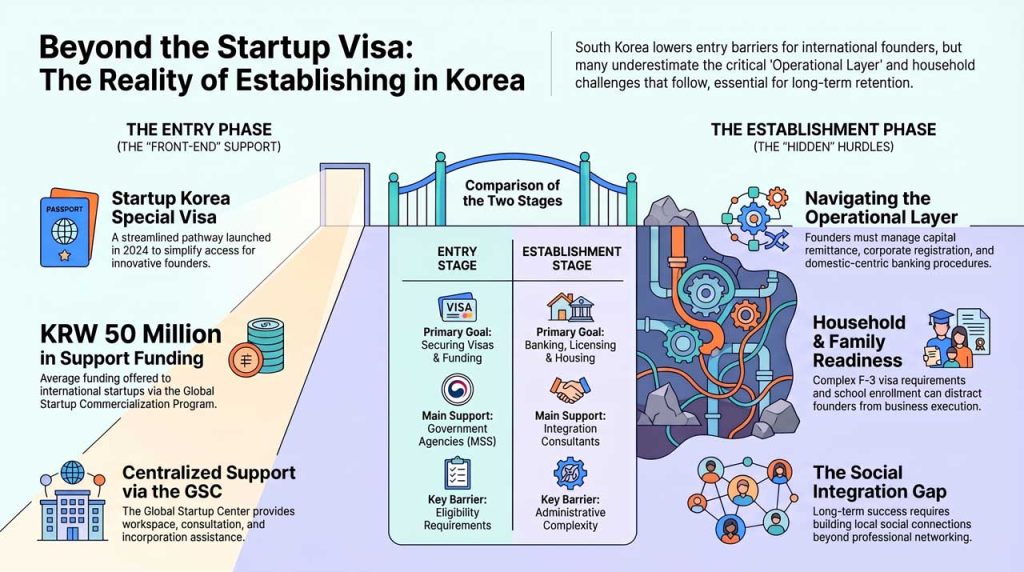
The Ministry of SMEs and Startups (MSS) launched the Startup Korea Special Visa in late 2024 to simplify access for innovative founders. More recently, the government’s Global Startup Commercialization Program also opened applications for international startups seeking to establish businesses in Korea, offering selected participants an average of KRW 50 million in support funding and English-language evaluation procedures.
The government’s broader support infrastructure has also expanded. The Global Startup Center (GSC), operated by the Korea Institute of Startup & Entrepreneurship Development (KISED), was established as a dedicated platform supporting foreign entrepreneurs through consultation, incorporation support, networking, workspace access, and visa-related assistance.
These developments demonstrate a clear policy direction. Korea wants more foreign founders to build companies locally.
However, entry approval and startup readiness are not always the same thing.
The Operational Layer Starts After Arrival
One of the most overlooked realities founders need to face after arrival in South Korea lies more on the operational layer.
According to Invest Korea’s official foreign-invested company establishment procedures, foreign entrepreneurs may need to navigate multiple administrative steps, including foreign investment notification, capital remittance, corporate registration, business registration, banking procedures, and industry-specific approvals depending on the nature of the business.
An integration consultant and Korean translator who has worked extensively with foreign residents and international professionals in Korea told KoreaTechDesk that administrative complexity often appears in unexpected places.
“Foreign residents encounter uncertainty when handling administrative or business-related procedures, particularly in areas such as licensing, opening businesses, or obtaining certain approvals.”
The challenge is not that the procedures are missing. Instead, many founders find themselves navigating systems built mainly for domestic users, where foreign applicants often need extra documentation, additional explanations, or further verification.
In some cases, requirements can vary depending on industry, institution, or local administrative interpretation.

The Hidden Challenges of Founder Relocation
Beyond the visible operational layers, there’s another hidden challenge that founders and operators often overlook, household readiness.
Startup discussions often focus on visas, funding, and company formation. Yet for many international entrepreneurs, relocation also involves moving a household.
Founders arriving with spouses, children, or dependent family members often face an additional layer of execution. Under revised F-3 dependent visa requirements that took effect in 2025, applicants staying in Korea for 12 months or longer may need to provide proof of residence, financial capability documents, legalized family relationship certificates, and supporting translations. Income thresholds also apply based on household size.
But administrative requirements are only one part of the challenge. Housing, school enrollment, healthcare access, and caregiving responsibilities can also affect a founder’s ability to focus on building the business.
“Many foreign entrepreneurs are well prepared financially and professionally, but may underestimate the importance of family-related practical considerations when relocating to Korea,”
the consultant said.
The consultant recalled an entrepreneur who had carefully prepared the business and financial aspects of relocation but later encountered unexpected caregiving needs for a family member with medical conditions. The company was ready to move forward, but the founder’s attention shifted toward immediate family requirements.
Cases like this suggest that founder readiness increasingly extends beyond just mere business preparation alone. Incorporation, immigration compliance, and family settlement often progress simultaneously, creating more operational demands that many international founders do not fully anticipate before arriving in Korea.

Founder Retention Requires More Than Business Momentum
Startup programs and visas can help founders enter Korea and begin building their companies. Retaining entrepreneurs over the long term, however, often depends on factors that extend beyond the business itself.
The consultant observed that founders who successfully establish long-term lives in Korea typically develop broader forms of stability alongside their companies.
“In my experience, the people who build successful long-term lives in Korea are usually those who gradually develop strong social and cultural connections within Korean society.”
Professional progress remains important, but founders also need practical stability. Predictable residency pathways, secure housing, local relationships, and confidence in navigating everyday systems can influence whether entrepreneurs continue investing their time and resources in Korea.
For startup ecosystems, this distinction matters. Attracting international founders is one challenge. Encouraging them to remain, expand their companies, hire locally, and build long-term operations requires an environment where both the business and the founder can become rooted.
As countries compete to attract global entrepreneurs, founder retention increasingly depends not only on entry pathways but also on the broader conditions that allow founders to build sustainable lives alongside sustainable businesses.

Korea’s Next Founder Advantage May Be Transition Support
Korea has already built much of the front-end infrastructure required to attract foreign entrepreneurs. Programs such as the Startup Korea Special Visa, the Global Startup Center, and international startup acceleration initiatives demonstrate a serious commitment to global founder attraction.
The next competitive advantage may depend less on creating additional entry pathways and more on helping founders navigate the transition into everyday operation.
The consultant believes stronger support during the first months after arrival could significantly improve long-term outcomes.
“Strong relocation and integration support during the first several months after arrival could make a very meaningful difference.”
That support can include practical areas such as housing, family settlement, documentation guidance, school placement, local administrative navigation, and access to trusted support networks.
For founders building companies in unfamiliar environments, these systems often influence execution just as much as capital, customers, or product development.
The Difference Between Entry and Establishment
Korea’s startup ecosystem has become increasingly effective at opening the door for international entrepreneurs.
So, the next stage of competition may revolve around what happens after founders walk through it.
Startup visas can help founders enter a market. Startup programs can help them launch. Long-term success, however, often depends on a broader operating environment that supports the founder as a person, a household decision-maker, and a business operator at the same time.
As more countries compete for global entrepreneurial talent, the jurisdictions that simplify that transition may ultimately gain the strongest advantage.
Key Takeaway
- Korea has expanded founder-access programs through initiatives such as the Startup Korea Special Visa, Global Startup Center, and international startup support schemes.
- Administrative execution remains a separate challenge after arrival, particularly in licensing, incorporation, business registration, banking, and approvals.
- Family relocation can become an overlooked founder risk, especially when caregiving needs, dependent documentation, housing, or settlement requirements are involved.
- Many entrepreneurs are professionally prepared but underestimate practical family and relocation considerations.
- Long-term founder retention depends on stability beyond the company itself, including housing, social connections, residency certainty, and personal security.
- Korea’s next competitive advantage may lie in founder transition support, helping international entrepreneurs move more smoothly from visa approval to sustainable operation.
- The global relevance extends beyond Korea, as countries competing for entrepreneurial talent increasingly face the same challenge: attracting founders is easier than helping them build lasting lives after arrival.
– Stay Ahead in Korea’s Startup Scene –
Get real-time insights, funding updates, and policy shifts shaping Korea’s innovation ecosystem.
➡️ Follow KoreaTechDesk on LinkedIn, X (Twitter), Threads, Bluesky, Telegram, Facebook, and WhatsApp Channel.
🤝 Looking to connect with verified Korean companies building globally?
Explore curated company profiles and request direct introductions through beSUCCESS Connect.