
Artificial intelligence has pushed organizations to rethink almost every stage of software development. Infrastructure decisions are changing alongside that shift. Instead of automatically choosing a familiar cloud platform at the beginning of a project, some product teams are asking a different question first: what does this AI workload actually need? A recent discussion with Razer suggests that this subtle change in thinking could become increasingly important as AI products mature.
AI Products Are Challenging the Cloud-First Habit
For years, centralized cloud platforms became the default foundation for many AI applications. They offered mature tooling, global availability, enterprise support, and access to advanced computing resources. As a result, many development teams naturally began infrastructure planning by selecting a cloud provider before evaluating the technical characteristics of individual AI workloads.
Today, that assumption has started to change.
As AI applications become more diverse, product teams are dealing with workloads that vary widely in latency requirements, output quality, scalability, operational guarantees, privacy, and cost sensitivity. A single infrastructure model no longer fits every deployment.
Quyen Quach, Vice President of Software at Razer, believes this shift should begin with the workload rather than the platform.
“Either way, we no longer treat centralized cloud as the default starting point,”
Quach told KoreaTechDesk.
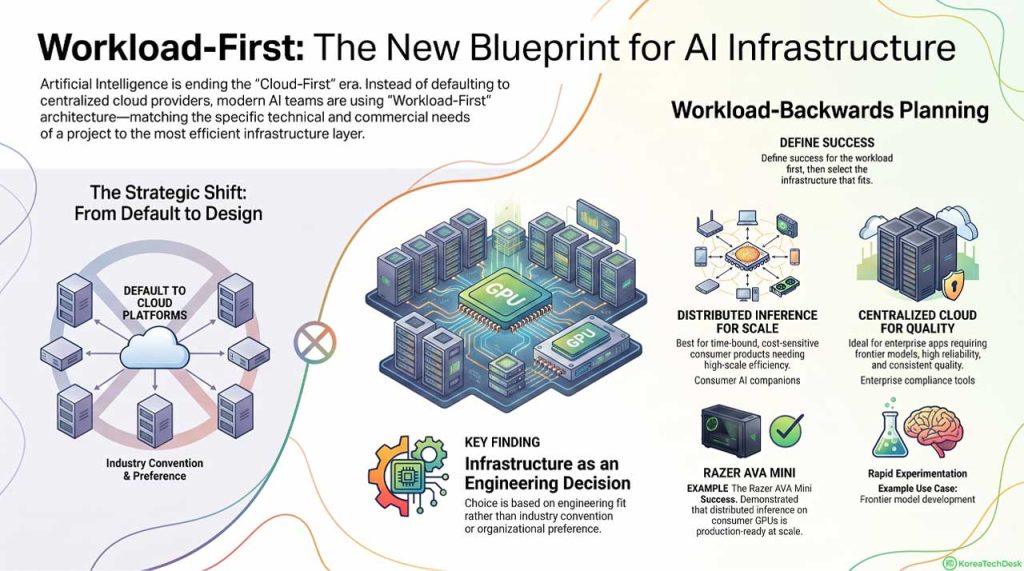
“That decision now begins with the workload… and works backwards to the most efficient infrastructure layer that can deliver that outcome.”
Instead of treating centralized cloud and distributed infrastructure as competing options, Quach positions the choice as a clear engineering decision: teams must select the environment that directly aligns with the technical and commercial demands of each deployment.

Production Experience Changed the Conversation
Razer’s recent AVA Mini deployment provided an opportunity to test that philosophy under real operating conditions.
The campaign used Razer AIKit, the company’s open-source AI development toolkit, to deliver personalized AI-generated pet companions to users during a global promotional event. Although the deployment attracted attention because of its scale, the more interesting lesson emerged after the system entered production.
According to Quach, the project demonstrated that distributed inference had moved beyond experimentation for a specific class of AI workloads.
“This deployment demonstrated that distributed inference on consumer-class GPUs is not just viable, but already production-ready at scale for the class of workloads we’ve described.”
That conclusion points to a broader shift: infrastructure decisions are no longer dictated by convention, but by the specific demands of each AI workload.
Different AI Workloads Need Different Infrastructure Decisions
Artificial intelligence no longer represents a single computing problem.
Some deployments prioritize rapid experimentation. Others demand predictable latency. Enterprise applications often require strict operational guarantees, compliance, and consistently high output quality. Consumer products may place greater emphasis on serving large numbers of users efficiently.
Quach explained that these differences require different infrastructure choices.
“For deployments where cost is the primary constraint and the experience is time-bound, distributed inference makes clear sense.”
At the same time, she emphasized that centralized infrastructure continues to play an essential role.
“For product performance use cases where consistency, reliability, and output quality are held to higher standards, centralized cloud and frontier models remain the right call.”
That distinction adds important nuance to today’s AI infrastructure debate. The discussion is no longer centered on identifying a universal winner. It is increasingly about determining which environment best satisfies the technical objectives of each workload.

Korea’s AI Investments Make Deployment Decisions More Important
The discussion arrives as South Korea continues expanding national AI infrastructure.
The Ministry of Science and ICT has proposed securing an additional 15,000 advanced GPUs through its 2026 budget plan, bringing the country’s cumulative target to 37,000 GPUs across several national initiatives. The government is also advancing the National AI Computing Center while broadening computing access for startups, researchers, and enterprises through public programs.
Separate initiatives have allocated advanced GPU resources to startups and SMEs while expanding high-performance computing support for AI development and inference.
These investments help ease one major barrier to AI development by expanding access to computing resources.
However, they do not eliminate another important challenge.
Startup teams still need to decide where each AI workload should run after those resources become available. Choosing infrastructure simply because it is familiar or widely adopted may not produce the best technical or commercial outcome.
Hence, for Korean founders building AI-powered software, commercialization increasingly depends on making infrastructure decisions that match product requirements rather than industry convention.
AI Strategy Is Becoming an Architecture Discipline
Additionally, industry research indicates that this shift is not limited to a single company.
Technology analysts increasingly expect organizations to modernize cloud environments to accommodate AI-specific computing requirements, while more inference workloads gradually move closer to users through endpoint, edge, or other specialized environments.
These trends do not signal the decline of centralized cloud computing. Instead, they illustrate how AI is creating a broader architectural landscape where multiple deployment options coexist.
Within that environment, infrastructure planning becomes less about organizational preference and more about engineering fit.
Razer’s experience illustrates that the first infrastructure decision may no longer be selecting a cloud provider. It may be understanding the workload well enough to know what kind of infrastructure it actually requires.

Beyond Infrastructure Choices, AI Teams Need Better Questions
The AI industry often celebrates advances in chips, models, and infrastructure capacity. Those developments remain essential, but they can also encourage organizations to focus on technologies before clarifying the problem they are trying to solve.
The more sustainable approach may begin with a different sequence.
Instead of asking where an AI application should run, teams may first need to define what success looks like for that workload. Only then can they determine which infrastructure offers the right balance of quality, latency, scalability, operational reliability, and commercial practicality.
That mindset may become increasingly valuable as South Korea expands its AI infrastructure ambitions. Public investment can widen access to compute, but long-term competitiveness will also depend on how intelligently companies use those resources.
Key Takeaway
- Razer argues that AI infrastructure decisions should begin with workload requirements, not with an automatic preference for centralized cloud services.
- Distributed inference proved production-ready for a specific category of workloads during Razer’s AVA Mini deployment.
- Centralized cloud remains essential for applications requiring stronger consistency, reliability, enterprise guarantees, and frontier-model performance.
- Korea is expanding national AI computing capacity, creating greater opportunities for startups while making infrastructure selection an increasingly important product decision.
- The next competitive advantage for AI startups may come from workload-first architecture, where deployment environments are chosen according to technical and commercial requirements rather than long-standing defaults.
– Stay Ahead in Korea’s Startup Scene –
Get real-time insights, funding updates, and policy shifts shaping Korea’s innovation ecosystem.
➡️ Follow KoreaTechDesk on LinkedIn, X (Twitter), Threads, Bluesky, Telegram, Facebook, and WhatsApp Channel.
🤝 Looking to connect with verified Korean companies building globally?
Explore curated company profiles and request direct introductions through beSUCCESS Connect.