
South Korea has spent years building one of Asia’s most comprehensive startup ecosystems. Funding, accelerators, public programs, and global expansion initiatives have become increasingly accessible. Yet a tougher question continues to surface after demo days end and overseas programs conclude: why do so few startups convert global exposure into sustainable international business?
Korea Has Built One of the World’s Strongest Startup Support Systems
South Korea has steadily built one of the most systematic approaches to startup development in the world.
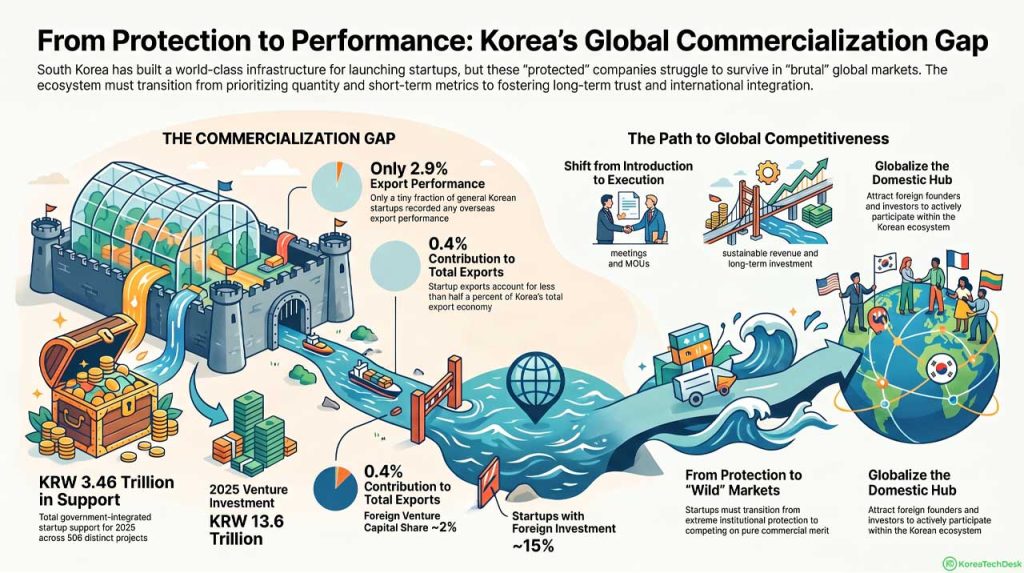
The Ministry of SMEs and Startups (MSS) announced KRW 3.46 trillion in integrated startup support for 2026 across 508 government projects, reflecting another year of expansion in public entrepreneurship support. Venture investment also continued its recovery, reaching KRW 13.6 trillion in 2025 while new venture fund formation climbed to KRW 14.3 trillion, according to MSS.
The numbers reflect an ecosystem that has become increasingly capable of creating startups.
Unfortunately, they do not automatically demonstrate an ecosystem that consistently creates globally commercial businesses.
That distinction sits at the center of an interview with Riso Dongok Ahn, CEO of The Garrison and Co-Director of Startup Grind Seoul.
Over the past decade, he has worked closely with both Korean startups expanding overseas and foreign startups entering Korea, advising founders, facilitating cross-border partnerships, and organizing one of the country’s most active global startup communities through Startup Grind Seoul.
His perspective is shaped by direct exposure to how deals are initiated, negotiated, and sustained across markets, giving him a practical view of where Korean startups succeed and where they struggle once they leave domestic support structures, and leading him to conclude that the ecosystem has not failed but has entered a new stage of development.
And during an exclusive interview, Riso told KoreaTechDesk,
“Government-driven innovation had great impact on building the foundation for Korean entrepreneurship and quantity of startups to grow.”
But then the harder challenge begins after that foundation has already been built.
Commercialization Begins Where Programs End
Korean startups regularly participate in overseas exhibitions, accelerator exchanges, trade missions, and global demo days. Many also return with new contacts, memorandums of understanding, or letters of intent.
Yet those milestones rarely guarantee sustainable commercial growth.
According to the Korea International Trade Association, exports by startups under seven years old have increased dramatically over recent years, reaching USD 2.42 billion in 2023. Even so, startup exports represented only about 0.4% of Korea’s total exports, highlighting how much of the country’s export economy is still driven by larger established companies.
The commercialization challenge also appears in broader ecosystem data. A 2025 report by the Science and Technology Policy Institute (STEPI) found that only 2.9% of general Korean startups recorded overseas export performance as of 2023.
The same report noted that foreign venture capital accounted for only about 2% of domestic startup investment, while only around 15% of Korean startups attracted foreign investment between 2015 and 2024.
Together, these figures suggest that building startups and commercializing them internationally remain two very different challenges.
Riso believes the breakdown usually appears after the initial introduction.
“Korean startups are mostly grown under extreme protection of institutional support,”
he said.
Expecting them to immediately compete inside global markets, where commercial realities are “wild and brutal,” creates unrealistic expectations.
His observation reflects a shift in focus, pointing to the clear limitations in how existing support structures translate into real-world outcomes.
It highlights that the capabilities required to launch a startup are completely different from those needed to compete internationally, build overseas partnerships, and generate sustained revenue in global markets.

Why Global Expansion Cannot Be Measured in Months
One of Riso’s key observations focuses on how globalization success is measured.
He suggests the ecosystem has placed significant emphasis on quantifiable short-term outputs, as publicly funded programs often operate within annual budgets and administrative reporting cycles.
“Korean ecosystem has fallen into a dilemma of quantification of everything.”
Hence, this then often shifts attention toward metrics such as meetings, business matching sessions, partnership announcements, signed NDAs, memorandums of understanding, or letters of intent.
While those indicators can demonstrate activity, they cannot reliably demonstrate commercialization.
According to Riso, investment and revenue remain the outcomes that matter most. And yet, unfortunately, those results often require years rather than months.
He believes globalization metrics should reflect how commercial growth actually unfolds over time, rather than expecting meaningful international traction within just a few months of completing a program.
And this perspective echoes a broader challenge seen across many innovation ecosystems.
Because in reality, building trust, refining products, negotiating partnerships, validating customers, and setting up local operations all take time and rarely move in step with government fiscal timelines.
Global Business Runs on Trust, Not Introductions
International expansion is often framed as a networking exercise, but Riso sees it in a more nuanced way. He believes that while introductions may open doors, it is the relationships that ultimately shape the outcome.
That is because from his experience, founders who succeed in building international partnerships tend to share a few common traits: a long-term mindset, a genuine willingness to create mutual value, andthe ability to communicate in ways that go beyond language alone.
“Do they know how to truly communicate with foreign partners, not only language but by heart.”
He also believes many founders underestimate the importance of giving first, rather than expecting immediate returns.
After years of operating within generous public support systems, it’s easy for expectations to lean toward receiving help instead of building truly reciprocal relationships.
But cross-border partnerships work differently.
Trust isn’t built through introductions alone—it grows over time through consistent execution, reliability, and shared incentives.
The Next Phase Requires Globalizing Korea’s Ecosystem Itself
The discussion around Korea becoming a global startup hub often centers on helping Korean startups expand into overseas markets.
But Riso believes there is another equally important piece of the puzzle.
In his view, Korea also needs to become a more attractive place for international founders, investors, experienced operators, and ecosystem experts to actively participate within the domestic ecosystem itself.
“We need much more foreign entrepreneurs, talents, investors, ecosystem experts to be active in Korea.”
And that goal goes beyond simply hosting international startup events.
It calls for policies, regulations, investment structures, and institutional support that reflect how businesses actually operate, rather than how systems are administratively organized.
Recent government initiatives are already moving in that direction.
In 2026, the Ministry of SMEs and Startups (MSS) expanded its Corporate Partnership for Overseas Expansion Program, allocating KRW 16.9 billion to support around 50 collaborative projects that connect Korean SMEs with the global networks of large corporations. The program also introduced multi-corporate consortium models, increased support for long-term overseas projects, and raised funding for participating SMEs to up to KRW 200 million per company.
Separately, programs such as the Global Startup Commercialization Support Program and the Global Startup Center continue to broaden support for international founders seeking to build businesses in Korea.
From Riso’s perspective, these efforts will have the greatest long-term impact if they also make it easier for domestic and international ecosystem participants to collaborate in more practical, day-to-day ways.

Commercialization Is Becoming Korea’s Next Startup Challenge
South Korea no longer needs to prove that it can build startups. Its startup infrastructure, venture capital market, university ecosystem, and public support mechanisms are already recognized internationally.
The more important question now is what happens after founders leave the accelerator, wrap up an overseas roadshow, or return home from an international demo day.
Because commercialization rarely hinges on a single introduction. Instead, it takes shape over time through patient effort, customer validation, trusted partnerships, and steady execution.
As Korea’s startup ecosystem continues to mature, these capabilities may ultimately define its global competitiveness.
Beyond Building Startups
Every startup ecosystem eventually reaches a point where creating more companies is no longer the primary challenge.
The next chapter becomes helping more of those companies survive without institutional protection and compete on commercial merit across international markets.
And South Korea appears to be approaching that transition.
That is why the country’s next success story may not be measured by the number of startups it creates, but by how many continue growing long after the programs that launched them have ended.
Key Takeaway
- South Korea has built a mature startup creation ecosystem supported by substantial public funding, venture investment, and institutional infrastructure.
- Commercialization remains the next major challenge, as global exposure does not automatically become sustainable international revenue.
- Commercialization depends on long-term execution, reciprocal relationships, and trust rather than business matching alone.
- Short-term program metrics cannot fully capture global expansion success, since meaningful investment and revenue often require years to develop.
- Global competitiveness increasingly depends on globalizing Korea’s domestic ecosystem, attracting more foreign founders, investors, and ecosystem operators alongside continued support for Korean startups.
– Stay Ahead in Korea’s Startup Scene –
Get real-time insights, funding updates, and policy shifts shaping Korea’s innovation ecosystem.
➡️ Follow KoreaTechDesk on LinkedIn, X (Twitter), Threads, Bluesky, Telegram, Facebook, and WhatsApp Channel.
🤝 Looking to connect with verified Korean companies building globally?
Explore curated company profiles and request direct introductions through beSUCCESS Connect.