
Many breakthrough technologies never fail in the laboratory. They fail much earlier, before a startup is formed, before investors get involved, and before customers ever see a product. As governments continue investing heavily in research and innovation, a more difficult question is emerging. Are research systems preparing scientists to create commercial impact, or simply rewarding scientific excellence?
Commercialization Starts Long Before a Product Exists
Research commercialization is often described as the final stage of innovation. The common narrative suggests that scientists complete their research first, then entrepreneurs, investors, or technology transfer offices take over.
According to commercialization practitioners working inside research ecosystems, that assumption is one of the biggest reasons promising technologies never reach the market.
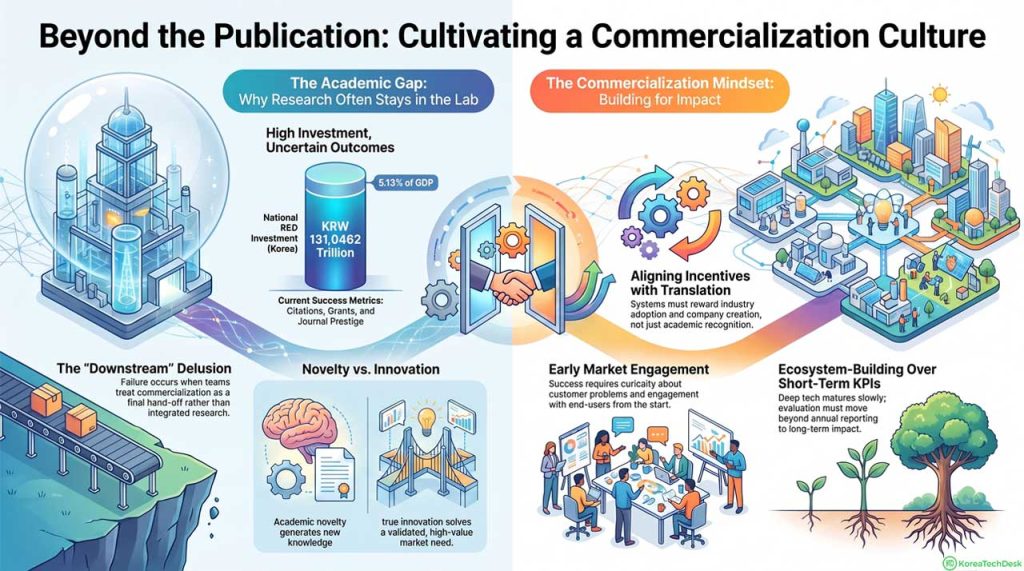
Korea provides an interesting backdrop for this discussion. According to the latest national R&D activity survey, the country invested KRW 131.0462 trillion in research and development during 2024, representing 5.13% of GDP. The figures place Korea among the world’s most research-intensive economies and reflect decades of sustained commitment to scientific advancement.
Strong investment, however, does not automatically determine how discoveries become commercial outcomes.
That distinction sits at the center of KoreaTechDesk’s conversation with Morteza Jeyhani, Manager of Innovation and Commercialization at the Ocean Frontier Institute in Canada and Chief Technology Officer of biotechnology startup SPARKED.
Having worked across academic research, commercialization programs, and venture development, he argues that many commercialization failures begin long before market entry even becomes part of the discussion.
“The most consistent breakdown occurs much earlier than many people expect, at the level of culture, incentives, and understanding of commercialization itself,”
Jeyhani told KoreaTechDesk in an exclusive interview.

Why Scientific Excellence Alone Does Not Create Commercial Impact
Commercialization is frequently treated as something that happens after research has been completed. Researchers publish findings, institutions celebrate scientific achievements, and only then does attention shift toward market applications.
Jeyhani believes this sequence misunderstands how commercialization actually develops.
“In many research environments, commercialization and entrepreneurship are still not fully integrated into how impact is defined or evaluated,”
he said.
“Researchers are often not given the resources, training, or ecosystem support needed to take the first step toward translation.”
His observation reflects a broader challenge facing many innovation ecosystems. Commercialization is not simply another project phase. It influences how research questions are framed, how collaborations develop, and how teams evaluate success throughout the research process.
Without that mindset, commercial translation simply becomes an additional task rather than an integral objective.

When Incentives Reward Publications Instead of Translation
Universities have long been at the heart of scientific discovery, with publications, citations, competitive grants, and journal recognition serving as key markers of academic excellence.
These measures still play an important role in advancing science. The challenge arises, however, when they begin to define the research impact almost entirely on their own.
“In many research institutions, there is still a strong emphasis on publications over translational outcomes,”
Jeyhani explained.
“The system primarily rewards citations, grants, and journal prestige rather than commercialization impact, industry adoption, or company creation.”
He believes that the way current evaluation systems are structured tends to favor more on academic outputs, often making it harder for researchers to think about real-world applications from the outset.
Korea’s research performance framework shows just how closely research outputs are monitored. Each year, the Korea Institute of Science and Technology Evaluation and Planning (KISTEP) publishes detailed analyses of national R&D programs, focusing on measurable results such as scientific publications.
While these evaluations play an important role in ensuring accountability, they tend to capture academic performance more easily than they reflect a team’s readiness for commercialization.
That distinction matters because commercialization requires behaviors that are harder to measure. Curiosity about customer problems, interdisciplinary collaboration, entrepreneurial learning, and continuous adaptation rarely fit neatly into annual reporting cycles.
Novelty Is Different From Innovation
One of Jeyhani’s strongest observations concerns a distinction that is often overlooked in commercialization discussions.
“In addition, academic research environments tend to incentivize novelty more than innovation,”
he said.
“The focus is often on generating new knowledge rather than solving validated market problems. While novelty is critical for scientific advancement, it does not automatically translate into market value.”
The difference may seem subtle, but it carries crucial implications.
Novelty pushes the boundaries of scientific understanding, while innovation turns those insights into real-world value by addressing problems people and organizations actually care about.
Neither is inherently more important than the other. Scientific breakthroughs remain essential, laying the groundwork for future technologies. But then the challenge emerges when research ecosystems assume that new discoveries will naturally evolve into market success, without the cultural, organizational, and entrepreneurial support needed to guide that transition.
As a result, commercialization often becomes much more challenging when researchers encounter these expectations only after spending years focused exclusively on developing the technology.

Culture Shapes Commercialization Earlier Than Most Institutions Realize
Funding often takes center stage in conversations about research commercialization. Around the world, governments are steadily expanding programs aimed at strengthening innovation ecosystems, supporting startups, and fostering closer ties between universities and industry.
Jeyhani acknowledges the importance of these efforts, but he also points out their limits. Financial support, he explains, cannot by itself make up for the absence of a strong commercialization culture.
“Funding alone does not guarantee successful outcomes,”
he said.
“Without a clear understanding of the commercialization pathway, market needs, timelines, and expected outcomes, capital is often deployed without building the surrounding infrastructure required for success.”
His perspective shifts attention away from budgets and toward institutional behavior.
If commercialization remains something researchers expect others to manage later, additional funding may improve research capacity without substantially improving commercialization outcomes.
Early Warning Signs Often Appear Inside Research Teams
Commercialization challenges rarely appear out of nowhere. As Jeyhani explains, research teams often show subtle but telling patterns well before their technologies run into market barriers.
“Some of the clearest early warning signs that a team is unlikely to succeed commercially, even when the underlying science is strong, include a lack of curiosity or willingness to engage with end users and market realities, and a tendency to treat commercialization as a downstream activity that can be ‘handed off’ rather than an integrated part of the research process.”
He also pointed to another recurring pattern that appears long before a technology reaches the market.
“Another common indicator is the absence of a clear problem-solution framing, and the focus remains primarily on publishing novelty rather than solving a validated high-value need.”
These behaviors are often reinforced by institutional incentives rather than individual decisions. Jeyhani noted that success is frequently measured through publications, grants, and technical milestones, while translation efforts receive far less recognition.
Under those conditions, researchers naturally prioritize the outcomes their institutions reward, making commercialization activities easier to postpone until much later in the innovation journey.

Building Ecosystems Instead of Measuring Short-Term Outputs
Deep technology commercialization rarely follows predictable timelines. Scientific discoveries often require years of validation, regulatory preparation, product refinement, and ecosystem development before generating measurable commercial outcomes.
Yet many innovation initiatives continue operating under relatively short evaluation cycles.
“Commercialization in deep tech and research-intensive sectors must be approached as a long-term ecosystem-building effort,”
Jeyhani said.
“One of the biggest challenges today is that these initiatives are still frequently evaluated using short-term KPIs that are fundamentally misaligned with how real innovation matures and reaches market impact.”
This creates a structural tension.
Governments understandably seek accountability for public investment. Research organizations require measurable performance indicators. Commercialization, however, develops through relationships, learning, experimentation, and adaptation that often unfold across much longer horizons.
Balancing those realities remains one of the most difficult challenges facing innovation ecosystems worldwide.
Rethinking What Research Success Means
Much of the conversation around research commercialization still revolves around larger funding programs, more startup support, and stronger technology transfer mechanisms. Those efforts remain important, but Jeyhani believes they address the problem only after the foundations have already been laid.
“Commercialization and entrepreneurship are still not fully integrated into how impact is defined or evaluated,”
he said.
“Researchers are often not given the resources, training, or ecosystem support needed to take the first step toward translation.”
And his observation challenges one of the most common assumptions in innovation policy. Commercialization is often treated as the final destination of successful research. In practice, it is shaped much earlier by what institutions reward, what researchers are encouraged to pursue, and how scientific impact is defined long before a product, startup, or licensing opportunity exists.
That perspective also reframes the question facing research-intensive economies such as Korea. The next breakthrough may not depend solely on producing more discoveries or allocating larger R&D budgets. It may depend on building research environments where commercialization is no longer viewed as work that begins after scientific success, but as part of the journey that gives scientific success broader economic and societal meaning.
And so, perhaps the most important lesson is also the simplest. If commercialization is expected to begin only after the science is finished, then at that point, the opportunity to shape meaningful impact may have already—and unfortunately—been lost.
Key Takeaway
- Research commercialization begins long before market entry, through institutional culture, incentives, and how research impact is defined.
- Scientific novelty and commercial innovation are not the same. New knowledge does not automatically create market value.
- Research evaluation systems strongly influence commercialization behavior. Publications, citations, and grants remain essential, but they may not encourage early commercial thinking.
- Short-term performance metrics can conflict with deep technology commercialization, which often requires long development timelines and ecosystem coordination.
- Integrating commercialization into the research process, rather than treating it as a downstream activity, can strengthen the long-term translation of scientific discoveries into societal and economic impact.
– Stay Ahead in Korea’s Startup Scene –
Get real-time insights, funding updates, and policy shifts shaping Korea’s innovation ecosystem.
➡️ Follow KoreaTechDesk on LinkedIn, X (Twitter), Threads, Bluesky, Telegram, Facebook, and WhatsApp Channel.
🤝 Looking to connect with verified Korean companies building globally?
Explore curated company profiles and request direct introductions through beSUCCESS Connect.