

When companies struggle in China, the explanation often points toward competition, regulation, or changing consumer behavior. Yet many expansion efforts begin to weaken long before they face those external pressures. The problem frequently emerges inside the organization itself, where local teams recognize market shifts early while headquarters continues operating on assumptions that no longer match reality.
Governance Challenge in Korean Startup Global Expansion
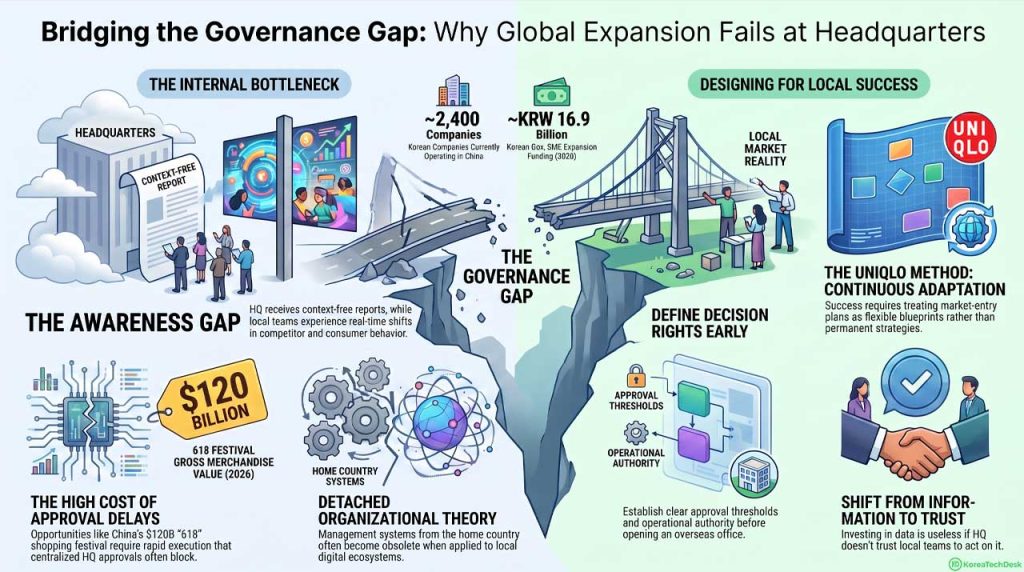
Cross-border expansion continues to be a major priority for Korean companies. According to the Ministry of SMEs and Startups (MSS), the government allocated KRW 16.9 billion in 2026 for overseas expansion partnership programs designed to help Korean SMEs access international markets through local networks, distribution channels, and business infrastructure.
At the same time, Korea’s global business footprint continues to grow. KOTRA’s latest overseas Korean company directory shows that nearly 2,400 Korean companies operate in China, making it one of the largest destinations for Korean businesses abroad.
Despite this growing presence, market entry itself is no longer the primary challenge. The larger question is how organizations make decisions after entering a foreign market.

The Local Team Often Sees Change Before Headquarters Does
Tatsuo Yamamoto, CEO of KENTOSHI and a veteran operator with over a decade of hands-on experience in China’s digital commerce and platform ecosystem, believes one of the most common problems is a growing disconnect between headquarters and local subsidiaries.
“A common pattern is a gap in awareness between the local subsidiary and the parent company,”
Yamamoto told KoreaTechDesk during an exclusive interview on China market entry challenges, drawing on his experience advising and working with foreign companies navigating China’s fast-evolving market.
According to Yamamoto, local teams experience market changes directly through customer interactions, platform developments, competitor activity, and business partners. Headquarters, meanwhile, often receives summarized reports that remove much of the context behind those developments.
As a result, both sides may believe they are looking at the same market while reaching very different conclusions.
This challenge is not just unique to China. Because most of the time, it comes up when startups and growing companies expand overseas but continue to keep strategic decision-making centralized at headquarters.

When Market Opportunities Become Approval Problems
China’s digital economy increasingly operates through platform ecosystems that reward rapid execution.
Major shopping events, platform campaigns, influencer collaborations, and promotional partnerships often emerge within relatively short decision windows. For example, according to Reuters, China’s 2026 “618” shopping festival generated RMB 863.6 billion (approximately USD 120 billion) in gross merchandise value across major e-commerce platforms, illustrating the scale of opportunity attached to platform-driven commerce.
Yet Yamamoto argues that many foreign companies struggle to respond because local teams cannot move independently.
He recalled situations where local teams were eager to participate in platform campaigns that aligned with emerging consumer trends. It was clear there was an opportunity, but internal approval processes often got in the way.
“Explaining it to headquarters and getting approval is often too late, and approval is frequently not granted.”
In these situations, companies are not necessarily making the wrong call. They are just making it too late, because the opportunity has long passed.

Why Reports Cannot Fully Capture Local Market Reality
Many organizations rely on reporting systems to maintain oversight of overseas operations. Those systems are important, but Yamamoto believes they can create a false sense of understanding when decision-makers become too dependent on them.
According to him, organizational theories and management systems developed in the home country gradually become detached from local conditions if they are not continuously updated.
“Organizational theories and systems brought from the home country tend to become detached from reality over time,”
Yamamoto said.
This becomes particularly problematic in markets where customer behavior, platform dynamics, and competitive conditions evolve differently than headquarters expects.
When local teams repeatedly encounter situations that do not fit headquarters assumptions, execution quality begins to deteriorate. Decisions take longer, opportunities are missed, and local operators become increasingly constrained.
What Uniqlo’s China Journey Reveals About Adaptation
Yamamoto then pointed to Uniqlo as an example of how adaptation can become necessary after market entry.
According to his observations, Uniqlo’s early positioning in China relied heavily on affordable apparel. Over time, however, the company strengthened its focus on LifeWear, expanded digital engagement, invested in flagship locations, and developed strategies better aligned with Chinese consumer expectations.
The lesson is not that the original strategy failed entirely. Rather, it demonstrates that successful companies rarely treat their market-entry plan as permanent.
After all, China’s consumer market continues evolving alongside stronger domestic competitors and changing customer expectations. So, companies that remain competitive are often those willing to reassess assumptions and adjust accordingly.
What Korean Startups Should Fix Before Opening a China Office
Building on these challenges, Korean startups expanding overseas often run into similar issues.
Many founders focus heavily on product-market fit, customer acquisition, and localization. These elements remain important, but governance design often receives far less attention during expansion planning.
Before opening an overseas office, companies should establish clear decision rights, approval thresholds, and operational authority for local teams.
Questions such as who can approve marketing partnerships, who controls local budgets, and how quickly market opportunities can be evaluated may ultimately influence outcomes more than the expansion announcement itself.
Because when it comes from global market expansion, the challenge is not only choosing between headquarters control and local autonomy, but also ensuring that local knowledge can actually influence organizational action.
The Hidden Cost of Approval Distance
As Korean startups continue expanding into international markets, many discussions still focus on access, partnerships, and market potential.
Those factors remain important, but Yamamoto’s experience suggests another issue deserves equal attention.
A local office can identify customer needs, platform opportunities, and competitive threats. Yet if every decision must travel through layers of review before action is possible, valuable market intelligence loses much of its value.
In fast-moving markets, the distance between observation and decision can become a competitive disadvantage in itself.
Beyond Information, Toward Trust
Companies often invest significant resources collecting information about overseas markets. Reports become more detailed, dashboards become more sophisticated, and communication channels become more frequent.
Yet information alone does not solve the underlying problem.
The companies that navigate international expansion successfully are often those that build enough trust in local teams to let knowledge become action. In that sense, the challenge is not simply understanding a foreign market. It is creating an organization capable of responding when that understanding arrives.
Key Takeaway
- Many overseas expansion failures begin with governance issues rather than market access problems.
- Awareness gaps between headquarters and local subsidiaries remain a recurring challenge in China.
- Approval delays can cause companies to miss platform partnerships, promotional campaigns, and emerging market opportunities.
- Organizational systems developed in the home market can gradually become disconnected from local realities abroad.
- Uniqlo’s evolution in China illustrates the importance of continuously adapting strategy after market entry.
- For Korean startups, decision rights and local operational authority should be planned before overseas expansion begins.
- The most valuable local market insight becomes ineffective if organizations cannot act on it in time.
– Stay Ahead in Korea’s Startup Scene –
Get real-time insights, funding updates, and policy shifts shaping Korea’s innovation ecosystem.
➡️ Follow KoreaTechDesk on LinkedIn, X (Twitter), Threads, Bluesky, Telegram, Facebook, and WhatsApp Channel.
🤝 Looking to connect with verified Korean companies building globally?
Explore curated company profiles and request direct introductions through beSUCCESS Connect.