

For many foreign companies, entering China is often treated as the primary challenge. Yet some of the biggest setbacks emerge after the launch event, partnership signing, or first wave of customer acquisition. China remains one of the world’s largest consumer markets, but maintaining competitiveness inside it requires a different set of capabilities. In many cases, the problem is not market access. It is the ability to keep up once the market starts moving.
China Still Offers Scale, But Scale No Longer Guarantees Success
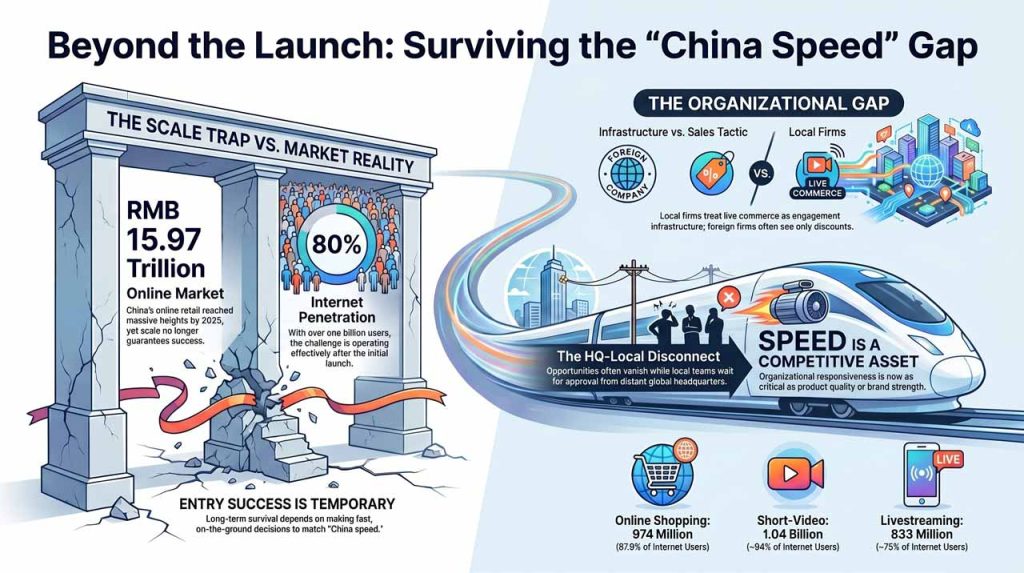
China remains a market that few global companies can ignore. According to China’s National Bureau of Statistics, the country’s online retail sales reached RMB 15.97 trillion (approx. USD 2.36 trillion) in 2025, while online retail sales of physical goods accounted for more than a quarter of total retail sales. Internet penetration surpassed 80%, supported by more than one billion internet users.
These figures continue to attract foreign brands, technology companies, and consumer businesses seeking growth opportunities. Yet scale alone no longer provides a competitive advantage. The challenge increasingly lies in how companies operate after entering the market.
That distinction has become increasingly important as China’s digital economy continues evolving through new platforms, changing consumer behavior, and intensifying local competition.

The Real Challenge Begins After Market Entry
According to Tatsuo Yamamoto, CEO of KENTOSHI and a long-time operator in China’s digital economy, many foreign companies underestimate the difference between entering the market and remaining competitive inside it.
Drawing on nearly two decades of experience working across China’s internet and marketing sectors, Yamamoto told KoreaTechDesk that successful market entry often creates a false sense of achievement.
“When entering the Chinese market, it is crucial to first conduct thorough market research and consider how to leverage a company’s strengths,”
he said.
“However, even if you succeed in entering the market, that success is only temporary.”

He explained that maintaining competitiveness requires companies to adapt to what many operators describe as “China speed,” a market environment where consumer trends, digital channels, and competitive conditions can change rapidly.
In his view, long-term success depends on an organization’s ability to make fast decisions on the ground while continuously adjusting to local realities.
When Headquarters and Local Teams Stop Seeing the Same Market
One of the recurring problems Yamamoto has observed is the growing disconnect between headquarters and local subsidiaries.
China’s market dynamics are often difficult to understand through reports and performance dashboards alone. As a result, local teams may recognize emerging shifts much earlier than executives outside the country.
“The market environment and speed of change in China are difficult to understand by looking at data alone,”
Yamamoto said.
“It’s hard to grasp without being on the ground.”
That gap can create delays in decision-making at exactly the moment when speed matters most.
Yamamoto then recalled situations where local teams identified opportunities to participate in platform-led campaigns and trend-driven promotions. While local operators wanted to move quickly, obtaining approval from headquarters often took too long.
And in some cases, by the time discussions were completed and approvals were reviewed, the opportunity had already passed.
The result is not necessarily a single catastrophic mistake. Instead, competitiveness gradually erodes through a series of missed opportunities.

China’s Digital Economy Rewards Adaptation
Furthermore, China’s digital ecosystem has become increasingly complex and platform-driven.
According to the China Internet Network Information Center (CNNIC), China had approximately 974 million online shopping users by the end of 2024, representing 87.9% of internet users. The country also had around 1.04 billion short-video users and 833 million livestreaming users. As these digital channels continue evolving, new forms of consumer engagement can scale across the market at remarkable speed.
In that environment, companies are often required to make operational decisions much faster than traditional international expansion models were designed to support.
Yamamoto believes one of the clearest examples is live commerce.
When livestream shopping first gained popularity, many overseas companies viewed it primarily as a discount channel. Some worried about price erosion, brand dilution, or the possibility that the trend would fade.
But Chinese companies often approached it differently.
According to Yamamoto, local firms increasingly treated live commerce as a customer engagement infrastructure that combined product education, customer service, fan building, entertainment, and sales within a single channel.
“In China, live commerce was seen as infrastructure that played a role in customer contact, fan building, customer service, educational activities, entertainment, and product sales.”
As a result, many Chinese companies invested heavily in dedicated teams, daily broadcasting, influencer partnerships, and performance analysis. Meanwhile, foreign companies that delayed adoption often found themselves reacting to a market that had already moved ahead.

Why Organizational Lag Has Become a Competitive Risk
The common assumption is that foreign companies struggle in China because of regulations, competition, or cultural differences. Yet Yamamoto argues that organizational adaptation deserves equal attention.
“There is insufficient understanding of the market culture and its changes.
The pace of corporate growth does not keep pace with market changes.”
He also pointed to management practices that are often transferred directly from headquarters without sufficient adjustment for local conditions. According to Yamamoto, evaluation systems, training methods, and operational structures that work in a company’s home market may become less effective inside China’s rapidly evolving business environment.
As local competitors strengthen and market conditions shift, these organizational limitations can quietly erode competitiveness long before financial results reveal the problem.
This challenge is visible even among large global companies. Recent developments involving major international brands operating in China illustrate how difficult it has become to maintain momentum in markets where consumer expectations, distribution channels, and competitive pressures continue to evolve.
So for startups and growth-stage companies, the implications may be even greater because resources are more limited, and mistakes are even harder to absorb.
What Cross-Border Companies Should Learn Before Expanding Into China
The lesson emerging from China’s digital economy is not that foreign companies should avoid the market. After all, China remains one of the world’s most important consumer and technology ecosystems. So, the opportunity there remains highly substantial.
The more important lesson is that market entry should not be mistaken for market readiness.
Companies that treat China as a long-term operating environment rather than a one-time expansion project are often better positioned to respond when conditions change. They invest in local intelligence, empower teams closer to customers, and build systems that can adapt quickly.
It is highly crucial to understand that in a market where new platforms, new behaviors, and new competitors can emerge rapidly, organizational speed will become as important as product quality or brand strength.
Beyond Market Access: The Cost of Standing Still
For years, discussions about China expansion focused on gaining access to the market. Today, access is often only the first step because the larger challenge is more on maintaining alignment between headquarters, local teams, and the pace of the market itself.
In the end, as China’s digital economy continues to create opportunities for companies willing to invest, adapt, and learn, it also exposes organizations that struggle to translate local signals into timely action.
And the companies that remain competitive are not always the ones that entered first. They are often the ones that continue adjusting after entry.
Key Takeaway
- China market entry and long-term competitiveness are two different challenges.
- Tatsuo Yamamoto of KENTOSHI argues that initial market success is often temporary without continuous adaptation.
- A growing awareness gap between headquarters and local subsidiaries can delay decisions and reduce competitiveness.
- China’s digital economy rewards fast execution, particularly in areas such as platform campaigns and live commerce.
- Companies that viewed live commerce as customer engagement infrastructure moved faster than those that treated it as a temporary sales tactic.
- The biggest risk for many foreign companies is not market access but organizational lag.
- For Korean startups, brands, and technology companies pursuing cross-border expansion, decision-making speed and local responsiveness are becoming critical competitive advantages in China.
– Stay Ahead in Korea’s Startup Scene –
Get real-time insights, funding updates, and policy shifts shaping Korea’s innovation ecosystem.
➡️ Follow KoreaTechDesk on LinkedIn, X (Twitter), Threads, Bluesky, Telegram, Facebook, and WhatsApp Channel.
🤝 Looking to connect with verified Korean companies building globally?
Explore curated company profiles and request direct introductions through beSUCCESS Connect.