
KoreaTechDesk | Korean Startup and Technology News

Sat, June 06, 2026

Sign in

Virtual Demo Day
Menu
  • Home
  • Startup News
    • AI & Big Data
    • AR & VR
    • Blockchain
    • Clean Technology
    • Content & Games
    • Cybersecurity
    • Enterprise & SaaS
    • FinTech
    • Gadgets & Electronics
    • Health & Bio
    • Manufacturing
    • Press Release
    • IoT
    • Marketplaces & E-commerce
    • Robotics
    • Transportation
    • Investments
    • Ecosystem & Lists
  • Governments
    • Artificial Intelligence Industry Cluster Agency
    • Daegu Technopark
    • GANGNAM-GU
    • Gyeonggido Business & Science Accelerator
    • Hwaseong Industry Promotion Agency
    • Invest Seoul
    • Korea Creative Content Agency
    • Korea Internet & Security Agency
    • Korea Information Security Industry Association
    • Korea Institute of Startup & Entrepreneurship Development
    • Korea Tourism Organization
    • Korea Trade-Investment Promotion Agency
    • Ministry of Culture, Sports and Tourism
    • Ministry of SMEs & Startups
    • National IT Industry Promotion Agency
    • Pangyo Techno Valley
    • Seoul Business Agency
    • Seoul FinTech Lab
    • South Gyeongsang Province
    • Seoul Metropolitan Government
  • Events
    • COMEUP
    • Korea Fintech Week
    • K-Content Expo
    • NextRise
    • Try Everything
  • Interviews
    • Investors’ interviews
    • Founders’ interviews
  • Programs
    • Asan Voyager
    • CAPA Global Program
    • Campus Town Program
    • SGSC Global Bootcamp
    • Gangnam-gu Global Roadshow
    • Global SaaS Marketplace Support Project
    • LAUNCHPAD
    • COMEUP STARS 120
    • K-Startup Grand Challenge
    • TIPS X beSUCCESS Global Project
    • SFL Global Program
    • KTO Global Showcase
    • Yonsei Univ Global Class
    • KOSME Global Program
  • Partner With Us
    • Press Release
    • Startup Scouting
    • Business Agencies
    • Global Mentorship Program
    • Investment Opportunities
    • K-Scouter Program
  • Lists
  • Home
  • Startup News
    • AI & Big Data
    • AR & VR
    • Blockchain
    • Clean Technology
    • Content & Games
    • Cybersecurity
    • Enterprise & SaaS
    • FinTech
    • Gadgets & Electronics
    • Health & Bio
    • Manufacturing
    • Press Release
    • IoT
    • Marketplaces & E-commerce
    • Robotics
    • Transportation
    • Investments
    • Ecosystem & Lists
  • Governments
    • Artificial Intelligence Industry Cluster Agency
    • Daegu Technopark
    • GANGNAM-GU
    • Gyeonggido Business & Science Accelerator
    • Hwaseong Industry Promotion Agency
    • Invest Seoul
    • Korea Creative Content Agency
    • Korea Internet & Security Agency
    • Korea Information Security Industry Association
    • Korea Institute of Startup & Entrepreneurship Development
    • Korea Tourism Organization
    • Korea Trade-Investment Promotion Agency
    • Ministry of Culture, Sports and Tourism
    • Ministry of SMEs & Startups
    • National IT Industry Promotion Agency
    • Pangyo Techno Valley
    • Seoul Business Agency
    • Seoul FinTech Lab
    • South Gyeongsang Province
    • Seoul Metropolitan Government
  • Events
    • COMEUP
    • Korea Fintech Week
    • K-Content Expo
    • NextRise
    • Try Everything
  • Interviews
    • Investors’ interviews
    • Founders’ interviews
  • Programs
    • Asan Voyager
    • CAPA Global Program
    • Campus Town Program
    • SGSC Global Bootcamp
    • Gangnam-gu Global Roadshow
    • Global SaaS Marketplace Support Project
    • LAUNCHPAD
    • COMEUP STARS 120
    • K-Startup Grand Challenge
    • TIPS X beSUCCESS Global Project
    • SFL Global Program
    • KTO Global Showcase
    • Yonsei Univ Global Class
    • KOSME Global Program
  • Partner With Us
    • Press Release
    • Startup Scouting
    • Business Agencies
    • Global Mentorship Program
    • Investment Opportunities
    • K-Scouter Program
  • Lists
2026-02-25_AIS 2026_Conference Banners_1920x480
Home Communications

Another Missing Layer in Korea’s Global Talent Strategy: The Daily Life Support

by KoreaTechDesk Writer
June 4, 2026
in Communications
0

South Korea has spent years building pathways to attract international talent. Startup visas, global recruitment programs, international universities, and immigration reforms all reflect that effort. Yet as the foreign resident population continues to grow, a different question is emerging. Now, getting people to Korea is one challenge. Helping them build long-term lives after arrival may become another more important test.

Korea’s Global Talent Ambition Is Reaching a New Stage

South Korea’s internationalization efforts are becoming increasingly visible across its economy, education system, and startup ecosystem. According to government data, the country’s foreign resident population reached approximately 2.73 million in 2025, representing about 5.3% of the total population.

At the same time, official surveys suggest many foreign residents are not simply passing through. Statistics Korea data shows that nearly 90% of surveyed foreign residents expressed interest in continuing to stay in Korea after their current period of residence.

The conversation is gradually shifting beyond just mere attraction. As more foreign residents choose to remain in Korea, the question is no longer how to bring talent into the country. The more difficult challenge is how to encourage them to stay.

Startups, universities, employers, and government agencies all have a stake in that outcome. Long-term talent retention increasingly depends on the experience people have after arrival, not simply the pathway that brought them to Korea.

Illustration of foreign talent in Korea. | Source: Canva Photos

Integration Infrastructure Already Exists

Korea has not ignored this issue.

The government operates the Korea Immigration and Integration Program (KIIP), which provides education on Korean language, culture, and society. The Ministry of Justice has also expanded newcomer support programs designed to help foreign residents understand daily life, administrative systems, and legal requirements.

Demand for these programs continues to rise. Ministry of Justice data shows KIIP participation exceeded 90,000 people in 2025, reflecting growing interest among foreign residents seeking deeper integration into Korean society.

Seoul has also developed a broad support ecosystem. Organizations such as the Seoul Global Center provide consultation services covering immigration, taxation, labor issues, business support, and legal matters for international residents.

These developments indicate that Korea has already moved beyond a purely immigration-focused approach. Integration support is increasingly being treated as part of broader talent policy.

The Gap Is Often Practical, Not Legal

Despite these advances, daily life remains one of the least discussed aspects of talent retention.

An integration consultant and Korean translator with extensive experience supporting foreign residents through residency, settlement, and integration processes in South Korea told KoreaTechDesk that Korea has already made meaningful progress in becoming more welcoming and internationally accessible.

“Korea has already made very meaningful progress in becoming more international and welcoming to foreign residents.”

However, the consultant believes the next opportunity lies in making everyday adaptation easier.

“One area that could perhaps be further strengthened is practical day-to-day integration support for newcomers.”

The challenge is not necessarily a lack of systems. Instead, it is helping people understand how to navigate them.

Many foreign residents arrive with little familiarity with Korean administrative procedures, cultural expectations, healthcare systems, housing processes, banking requirements, or workplace norms. While information often exists, finding and understanding it can still be difficult, particularly during the first months after arrival.

The consultant suggested that more centralized guidance services could help simplify the transition.

“It could be very beneficial to have more centralized guidance services or support organizations where newly arrived foreigners could receive simple, step-by-step explanations about life in Korea, administrative systems, and cultural expectations in an accessible way.”

Why This Matters for Talent Retention

This issue extends beyond individual convenience.

As countries compete for skilled professionals, entrepreneurs, researchers, and students, quality of life increasingly influences talent decisions. A strong visa framework may open the door, but long-term retention often depends on how easily people can establish stability after arrival.

The consultant noted that integration programs already play an important role in helping foreign residents develop a deeper understanding of Korean society.

But at the same time, rising participation levels suggest demand may be outpacing current capacity.

“Demand for these programs has become very high, which demonstrates how many foreign residents are genuinely interested in integrating more deeply into Korean society.”

For ecosystem stakeholders, this shows that many international professionals are not looking only for mere employment opportunities. They are looking for belonging, predictability, and confidence that they can build a future in the country.

Illustration of global talents in workplace environment. | Source: Canva Photos

Integration Is Not a One-Sided Process

Beyond formal programs and administrative support, the discussion pointed to another factor that is harder to measure: the quality of everyday interactions between Korean citizens and international residents.

Korea’s integration debate is often framed around language acquisition, cultural adaptation, or compliance with administrative requirements. Those remain important. Yet long-term inclusion also depends on opportunities for mutual understanding.

According to the consultant, stronger intercultural engagement could help both Korean citizens and international residents navigate differences more comfortably.

“One important aspect is encouraging not only foreigners to adapt to Korean society, but also creating more opportunities for mutual cultural understanding between Koreans and international residents.”

This perspective aligns with a broader trend visible in many countries competing for global talent. Successful retention often depends not only on policy design, but also on the strength of social connections that people build after arrival.

The Next Competitive Advantage May Be Everyday Livability

South Korea already possesses many advantages that attract international talent. Safety, advanced infrastructure, healthcare, education, and technology continue to strengthen the country’s global appeal.

The next phase may be less about creating new visa categories and more about improving the experience that follows arrival.

As Korea’s foreign resident population grows, practical guidance, accessible integration programs, community connections, and intercultural confidence may become increasingly important components of talent strategy.

For global professionals deciding where to build careers, and for startups seeking international talent, those everyday factors can influence long-term decisions just as much as policy incentives.
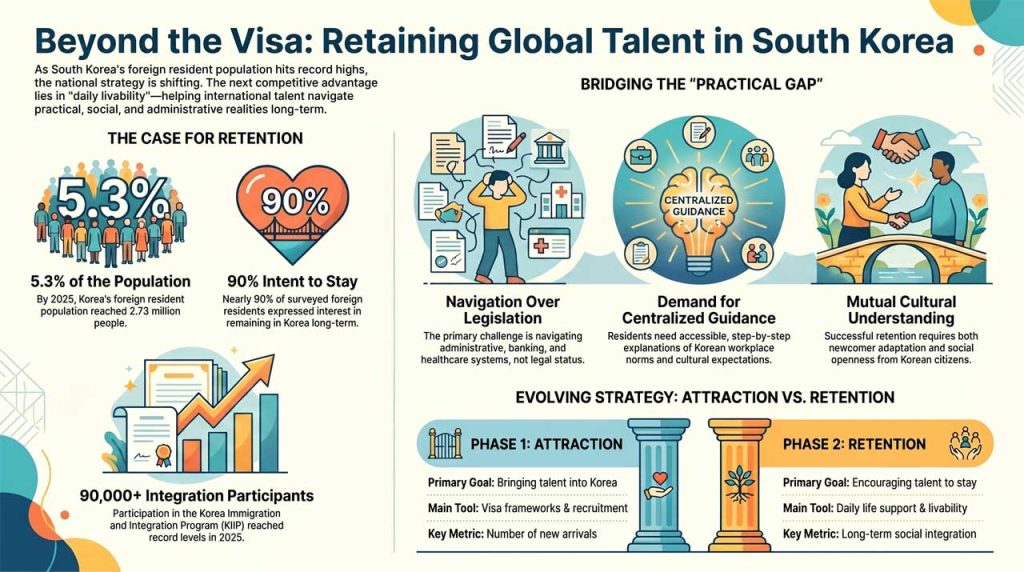
Insights on retaining global talents in Korea. | AI infographic

Key Takeaway

  • South Korea’s foreign resident population has reached record levels, making talent retention an increasingly important policy and ecosystem challenge.
  • Official data indicates that many foreign residents want to remain in Korea long term, creating demand for stronger integration support.
  • Programs such as KIIP and newcomer support initiatives are expanding, demonstrating Korea’s commitment to integration infrastructure.
  • According to an integration consultant and Korean translator who works with foreign residents, the next opportunity lies in improving practical day-to-day guidance for newcomers.
  • Mutual cultural understanding, not only foreign resident adaptation, emerged as a key theme in long-term integration.
  • For founders, employers, universities, and policymakers, everyday livability may become an important competitive advantage in retaining international talent in Korea.

🤝 Looking to connect with verified Korean companies building globally?
Explore curated company profiles and request direct introductions through beSUCCESS Connect.


– Stay Ahead in Korea’s Startup Scene –
Get real-time insights, funding updates, and policy shifts shaping Korea’s innovation ecosystem.
➡️ Follow KoreaTechDesk on LinkedIn, X (Twitter), Threads, Bluesky, Telegram, Facebook, and WhatsApp Channel.

Tags: expat life in South Koreaforeign professionals in Koreaforeign resident integrationforeign residents in Koreaglobal talentglobal talent in Koreaglobal talent strategyinternational talent retentionKIIPKorea global talent strategyKorea Immigration and Integration Programliving and working in South Koreamulticultural integration in KoreaSouth Korea immigration policy
Previous Post

Why Korean Drama Production Is Becoming an IP-Led Global Business

Next Post

Why Foreign Companies Lose Momentum in China After Market Entry

Next Post

Why Foreign Companies Lose Momentum in China After Market Entry

MOST READ ARTICLE OF THE WEEK

1.
Korean Brands Are Overlooking a Global Test Market Inside Korea
30 May 2026
2.
Why Diagnostic Startups Break Down Between Prototype and Production
31 May 2026
3.
Why Korean Startups Lose Talent in the First 90 Days After Hiring
31 May 2026
4.
Korean Communication Is Becoming a Harder Problem for AI — Why?
1 Jun 2026
5.
Why Cybersecurity Is Becoming the Real Barrier to FinTech Expansion in MENA
1 Jun 2026
Register for Event

AIS-2026 Conference

AIS 2026 Conference

List Article

1.
The Hardest Part of Korea Market Entry: Staying in The Game
3 Jun 2026
2.
Why M&A Value Is Lost After the Deal Closes
30 May 2026
3.
Foreign Companies Budget for Korea Entry, but the Real Costs Start After Hiring
23 May 2026
4.
Why Fast Korea Entry Structures Can Become Expansion Traps
16 May 2026
5.
The Real Crisis in Startup Scaling: When the Founder Becomes the System
15 May 2026

Similar Articles

Communications

Korean Startup Teams Can Look Aligned While Quietly Falling Apart

More
Communications

Korean Communication Is Becoming a Harder Problem for AI — Why?

More
Communications

Why Korean Startups Lose Talent in the First 90 Days After Hiring

More

Topics

Menu
  • AI & Big Data
  • AR & VR
  • Blockchain
  • Clean Technology
  • Content & Games
  • Cybersecurity
  • Enterprise & SaaS
  • FinTech
  • Gadgets & Electronics
  • Health & Bio
  • IoT

Program

Menu
  • Asan Voyager
  • CAPA Global Program
  • SGSC Global Bootcamp
  • LAUNCHPAD
  • COMEUP STARS 120
  • K-Startup Grand Challenge
  • TIPS X beSUCCESS Global Project
  • SFL Global Program
  • KTO Global Showcase
  • Yonsei Univ Global Class
  • KOSME Global Program

About

Menu
  • About Us
  • all articles
  • Terms of Use
  • Privacy
  • Cookie-policy
  • twitter

Subscribe and be informed first hand about actual Korean startup news.

All the day’s headlines and highlights, direct to you every morning.

[mc4wp_form id="3766"]

Contact us : [email protected]

Topics

Menu
  • AI & Big Data
  • AR & VR
  • Blockchain
  • Clean Technology
  • Content & Games
  • Cybersecurity
  • Enterprise & SaaS
  • FinTech
  • Gadgets & Electronics
  • Health & Bio
  • IoT

Program

Menu
  • Asan Voyager
  • CAPA Global Program
  • SGSC Global Bootcamp
  • LAUNCHPAD
  • COMEUP STARS 120
  • K-Startup Grand Challenge
  • TIPS X beSUCCESS Global Project
  • SFL Global Program
  • KTO Global Showcase
  • Yonsei Univ Global Class
  • KOSME Global Program

About

Menu
  • About Us
  • all articles
  • Terms of Use
  • Privacy
  • Cookie-policy
  • twitter

Subscribe and be informed first hand about actual Korean startup news.

All the day’s headlines and highlights, direct to you every morning.

[mc4wp_form id="3766"]

© 2023 Koreantech News & Media Korea Zrt. All rights reserved.

Our Spring Sale Has Started

You can see how this popup was set up in our step-by-step guide: https://wppopupmaker.com/guides/auto-opening-announcement-popups/

Our Spring Sale Has Started

You can see how this popup was set up in our step-by-step guide: https://wppopupmaker.com/guides/auto-opening-announcement-popups/

We hope you enjoy our content, May you please give us Feedback regarding our website!

[gravityform id=”17″]

dgdfgfdgdf

What you think about Koreatechdesk, Share your idea with us!

[gravityform id=”16″]

Invitation submission has been closed