
Talent hiring outcomes in South Korea often hinge on factors that are rarely visible to candidates. Beyond qualifications, companies assess how a hire will function inside existing teams, communicate in daily workflows, and sustain long-term stability. These internal considerations are shaping hiring decisions in practice, offering a clearer view of why even highly capable international professionals do not always move forward.
The Decision Layer Most Candidates Never See in Korea’s Hiring Filter
For many international professionals, reaching the final stages of hiring in South Korea often feels like a strong signal of success. The qualifications are there. The experience aligns. The role appears within reach.
Yet, the final decision frequently moves in another direction.
The gap may not always be visible from the outside. After all, it does not sit in resumes or interviews alone but how companies evaluate risk inside their own operations.
As discussions on Korea’s talent hiring gap continues, Monica Jung, founder and CEO of MH CAREER and a professional career strategist explains through her work with international candidates and employers, hiring decisions often come down to a practical question: can this person operate smoothly within the team without creating additional complexity?
And that question immediately reshapes how capability is judged in practice.
Internal Communication Sets the First Barrier
Across many hiring decisions, internal communication often carries more weight than technical skill alone.
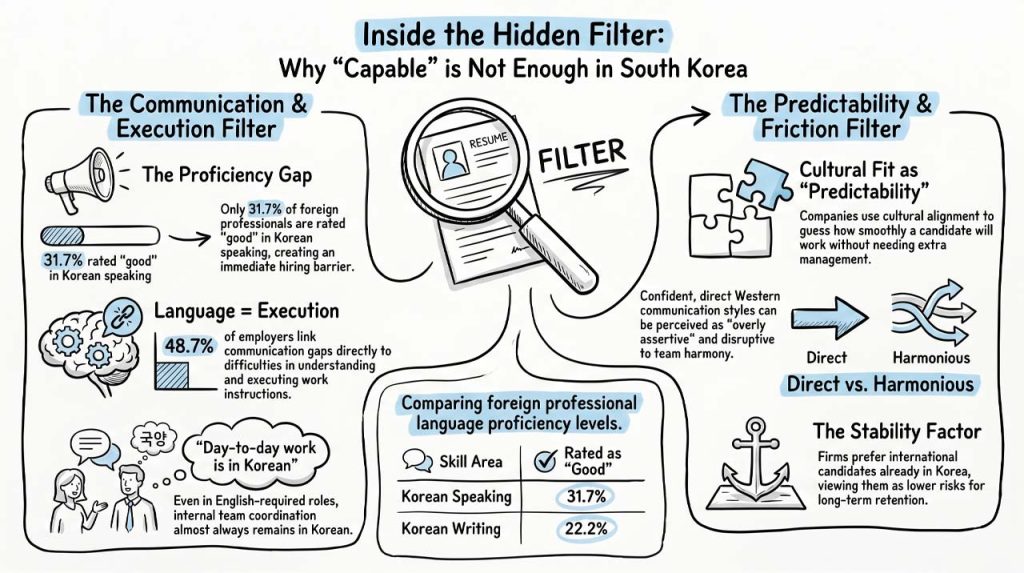
According to the 2025 Survey on Immigrants’ Living Conditions and Labor Force by Statistics Korea and the Ministry of Justice, only 31.7% of foreign professionals were rated “good” in Korean speaking ability. Meanwhile, writing proficiency was even lower at 22.2%.
These figures matter because internal communication in many Korean companies still operates primarily in Korean. As Jung noted,
“Even in roles where English is required externally, day-to-day communication inside the team is often still in Korean, especially in larger or more traditional organizations.”
The implication is straightforward. Korean language is not simply an added advantage. It is closely tied to how work gets done. Without that, even highly qualified candidates may struggle to function effectively within teams.

Hiring Decisions Are Structured Around Friction
Once communication risk is introduced, hiring decisions shift quickly.
Employers are not only evaluating what a candidate can do. They are assessing how much additional coordination and support will be required after hiring.
Recent data from the Ministry of Employment and Labor reinforces this dynamic. A 2026 report found that 48.7% of employers expressed dissatisfaction with foreign workers’ Korean speaking ability. Nearly half also reported difficulty in communication related to understanding work instructions.
While this data reflects a broader labor market, the underlying signal is consistent. Communication gaps are directly linked to execution challenges in the workplace.
Jung describes similar patterns in professional hiring contexts. Even when a candidate’s technical capability is clear, concerns can arise around how smoothly they will integrate into existing workflows.
In practice, the decision often becomes less about capability and more about operational friction.
Cultural Fit Becomes a Proxy for Predictability
Communication alone does not explain the full picture. Cultural alignment plays a critical role in how companies assess integration risk.
Korean workplaces tend to operate with implicit communication norms. Feedback may not always be direct. Expectations are often shaped through shared context rather than explicit instruction.
Within this environment, companies look for signals that a candidate can navigate these dynamics without disruption.
Jung pointed out,
“In Korea, team harmony is highly valued, and communication style is often interpreted in that context. A communication style that feels confident and direct in a Western context may sometimes come across as overly assertive in Korea.”
At the same time, qualities such as situational awareness and adaptability are viewed as essential for maintaining team cohesion.
Cultural fit, in this context, is not an abstract preference. It functions as a practical proxy for predicting how smoothly a candidate will work within the team.
Predictability and Retention Shape Final Outcomes
Beyond immediate integration, companies also consider longer-term stability.
Hiring is not only about filling a role. It is about reducing uncertainty over time.
According to a 2024 report by the Korea International Trade Association, companies show a higher willingness to hire international students already based in Korea compared to candidates applying from abroad. The difference is linked to familiarity with language, culture, and working environment.
This preference reflects a broader pattern. Candidates who appear more predictable in terms of adaptation and retention are often favored, even when technical qualifications are similar.
Jung highlights that companies frequently evaluate whether a candidate is likely to stay long term and continue contributing without requiring repeated adjustment. If that confidence is not clear, hiring decisions may shift toward candidates who feel easier to integrate.
In this sense, predictability becomes as important as capability.
“The decision often comes down to a few key considerations. Will this person make communication more complicated? Will they require extra onboarding effort? Are they likely to stay long term? If there isn’t enough confidence in those areas, hiring may not move forward.”
Why Strong Candidates Still Get Rejected
Even when candidates meet all formal requirements and demonstrate strong technical capability, hiring decisions do not always follow.
In practice, the evaluation extends beyond qualification. Companies weigh a combination of factors that influence how a hire will function within the organization, including communication flow, team dynamics, and long-term stability.
After all, gaps in internal communication can slow execution. Misalignment in working style can affect collaboration. And uncertainty around retention introduces additional risk over time.
Jung notes that in these situations, companies often move toward candidates who feel more predictable and easier to integrate into existing structures.
“I’ve seen cases where the candidate’s technical skills were clearly sufficient, but there was some hesitation around team fit, communication, or how much additional management might be required.
In those situations, companies often lean toward candidates who feel more predictable and easier to integrate.”
The outcome is not a rejection of global talent itself. It reflects how hiring decisions are shaped by the need to manage operational complexity within the company.
What This Means for Global Talent and Korean Companies
So for international professionals, success in Korea is not determined by credentials alone. The ability to communicate within existing team dynamics, navigate implicit expectations, and align with internal workflows often carries equal weight.
On the company side, hiring reflects a clear preference for stability and control. This approach supports smoother integration in the short term, but it also narrows the range of talent that can be effectively brought into the organization.
As Korean companies expand beyond domestic markets, this tension becomes harder to ignore. The need to operate globally will increasingly depend on how well firms can integrate talent that does not naturally fit into existing systems.
A System Built to Minimize Disruption
Finally, South Korea’s hiring environment is not shaped by a lack of openness, but by how companies manage internal operations.
Performance alone is rarely the deciding factor. What matters is how smoothly a candidate can integrate into existing workflows, communication patterns, and team dynamics.
Hence, for global talent, the question has now shifted. Being qualified alone is no longer enough. Because the real test lies in the ability to operate effectively within the system as it functions in practice.
Key Takeaway
- Internal communication remains a primary hiring filter, with only 31.7% of foreign professionals rated strong in Korean speaking ability.
- Employers link language gaps directly to workplace execution challenges, with 48.7% expressing dissatisfaction in Korean communication.
- Korean companies assess candidates based on integration risk, including communication complexity and onboarding effort
- Cultural fit functions as a proxy for predictability in high-context, team-oriented work environments
- Hiring decisions prioritize candidates who are easier to integrate and more likely to stay long term
- Strong candidates are not rejected due to lack of skill, but due to perceived operational and retention risks within companies
– Stay Ahead in Korea’s Startup Scene –
Get real-time insights, funding updates, and policy shifts shaping Korea’s innovation ecosystem.
➡️ Follow KoreaTechDesk on LinkedIn, X (Twitter), Threads, Bluesky, Telegram, Facebook, and WhatsApp Channel.
🤝 Looking to connect with verified Korean companies building globally?
Explore curated company profiles and request direct introductions through beSUCCESS Connect.