
Korea is rapidly positioning itself as a destination for global talent, with rising international student inflows and sustained policy support. However, entry into the workforce tells a different story. Employment outcomes remain concentrated in specific roles and sectors, revealing a gap between growing global interest and the narrower realities of how hiring demand is structured in practice.
Korea’s Global Talent Pipeline Is Expanding Rapidly
South Korea’s international talent inflow is no longer marginal. It is structured, policy-driven, and increasing.
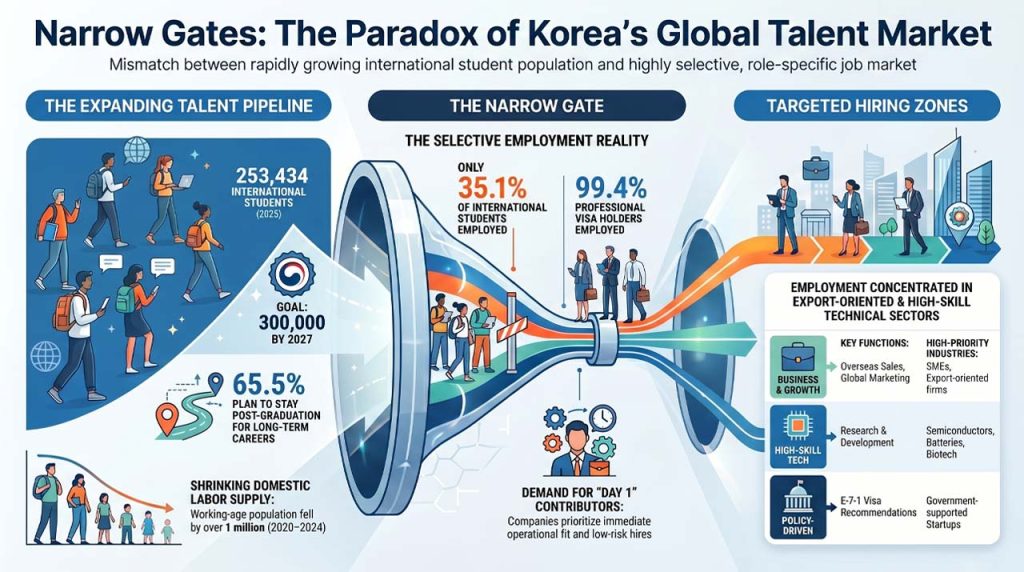
According to the government’s Study in Korea statistics, the number of international students reached 253,434 in 2025, up from 208,962 in 2024. The government continues to push toward a target of 300,000 students by 2027 under its Study Korea 300K initiative.
Intent to remain in Korea is also rising. Among international students, 65.5% indicated they plan to stay after graduation, and 36.2% cited employment as the primary reason.
This points to a broader shift, where Korea is no longer approached solely as a place to study, but increasingly considered as a potential long-term career market.
While Korea’s cultural visibility continues to draw attention, official data suggests that most international students are driven by academic quality and long-term career prospects, indicating that interest is evolving into more pragmatic, opportunity-based decision-making.
Employment Outcomes Remain Uneven Despite Rising Interest
Still, the increase in international talent does not translate evenly into employment.
Data from Statistics Korea shows that among foreign residents aged 15 and above, there were 236,000 international students in 2025. Yet only 35.1% of them were employed, while 58.8% remained economically inactive.
In contrast, foreign professionals already classified under work-based categories show a very different outcome. Employment among professional visa holders reached 99.4%.
This divergence highlights a structural reality. Korea is not broadly absorbing incoming global talent. The data suggests that it is selectively absorbing individuals who already meet specific employment conditions.
So in practice, entry often depends on alignment with predefined roles and qualifications, creating a more selective pathway into employment.
Hiring Demand Is Concentrated in Specific Functions
Where hiring does occur, it tends to cluster in clearly defined areas.
Government programs and policy signals show that foreign hiring is strongly tied to business needs, particularly in export-oriented roles. The Ministry of SMEs and Startups has introduced programs that connect international students to overseas sales, global marketing, and export-related positions, with structured pathways through E-7-1 visa recommendations.
At the same time, high-skill immigration pathways are focused on advanced industries. Korea’s top-tier visa initiatives prioritize talent in semiconductors, batteries, biotechnology, and related sectors, with strict eligibility criteria tied to academic background, work experience, and income thresholds.
These patterns indicate that hiring is not expanding across the board. It is concentrated in areas where companies face immediate commercial or technical demand.
This aligns with broader labor market signals. OECD data shows Korea’s working-age population declined from 36.64 million in 2020 to 35.62 million in 2024, reinforcing the need to attract foreign talent. Yet the response remains targeted rather than broad-based.
Companies Prioritize Immediate Contribution Over Potential
At the company level, hiring decisions are shaped by operational requirements rather than long-term potential alone.
Monica Jung, founder and CEO of MH CAREER and a professional career strategist who works directly with global professionals entering Korean job market, observes that opportunities tend to emerge only when there is a clear business need.
“A large portion of the demand I see is tied to companies expanding internationally, particularly in roles such as overseas sales and global marketing.”
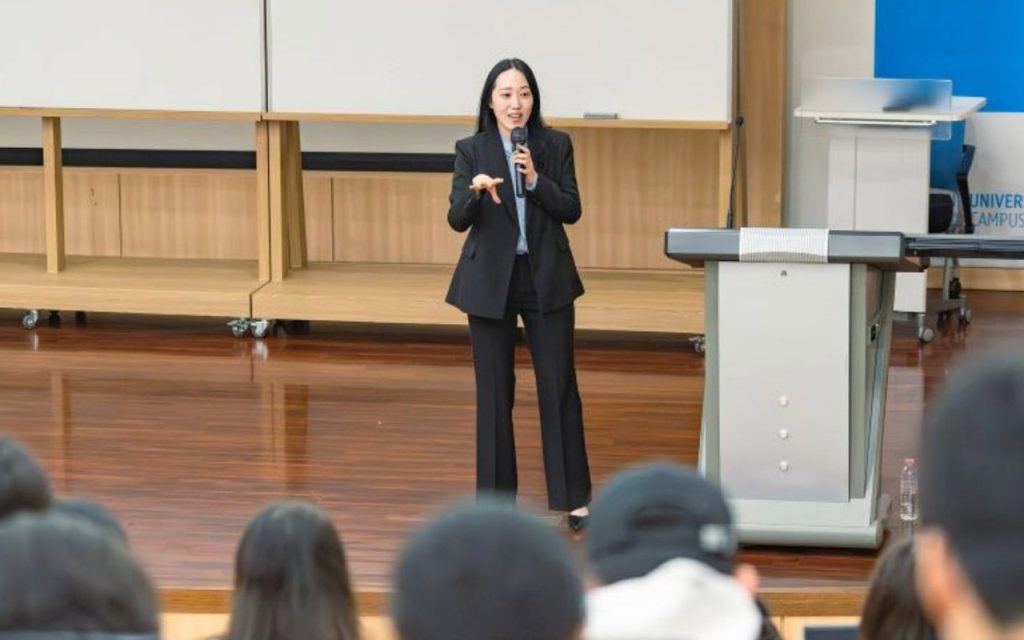
This demand structure affects how candidates are evaluated. According to Jung, companies focus on whether a candidate can immediately offer contribution rather than on motivation or long-term potential.
“From a company’s perspective, the key question is whether the candidate can contribute from day one.”
This then results in a hiring environment that remains selective even as talent inflow increases. It doesn’t mean that employers are rejecting global talent outright. It just signals that they are filtering for candidates who fit immediate operational requirements.
Moreover, it reflects a broader risk-sensitive approach to hiring. Employment regulations and organizational structures encourage companies to prioritize predictability, leading to more cautious selection processes.
The Expectation Gap Is Growing
The mismatch between rising interest and selective hiring is increasingly visible at the individual level.
Many international candidates approach Korea with strong personal motivation, often influenced by the country’s global presence, culture, and perceived opportunities. However, companies evaluate candidates based on immediate contribution and alignment with specific roles.
Jung notes that this creates a consistent gap between motivation to work in Korea and the criteria companies apply when making hiring decisions.
“The Korean job market is much more about immediate contribution and organizational fit than personal interest.”
This gap is not simply about competitiveness. It reflects a structural difference between how the market is perceived and how it operates in practice.
What This Means for Global Talent and Startups
South Korea’s global talent push is creating real entry points into its workforce, but those entry points remain tightly defined.
Opportunities are most visible in export-facing roles and specialized sectors, where companies have immediate business needs. Access, however, depends less on interest in Korea and more on how directly a candidate can contribute within those constraints.
This structure shapes how international hiring functions across the ecosystem. Startups and companies are already engaging foreign talent, particularly in roles linked to global expansion. Yet hiring remains concentrated, with limited extension into broader functions. As a result, the growing inflow of international professionals does not translate into equally broad workforce integration.
For global observers, this signals a specific model rather than a general opening. Korea is not building an open labor market for international talent. It is building a targeted pipeline aligned with economic priorities, where participation depends on role alignment and immediate applicability rather than overall availability of talent.
Korea: A Growing Talent Pipeline, Still Selectively Absorbed
At the end of the day, South Korea is building one of Asia’s most visible international talent pipelines, backed by policy expansion and sustained inflow across education and skilled migration channels. The momentum is clear, and it is certainly accelerating.
But what remains constrained is how that talent is absorbed into the workforce. Hiring continues to follow defined business needs, with companies selecting candidates who can deliver immediate, low-risk contribution in specific roles.
So, the gap is not about attracting global talent. It lies in how narrowly that talent is integrated once it arrives. As inflow scales, the real test for Korea’s ecosystem is no longer access, but how far participation can extend beyond a limited set of functions and pathways.
Key Takeaway
- South Korea’s international student population reached 253,434 in 2025, with a target of 300,000 by 2027
- 65.5% of international students plan to stay, but employment conversion remains uneven
- Only 35.1% of international students are employed, compared to 99.4% of professional visa holders
- Hiring is concentrated in overseas sales, global marketing, and export-linked roles, as well as STEM sectors
- Companies prioritize candidates who can contribute immediately, shaping a selective hiring environment
- Korea’s global talent strategy is expanding, but absorption remains targeted and role-specific, not broad-based
– Stay Ahead in Korea’s Startup Scene –
Get real-time insights, funding updates, and policy shifts shaping Korea’s innovation ecosystem.
➡️ Follow KoreaTechDesk on LinkedIn, X (Twitter), Threads, Bluesky, Telegram, Facebook, and WhatsApp Channel.
🤝 Looking to connect with verified Korean companies building globally?
Explore curated company profiles and request direct introductions through beSUCCESS Connect.