
South Korea’s AI healthcare sector is no longer defined by early experimentation. Regulatory approvals are rising, clinical validation is expanding, and government support remains active. Yet a different question is now emerging across the ecosystem. Why do so few of these technologies turn into scalable businesses?
The answer is beginning to take shape. The gap is no longer technical. It sits within the systems that connect innovation to market adoption.
Korea’s Innovation Engine Is Working, Conversion Is Not
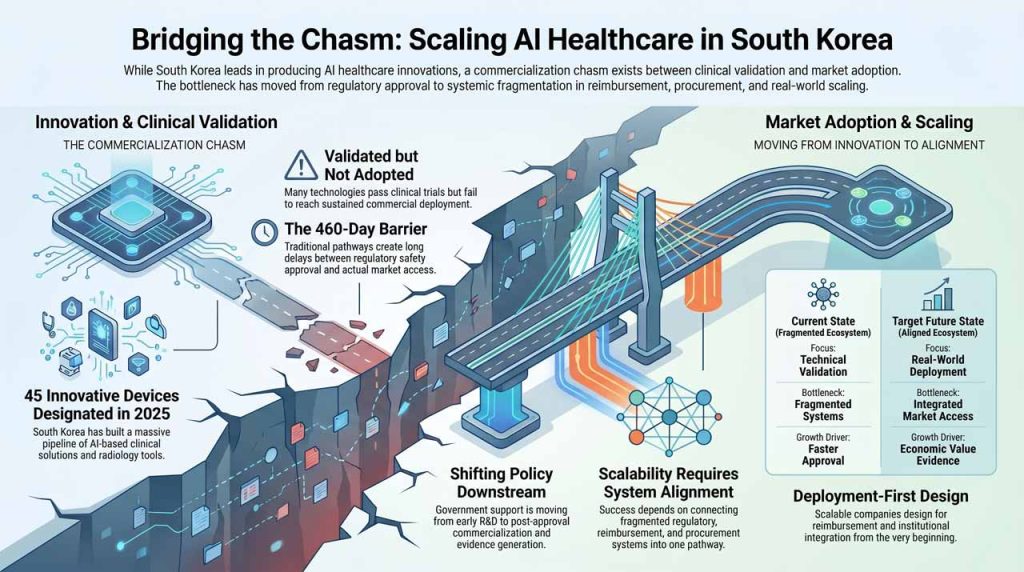
South Korea has built a visible pipeline of AI healthcare technologies. As of October 2025, 16 AI-based radiology solutions were already in clinical use, according to the Korean Journal of Radiology. The Ministry of Food and Drug Safety designated 45 innovative medical devices in 2025, many involving AI.
These are not merely early-stage signals. They have actually showed a functioning innovation engine supported by regulatory recognition and clinical validation.
Yet the outcome at the company level remains uneven. Many solutions progress through pilot testing and validation but do not reach sustained commercial deployment. This disconnect has become increasingly visible in both policy direction and industry behavior.
Dr. Wonju Hwangbo, Founder & CEO of AORAEL, Director of Korea Society of Technology for Sustainable Future (KSTSF), and Senior Fellow at National Assembly Policy Research Group (Korea), describes the pattern directly to KoreaTechDesk,
“Many technologies remain validated but not adopted.”
So this is not a failure of invention. Instead, it is a failure of conversion.
The Commercialization Gap Is Now the Real Bottleneck
The Korean ecosystem is encountering a mid-stage constraint that sits between successful validation and scalable business outcomes. This stage is often less visible than early innovation, but it is where most technologies stall.
Dr. Hwangbo frames this clearly:
“This is often described as the commercialization chasm.”
In Korea, this gap reflects a structural challenge. Previously, KoreaTechDesk discussed how technologies can demonstrate clinical value, yet still struggle to translate into scalable, revenue-generating deployments.
And government policy has begun to reflect this shift. The Ministry of Health and Welfare has expanded support programs that focus on post-approval stages, including real-world data generation, economic evaluation, and post-approval commercialization pathways. These measures are designed to address a problem that appears after validation, not before it.
Fragmented Systems Slow Down Scaling
However, the difficulty does not stem from a single barrier. It comes from multiple systems that operate in sequence but do not always align.
Regulatory approval, handled by MFDS, confirms safety and performance. It does not guarantee reimbursement or procurement. That next stage depends on evaluation processes involving agencies such as HIRA and NECA, where clinical value and pricing are assessed.
Even with recent reforms, this structure remains layered. The Korean Journal of Radiology notes that the traditional pathway can take around 460 days. Although new fast-track mechanisms have reduced entry timelines, the broader system still separates approval from market access.
Reimbursement adds another layer of uncertainty. HIRA introduced a temporary listing framework, with the first innovative technology listed in December 2023. This expanded access to approximately 200,000 patients, according to its sustainability report. At the same time, long-term pricing models and evaluation criteria continue to evolve.
Data access, often seen as a strength in Korea, also reflects this pattern. The government has expanded data voucher programs and standardized review processes. Access has improved, but remains structured and institutional, requiring coordination across multiple bodies.
Dr. Hwangbo summarizes the issue at a system level:
“Clinical validation, reimbursement, and procurement operate in fragmented ways.”
This fragmentation slows scaling even when each individual component is functioning.
Policy Is Moving Downstream to Close the Gap
Recent policy moves provide a clear signal about where the bottleneck lies.
The Ministry of Health and Welfare has introduced programs that target post-approval commercialization. These include support for real-world evidence generation, economic evaluation, and partnerships between hospitals and companies.
At the same time, the government plans to expand AI demonstration projects and increase support for medical data utilization. Training programs have also been introduced to address limited pathways to scale beyond early institutional deployments.
These are not early-stage initiatives. They are designed to support technologies that have already been developed and approved, but have not yet scaled.
This shift suggests that Korea has entered a new phase. The priority is no longer generating innovation. It is building the infrastructure that allows innovation to become part of the healthcare system.
Faster Approval Does Not Mean Faster Growth
Korea has made visible progress in regulatory speed. New pathways allow certain medical devices to enter clinical use more quickly after approval.
However, policy developments that followed indicate that regulatory acceleration alone is not enough. Even with faster entry, the government has had to introduce additional support at the commercialization stage.
And this sequence is crucial because it shows that reducing approval timelines does not automatically lead to broader adoption or business scaling.
Why? Because the bottleneck has now moved beyond regulation into system alignment.

Korea’s Position in a Global Context
Korea’s situation reflects a broader shift in AI healthcare, though the dynamics are more visible in its system.
The country combines strong R&D capacity, advanced digital infrastructure, and a centralized healthcare structure. These conditions support rapid development and early validation of AI technologies.
At the same time, integration across regulation, reimbursement, and market access is still evolving. In more mature markets, these elements are increasingly connected earlier in the product lifecycle. In Korea, they continue to operate in sequence, which slows the transition from approval to scalable deployment.
This does not suggest a lack of capability. It points to a system in transition, where the focus is moving from building technology to aligning the conditions required to scale it.
What Separates Scalable Companies from the Rest
Within this environment, the difference between companies that scale and those that stall becomes clearer.
Technologies that succeed are not defined by performance alone. They are designed with deployment in mind from the beginning. This includes aligning with reimbursement, governance, and market access requirements.
Dr. Hwangbo emphasizes this point:
“Successful projects are designed for real-world deployment from the beginning.”
In contrast, solutions that focus primarily on technical validation often remain in pilot stages. The gap is not in capability, but in system readiness.
Implications for Global Founders and Investors
Korea offers a useful reference point for understanding AI healthcare commercialization more broadly. After all, its challenge also reflects a wider industry pattern in which strong innovation output does not automatically lead to scalable businesses.
For founders, this means product-market fit extends beyond performance. It includes alignment with institutional systems, financial pathways, and operational realities.
As for investors, evaluation must move beyond technical metrics. The critical questions now relate to how a company navigates reimbursement, integrates into healthcare systems, and progresses beyond pilot deployments.
In this context, Korea provides a case where the gap between innovation and commercialization is visible, measurable, and increasingly addressed through policy.
Korea AI Healthcare Commercialization Hinges on System Alignment
At the end of the day, South Korea has established a strong base in AI healthcare, supported by steady regulatory progress and continued policy investment. The pipeline of technologies is growing, and validation pathways are becoming more defined.
So the challenge now sits beyond development. Scaling these technologies depends on how effectively the ecosystem connects regulatory approval, reimbursement, procurement systems, and market access into a coherent pathway.
Each part of the system is advancing, but alignment across them remains incomplete. As a result, technologies that succeed in validation often struggle to expand into sustainable, large-scale deployment.
The trajectory of Korea’s AI healthcare sector will depend on how quickly this alignment can be achieved.
Key Takeaway
- South Korea has established a strong pipeline of AI medical technologies, supported by regulatory recognition and clinical validation
- The main constraint lies in commercialization, particularly in converting validated technologies into scalable business models
- Fragmentation across reimbursement, procurement, and data systems continues to slow market expansion
- Government policy is shifting toward post-approval commercialization support, including real-world evidence and economic validation
- Faster regulatory approval has not translated into scalable growth, indicating the bottleneck has moved beyond regulation
- Korea’s experience highlights a broader insight for the global ecosystem:
AI healthcare scales through system alignment, not technology alone
– Stay Ahead in Korea’s Startup Scene –
Get real-time insights, funding updates, and policy shifts shaping Korea’s innovation ecosystem.
➡️ Follow KoreaTechDesk on LinkedIn, X (Twitter), Threads, Bluesky, Telegram, Facebook, and WhatsApp Channel.
🤝 Looking to connect with verified Korean companies building globally?
Explore curated company profiles and request direct introductions through beSUCCESS Connect.