

AI can now generate product descriptions, advertising visuals, campaign copy, and marketplace content faster than most human teams can produce manually. Yet as automation accelerates across global e-commerce, a new problem is quietly emerging. Content is becoming easier to produce, but increasingly harder to differentiate. That tension is now pushing Korean AI startups and commerce operators toward a more difficult question: if AI can reproduce almost everything, what parts of brand identity still remain genuinely human?
Brand Trust Is Becoming More Valuable as AI Content Becomes Cheaper
Generative AI is rapidly lowering the cost of producing commercial content across global e-commerce. Product descriptions, advertising visuals, promotional copy, and marketplace assets can now be generated at a scale that would have previously required large creative teams.
But as AI-generated commerce content becomes more abundant, another layer of competition is becoming more important: trust.
Edelman’s 2025 Brand Trust report found that 80% of consumers trust the brands they use, while many respondents viewed trusted brands as sources of stability, confidence, and reassurance in increasingly uncertain environments.
Kantar’s BrandZ framework similarly argues that the world’s strongest brands consistently outperform by building “meaningful, different, and salient” consumer relationships rather than competing on visibility alone.
This means that while AI can indeed dramatically accelerate content production, producing more content does not automatically create stronger differentiation, emotional credibility, or long-term customer trust.
KoreaTechDesk’s discussion with Fulcrum Technologies CEO Woobin Koh continues, and he believes this is where current AI systems still encounter structural limitations inside commerce.
“Brand voice is not simply tone,”
Koh told KoreaTechDesk in a written interview.
“It is a founder’s worldview, the accumulated history of a brand’s relationship with its customers, and critically, the things a brand chooses not to say.”

Why Premium Commerce Is Especially Sensitive to AI Sameness
The pressure becomes even more visible in premium and founder-led commerce categories.
Luxury and high-consideration consumer brands increasingly compete on emotional differentiation rather than pure functional advantage. Bain & Company’s 2025 luxury market research reported that roughly 20 million consumers exited the luxury market during 2025, reducing the active customer base to around 330 million people, down from approximately 400 million in 2022.
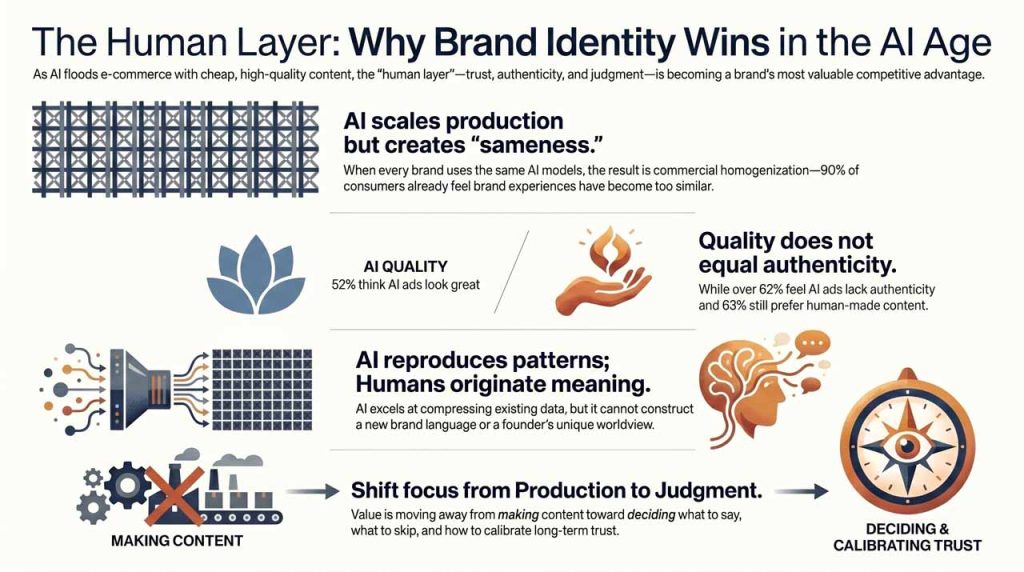
The same research also revealed a growing dissatisfaction problem. Bain found that 70% of consumers were dissatisfied with current luxury in-store experiences, while 90% believed customer experiences across brands had become too similar.
That environment creates risk for AI-generated commercialization strategies built primarily around efficiency and scale.
If multiple brands rely on similar AI models, optimization systems, aesthetic trends, and content-generation patterns, the danger is not necessarily low-quality output. The larger risk is commercial homogenization.
Deloitte’s analysis of AI adoption in luxury retail similarly argued that AI implementation must remain aligned with brand values, craftsmanship, exclusivity, and authenticity rather than functioning purely as a cost-reduction tool.
The challenge becomes more complicated because premium consumers are often evaluating more than product information itself. They are also evaluating credibility, cultural positioning, restraint, taste, and whether a brand feels genuinely differentiated from competitors.
Koh believes this creates a structural limitation for current AI systems inside high-end commerce categories.
“AI can compress and reproduce existing patterns with increasing fidelity,”
he explained.
“What it cannot yet do is construct a brand language that does not yet exist.
That act of origination is still human.”

Consumers Are Separating AI Quality From AI Authenticity
Korean consumer research increasingly reflects this distinction between technical quality and perceived authenticity.
TrendMonitor’s 2026 survey on generative AI advertising found that 52.0% of respondents believed recent AI advertisements were better than expected, while 46.5% said AI-generated ads now feel as natural as human-made content.
At the same time, skepticism remained remarkably high.
The same survey found that 62.4% of respondents felt AI-generated advertisements appeared less authentic, while 63.0% still preferred human-created advertising content. Another 86.5% believed companies should clearly disclose AI-generated advertising usage.
And those findings align with broader academic research surrounding AI-generated commercial content as well.
A 2025 study published in Administrative Sciences found that consumers often react differently once they become aware that advertising imagery was generated using AI systems. Researchers linked this response partly to “algorithm aversion,” where audiences become more skeptical once persuasion appears machine-generated rather than human-directed.
This creates a growing trust paradox inside AI commerce.
Consumers increasingly accept AI-assisted production as normal. However, acceptance of AI efficiency does not automatically translate into emotional trust toward AI-originated branding.
That distinction may become commercially significant as AI-generated content becomes increasingly indistinguishable at the technical level.
Korea’s AI Ecosystem Is Moving Toward Trust-Centered Commercialization
South Korea’s broader AI environment also reflects rising attention toward trust and transparency.
The country’s AI Basic Act officially took effect in January 2026, establishing governance frameworks around trustworthy AI development, transparency, and safety obligations. Korea’s Ministry of Science and ICT also introduced discussions around AI-generated watermarking systems as part of broader efforts to reduce misuse and strengthen trust in synthetic content environments.
But the policy direction itself matters less than the underlying commercial implication.
As AI-generated media becomes harder to distinguish visually, commercial trust may increasingly depend on reputation, transparency, and long-term brand credibility rather than production quality alone.
This becomes particularly relevant for founder-led startups and emerging commerce brands attempting to scale internationally.
Unlike large incumbents with decades of accumulated brand equity, younger companies often rely heavily on perceived authenticity and founder identity to build early trust with customers.
Therefore, excessive automation risks weakening the very emotional differentiation these companies depend on to compete.
The Human Layer in Commerce May Shift From Production to Judgment
The broader shift occurring inside AI commerce may therefore have less to do with replacing human creativity entirely. It is more about relocating where human value sits inside commercial systems.
Earlier generations of e-commerce teams concentrated human labor heavily around production itself: writing copy, designing layouts, editing visuals, and assembling campaigns manually.
Now AI increasingly handles the first production layer.
What remains harder to automate is deciding which messages deserve amplification, what kind of customer relationship a brand wants to build, how much persuasion feels excessive, what cultural signals should remain implicit, and which forms of communication might ultimately damage trust rather than strengthen it.
Those decisions involve judgment rather than generation.
They also involve commercial restraint, something optimization-driven AI systems often struggle to model because restraint frequently depends on long-term brand positioning rather than short-term engagement metrics.
That may ultimately explain why AI-generated commerce content still encounters friction in premium retail environments despite rapid technical improvement.
And while the technical quality gap is narrowing quickly, the meaning gap remains much harder to close.
The Brands Most Likely to Survive AI Saturation Know What Not to Automate
As generative AI continues flooding global commerce ecosystems with increasingly polished content, differentiation itself may become scarcer.
That changes the nature of competitive advantage.
The strongest brands may no longer be the ones capable of producing the largest volume of optimized content. They may instead be the brands capable of preserving coherent identity, trust, emotional consistency, and strategic restraint while operating inside AI-accelerated environments.
In other words, the final human layer inside AI commerce may not be production at all.
It may be judgment.
Key Takeaway
- Generative AI is rapidly automating e-commerce content production, but faster content generation does not automatically create stronger brand differentiation or consumer trust.
- Premium and founder-led brands face growing pressure around authenticity and sameness, especially as AI-generated commercial content becomes increasingly widespread.
- Korean consumer research shows audiences distinguish between AI quality and AI authenticity, with many consumers still preferring human-created advertising despite improving AI output quality.
- Brand identity increasingly functions as commercial infrastructure, shaping trust, credibility, emotional positioning, and long-term customer relationships.
- AI can reproduce existing patterns but struggles to originate entirely new brand language rooted in founder worldview and accumulated customer history.
- As AI handles more first-layer production work, human value inside commerce may increasingly shift toward judgment, restraint, trust calibration, and long-term brand direction rather than manual content creation alone.
– Stay Ahead in Korea’s Startup Scene –
Get real-time insights, funding updates, and policy shifts shaping Korea’s innovation ecosystem.
➡️ Follow KoreaTechDesk on LinkedIn, X (Twitter), Threads, Bluesky, Telegram, Facebook, and WhatsApp Channel.
🤝 Looking to connect with verified Korean companies building globally?
Explore curated company profiles and request direct introductions through beSUCCESS Connect.