
Many startups entering Japan spend months researching customers, studying competitors, and attending networking events. Yet some of the most valuable market intelligence comes from a place founders rarely prioritize: the people working inside the market itself. As Japan’s international workforce continues to grow, a different view of market entry is beginning to emerge. Talent is no longer just a hiring issue. It is becoming part of the infrastructure that determines how companies learn, adapt, and build locally.
Japan’s Talent Challenge Is Becoming a Market Entry Challenge
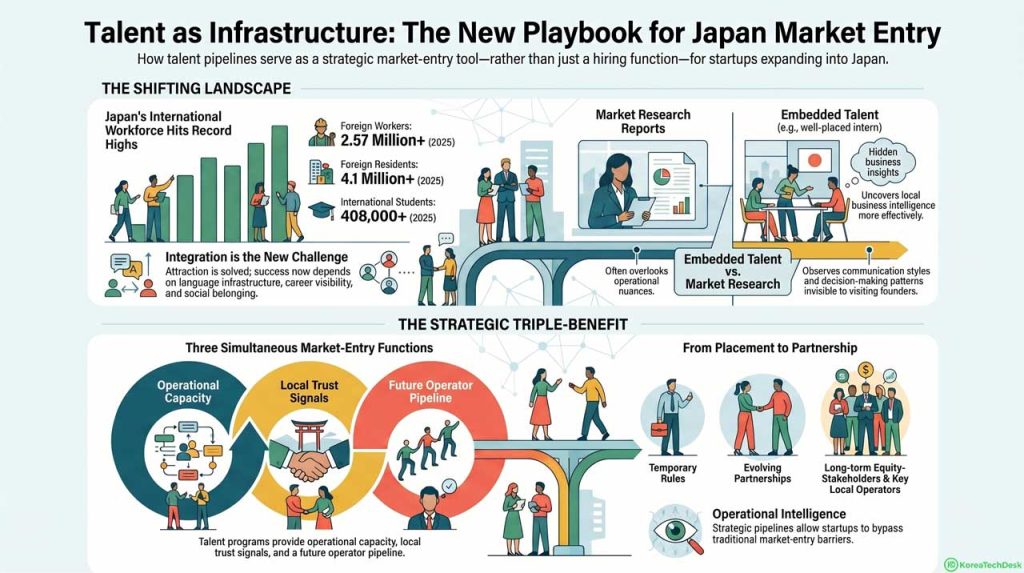
Japan’s workforce is becoming increasingly international. According to Japan’s Ministry of Health, Labour and Welfare, the country employed more than 2.57 million foreign workers as of October 2025, the highest figure since reporting began. The number of workplaces employing foreign workers also reached a record 371,215.
At the same time, the Immigration Services Agency reported that Japan’s foreign resident population exceeded 4.1 million for the first time at the end of 2025. International student enrollment is also expanding rapidly. Japan’s Ministry of Education, Culture, Sports, Science and Technology reported more than 408,000 international students in 2025, another record.
These numbers are often discussed through the lens of labor shortages, demographic pressures, and workforce policy. For foreign startups and SMEs entering Japan, however, they reveal a different opportunity.
Because now, the question is no longer simply how to hire talent. The more strategic question is how talent can help companies understand, navigate, and operate inside the market itself.

Why Integration Matters More Than Attraction
Thom Peace, Founder and CEO of Peace Works K.K., and Executive Director of Aoyama Professionals, has spent years working across international talent programs, business development, and cross-border collaboration in Japan.
As the discussion on Korea-Japan startup partnership challenges continues with KoreaTechDesk, Peace argued that attracting international talent is no longer Japan’s primary challenge.
“Attraction is a solved problem. Japan’s appeal, safety, culture, food, quality of life, sells itself.”
According to Peace, the more important challenge begins after talent arrives.
“The gap is entirely on the integration side, and it sits in three places: language infrastructure, career pathway visibility, and social belonging.”
His observation reflects a reality many foreign companies face after establishing a local presence. While recruiting talent is often achievable, creating an environment where people can contribute, grow, and stay engaged is far more challenging.
The Missing Layer Behind Successful Market Entry
Most market-entry discussions focus on partnerships, localization, regulatory requirements, and customer acquisition. Those elements matter, but they rarely explain how companies develop a practical understanding of local business behavior.
Peace believes talent programs can fill that gap.
“The most important integration factor I’ve observed isn’t any of these individually.
It’s whether the international talent has someone invested in their long-term success, not just their immediate placement.”
That difference helps explain why some organizations benefit more from talent programs than others.
Companies that treat internships or project-based placements as temporary labor tend to gain only limited insight. In contrast, those that invest in people over a longer period often gain something far more valuable: local operators who understand both the company and the market.

Why an Intern Can Be More Valuable Than Market Research
For many founders, market research is one of the first steps before expanding. Reports, customer interviews, and advisory sessions all help reduce uncertainty.
Peace suggests that embedded talent can uncover insights that external research often overlooks.
“An intern placed well is worth more than a market research report.”
He then explained that interns occupy a unique position inside organizations.
“They are inside the organization, watching how decisions get made, understanding what the real priorities are, building relationships and delivering outcomes that a visiting founder can’t replicate in a two-day trip.”
This perspective reframes talent as a source of operational intelligence.
An intern working alongside local teams can observe communication styles, approval processes, purchasing behavior, customer expectations, and internal decision patterns. Those insights often emerge through daily interaction rather than formal research.
Talent Pipelines Create More Than Workforce Capacity
Peace believes structured talent programs serve several functions simultaneously for foreign startups entering Japan.
“For foreign startups specifically, a structured talent program serves three market-entry functions simultaneously.
It provides embedded operational capacity. It creates a trust signal. And it builds a pipeline of operators who can eventually grow with the venture.”
Each function addresses a common challenge in expansion.
Operational capacity helps startups execute locally without immediately building large teams. Trust signals demonstrate commitment to the market. Future operators create continuity as the business grows.
This becomes increasingly important as foreign-affiliated companies continue expanding in Japan. According to a recent survey by the Japan External Trade Organization (JETRO), roughly 60% of foreign-affiliated companies plan to strengthen or expand their operations in Japan, while talent acquisition remains one of the most persistent business challenges.

When Placement Becomes Partnership
The strongest example from Peace’s experience involved an intern who initially joined on a six-month commitment.
The intern worked across two company websites, helping improve design, site structure, search visibility, and formatting. The work generated measurable improvements in traffic, engagement, and inbound business inquiries.
The outcome extended far beyond the original internship.
“The internship is the first phase.”
After observing the intern’s performance over time, the company offered an equity position in one of its platforms. The relationship evolved from temporary placement into long-term participation in the business.
For startups entering Japan, that progression highlights an often-overlooked advantage of talent pipelines. Because in reality, they don’t merely identify potential hires, but also help uncover future contributors, operators, and stakeholders through hands-on collaboration.
What Korean Startups Can Learn From Japan’s Talent Environment
Korean startups now have growing access to Japan-focused expansion programs, investment initiatives, and ecosystem support networks. While many of these efforts help founders build connections and explore opportunities, talent strategy deserves just as much attention.
Companies entering Japan can benefit from treating internships, project-based placements, and international talent programs as part of their core market-entry strategy, rather than something to address later as a hiring need.
Individuals who understand local business culture, customer behavior, communication styles, and industry expectations often serve as the crucial link between strategy and execution.
Because in the end, startups that build these connections early may gain advantages that are difficult for competitors to replicate through research alone.
The Human Infrastructure Behind Expansion
Market entry is often discussed in terms of capital, partnerships, products, and regulation. While these elements are essential, they rarely work effectively on their own.
At the heart of it all are people. They bring relationships, context, and real-world experience across organizations, helping foreign companies move beyond surface-level understanding and into the realities of day-to-day operations.
And as Japan continues to attract international talent and foreign companies expand their presence, success may depend less on hiring quickly and more on building talent pipelines that turn local insight into lasting capability.
Key Takeaway
- Japan’s international workforce is reaching record levels, creating new opportunities for foreign companies to build local operating capability.
- Attraction is no longer the primary challenge. Integration remains the critical gap.
- Talent pipelines can provide embedded operational intelligence, helping startups understand how decisions, relationships, and workflows function inside the market.
- Well-structured internships can create market-entry advantages that traditional research and short-term visits often cannot replicate.
- Structured talent programs generate three benefits simultaneously: operational capacity, local trust signals, and future operator pipelines.
- The strongest talent programs create pathways for long-term contribution and business participation.
- For Korean startups expanding into Japan, talent strategy may be as important as partnership strategy in building sustainable local operations.
– Stay Ahead in Korea’s Startup Scene –
Get real-time insights, funding updates, and policy shifts shaping Korea’s innovation ecosystem.
➡️ Follow KoreaTechDesk on LinkedIn, X (Twitter), Threads, Bluesky, Telegram, Facebook, and WhatsApp Channel.
🤝 Looking to connect with verified Korean companies building globally?
Explore curated company profiles and request direct introductions through beSUCCESS Connect.