

Startup ecosystems have become exceptionally good at creating introductions. Governments organize summits, accelerators arrange matchmaking sessions, and investors connect founders across borders. Still, many of these conversations never become working partnerships. As Korea and Japan deepen startup cooperation through new programs, investment initiatives, and policy dialogue, a different question is emerging. What actually happens after the first meeting ends?
The Number of Cross-Border Opportunities Is Growing
Cross-border collaboration between Korea and Japan has been becoming increasingly structured.
In 2024, South Korea’s Ministry of SMEs and Startups (MSS) launched K-Startup Center Tokyo to support Korean startups entering Japan. The initiative was designed to provide local settlement support, acceleration programs, investment connections, and networking opportunities as more Korean companies explore expansion into the Japanese market.
The momentum continued in 2025. Korea and Japan held the second Japan-Republic of Korea Startup Policy Dialogue in Seoul, where both governments discussed startup expansion, foreign investment attraction, and ecosystem cooperation. MSS also hosted the Korea-Japan Startup Investment Summit 2025 in Tokyo and announced a KRW 29 billion Korea-Japan Cooperation Global Fund aimed at strengthening venture investment collaboration.
At the same time, Japan is actively seeking greater international participation in its economy. The Japanese government has established a target of JPY 120 trillion in foreign direct investment stock by 2030, while Japan External Trade Organization (JETRO) data shows foreign-affiliated companies continue to view the market positively, with many planning to expand their operations.
These developments create more opportunities for introductions than ever before.
The challenge, however, may no longer be access.

Why Introductions Often Fail to Become Partnerships
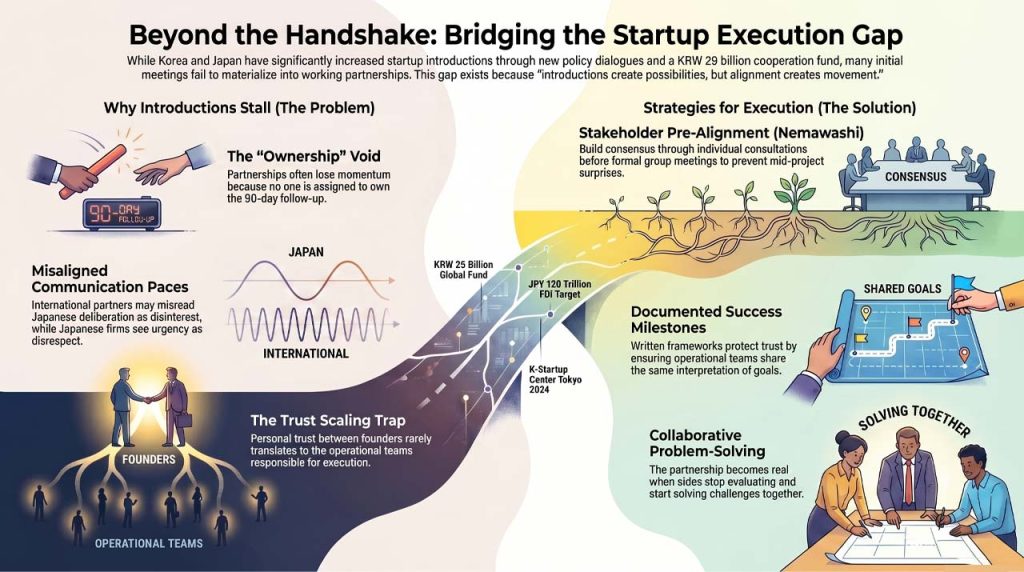
Public announcements often focus on the creation of partnerships, memorandums of understanding, and networking initiatives. Much less attention is given to the operational work required after the initial connection.
According to Thom Peace, Founder and CEO of Peace Works K.K., who works at the intersection of international business development, talent mobility, and cross-border ecosystem building in Japan, that is where many partnerships begin to lose momentum.
“The most common failure point isn’t enthusiasm. It’s the absence of a handoff structure after the introduction,”
Peace told KoreaTechDesk in an exclusive interview.
“Two parties meet, there’s genuine interest, and then both sides return to their existing workloads. Nobody owns the next step. Nobody has defined what success looks like at 90 days.”
His observation highlights a challenge that is often overlooked in ecosystem discussions. Building connections and building execution systems are not the same activity.
As startup ecosystems mature, the gap between introductions and implementation may become increasingly important.

The Hidden Cost of Misaligned Expectations
Cross-border partnerships face another challenge that rarely appears in official announcements: differing assumptions about how collaboration should progress.
Peace noted that Japan’s business environment can create misunderstandings when international partners expect immediate movement after initial discussions.
“International partners often interpret slow responses as disinterest. Japanese counterparts often interpret urgency as disrespect.”
The result is not necessarily conflict. More often, momentum gradually disappears because both sides misread each other’s behavior.
This challenge becomes particularly relevant as organizations expand internationally. The larger the number of stakeholders involved, the greater the risk that assumptions remain unspoken.
JETRO’s J-Bridge program, which supports collaboration between Japanese companies and overseas startups, similarly notes that response times can vary significantly because Japanese companies often require internal consultation before making decisions.
And for foreign founders accustomed to faster decision cycles, these differences can create confusion even when genuine interest exists on both sides.

Why Stakeholder Alignment Matters More Than Visibility
Peace believes one of the most underappreciated concepts in cross-border collaboration is pre-alignment.
Drawing on the Japanese concept of Nemawashi, which refers to quietly building consensus through individual conversations before formal meetings occur, he described the practice of consulting stakeholders individually before group discussions take place.
“The goal isn’t to control information. It’s to make sure nobody is surprised in a group setting by something that could have been resolved privately.”
This approach may appear inefficient to founders focused on speed. Yet in complex partnerships involving multiple organizations, investors, advisors, and operators, stakeholder alignment often determines whether discussions move forward or become stalled.
As startup ecosystems increasingly emphasize international expansion, alignment may become as important as access.
Introductions create possibilities. Alignment creates movement.
Trust Alone Cannot Scale Across Organizations
Trust remains one of the most frequently cited ingredients in international business relationships.
Peace argues that while trust is important, it is still insufficient on its own.
“Trust is the currency of Japanese business, but it’s a currency that operates between individuals, not organizations.”
The distinction becomes critical when partnerships move beyond founders and executives.
Operational teams, project managers, developers, and coordinators were not present when the relationship was initially established. Without documented responsibilities, milestones, and adjustment mechanisms, each side often develops different interpretations of what was agreed.
According to Peace, written frameworks do not weaken trust.
In fact, they protect the established trust.
As startup partnerships become larger and involve more stakeholders, execution systems become increasingly important because personal relationships alone cannot carry the entire burden of coordination.
When a Partnership Becomes Real
And so, the ultimate test of a partnership is not the announcement, the meeting, or even the agreement.
It is in the execution.

Peace believes the clearest indicator of a genuine partnership appears when both sides stop evaluating each other and begin solving problems together.
“The shift from ‘let me tell you what we do’ to ‘here’s a challenge we’re facing, how would you approach it?’ marks the real beginning of a working partnership.”
That perspective offers an important reminder for startup ecosystems increasingly focused on international expansion.
Connections may open doors. Partnerships are built after people walk through them.
Beyond the Introduction Economy
In the end, governments, investors, accelerators, and ecosystem builders have become highly effective at creating opportunities for founders to meet across borders.
The next challenge may lie in improving what happens after those meetings occur.
As Korea and Japan continue expanding startup cooperation through policy dialogue, investment initiatives, and ecosystem programs, the success of those efforts may depend less on the number of introductions generated and more on the operational structures that convert introductions into sustained collaboration.
The organizations that benefit most from growing cross-border ecosystems will not necessarily be those that create the most introductions. They will be the ones that build the systems to pragmatically execute after the introduction is made.
Key Takeaway
- Korea and Japan are expanding startup cooperation through initiatives such as K-Startup Center Tokyo, bilateral startup policy dialogue, and joint investment programs.
- Cross-border partnerships often fail after the introduction stage, not because of lack of interest but because ownership, follow-up structures, and success metrics are missing.
- According to Thom Peace, Founder and CEO of Peace Works K.K., many partnerships stall when “nobody owns the next step” after the initial connection.
- Stakeholder alignment and pre-consultation practices, including concepts similar to Nemawashi, can help prevent misunderstandings before they become operational obstacles.
- Trust supports partnerships, but execution systems sustain them. Documented responsibilities, milestones, and communication structures help partnerships scale beyond individual relationships.
- The strongest indicator of a successful cross-border partnership is collaborative problem-solving, where both sides begin addressing challenges together rather than evaluating each other’s capabilities.
- For founders, investors, and ecosystem operators pursuing cross-border business expansion, introductions create opportunity, but long-term value emerges through execution.
– Stay Ahead in Korea’s Startup Scene –
Get real-time insights, funding updates, and policy shifts shaping Korea’s innovation ecosystem.
➡️ Follow KoreaTechDesk on LinkedIn, X (Twitter), Threads, Bluesky, Telegram, Facebook, and WhatsApp Channel.
🤝 Looking to connect with verified Korean companies building globally?
Explore curated company profiles and request direct introductions through beSUCCESS Connect.