
A startup meeting ends smoothly. The AI-generated summary looks clear. Tasks are assigned, timelines appear aligned, and nobody openly disagrees. But then weeks later, execution begins drifting across teams, investors, and overseas partners who all believed they understood the same decision.
As Korean startups expand into increasingly global and AI-assisted environments, many organizations are discovering that operational coordination can create the illusion of alignment while deeper misunderstandings remain hidden underneath.
Korea’s Startup Ecosystem Is Becoming Structurally More Global
South Korea’s startup ecosystem is no longer operating primarily within domestic boundaries. Government-backed programs, global R&D partnerships, and corporate-led open innovation initiatives are increasingly connecting Korean startups with international investors, multinational companies, and overseas markets.
The Ministry of SMEs and Startups (MSS) recently expanded AroundX, its open innovation platform connecting startups with global corporations including OpenAI, Microsoft, AWS, NVIDIA, Siemens, Intel, Mercedes-Benz Korea, Oracle, IBM Quantum, and L’Oréal Korea. The 2026 program plans to support more than 400 startups through acceleration, proof-of-concept collaboration, and direct industry partnerships.
At the same time, Korean startups are increasingly operating through overseas expansion hubs. Yonhap reported that K-Startup Center programs across Seattle, Silicon Valley, Singapore, Tokyo, and Hanoi supported 119 startups that collectively raised around USD 240 million in overseas investment last year.
MSS has also expanded global collaborative R&D partnerships involving institutions such as Fraunhofer, Georgia Tech, Purdue University, Johns Hopkins University, and TNO, increasing the scale of cross-border startup cooperation in advanced technology sectors.
This creates a very different operational environment from earlier startup ecosystems centered around small local teams. Korean startups now frequently coordinate across headquarters, overseas branches, investors, enterprise partners, researchers, consultants, and multilingual stakeholders operating under different assumptions and communication cultures.
As collaboration expands globally, alignment becomes harder to interpret.

Shared Tools Do Not Guarantee Shared Understanding
Award-winning Global Impact Strategist, former Head of Communications for the UN Global Platform on Big Data, and Decision Shapers author Valerie Won Lee believes many organizations are beginning to confuse operational coordination with actual shared understanding.
As discussions on the Decision Shapers framework continues with KoreaTechDesk, Won Lee explained:
“Multicultural teams can become more aligned operationally while becoming less aligned interpretively.”
The distinction is becoming increasingly important inside startup ecosystems heavily dependent on remote collaboration, AI-assisted communication, and distributed execution workflows.
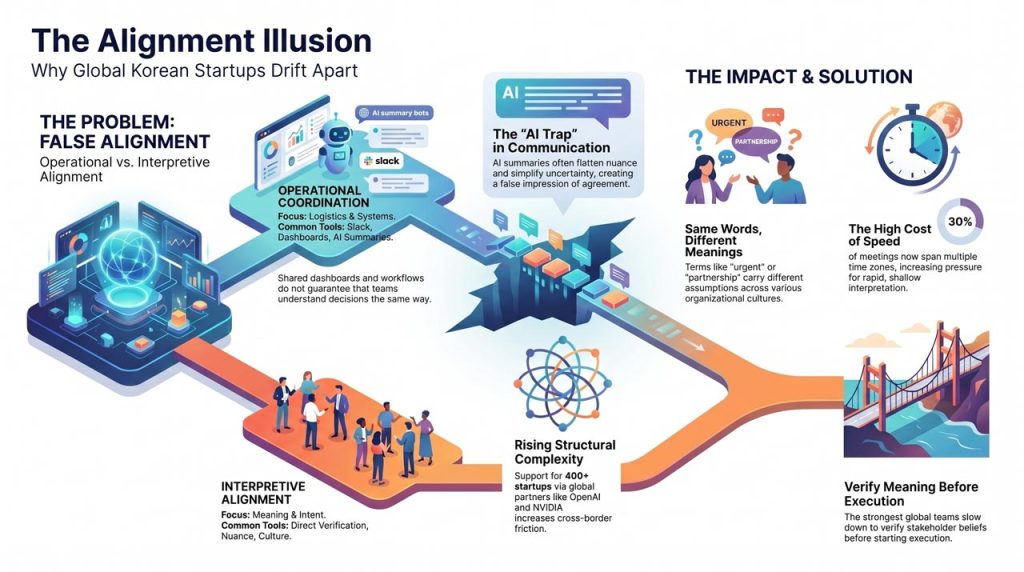
Operational alignment commonly refers to teams sharing the same dashboards, AI-generated summaries, Slack channels, meeting systems, workflows, and project management tools. On the surface, the organization appears connected and synchronized.
But interpretive alignment is different. It concerns whether people actually understand the meaning of a decision in the same way.
This is where friction often begins.
Won Lee noted:
“The earliest warning sign is usually that everyone is using the same words but not meaning the same thing.”
Inside global startup environments, words such as “launch,” “approval,” “commitment,” “urgent,” “partnership,” or “next step” may carry different assumptions depending on organizational role, national culture, seniority, or investor expectations.
A founder may interpret a discussion as a finalized decision. A product team may still view it as exploratory. Overseas partners may believe timelines are flexible while headquarters interprets them as fixed commitments.
The workflow appears aligned, but the meaning underneath it is not.

AI Summaries Can Make Organizations Look More Aligned Than They Really Are
The problem becomes more complicated once AI enters communication systems.
AI tools can now summarize meetings, translate discussions, standardize communication, and generate project updates across multiple languages and time zones within seconds. This improves coordination speed significantly, especially inside startups managing distributed teams and international partnerships.
But cleaner communication does not always mean deeper alignment.
Won Lee warned:
“AI can translate language, summarize meetings, and standardize communication.
But it can also flatten nuance.”
She added:
“A clean AI-generated summary can create the impression that everyone agreed, when in reality people may have understood the conversation differently.”
This concern is becoming increasingly relevant as startups rely more heavily on AI-generated documentation and meeting summaries as operational records.
Legal advisory firm White & Case recently warned that AI meeting tools create governance risks because machine-generated summaries, transcripts, and recordings may unintentionally become the accepted version of a discussion even when they fail to capture hesitation, unresolved disagreement, or contextual nuance.
Academic research is also beginning to support these concerns.
A Royal Society Open Science study archived through the University of Cambridge found that large language model summaries frequently overgeneralize information and omit limiting context. Researchers concluded that AI-generated summaries were significantly more likely than human summaries to simplify uncertainty into cleaner-looking conclusions.
Inside startup environments operating under pressure, this creates a dangerous possibility: teams may begin executing based on summaries that appear clearer than the original discussion actually was.
Global Startup Teams Often Misread the Same Decision Differently
The challenge is not simply about translation accuracy. It is about interpretation.
Research published in the Journal of Management found that multilingual and multicultural teams regularly face collaboration barriers caused not only by language differences, but also by emotional interpretation, indirect communication patterns, and differing assumptions around authority and decision-making.
Even highly fluent international teams can still misunderstand timing, urgency, ownership, or commitment because organizational meaning does not transfer perfectly across cultures.
Won Lee explained that these distortions often remain invisible during meetings themselves.
“Teams may have false alignment, unclear ownership, different assumptions about timing, different levels of commitment, and different interpretations of risk.”
This becomes especially dangerous in startups because execution cycles move quickly.
Misalignment may not appear immediately during discussion stages. The problem often surfaces later through delayed execution, conflicting investor expectations, inconsistent customer messaging, product rollout confusion, or breakdowns between headquarters and overseas operators.
Microsoft’s 2025 Work Trend Index further reflects the pressure shaping these environments. The report found that workers are interrupted every two minutes during core work hours, while 30% of meetings now involve multiple time zones. Chat activity outside normal working hours also continues to rise globally.
Under these conditions, organizations increasingly depend on compressed communication and rapid interpretation.
That creates pressure for teams to move quickly through alignment before they fully understand whether alignment actually exists.

Korean Startups Are Entering a New Execution Phase
South Korea’s startup ecosystem remains highly respected for disciplined execution. And it moves smoothly once organizational direction becomes clear internally.
However, global expansion is changing the nature of execution itself.
The challenge is no longer only how quickly teams move. It is whether teams across different cultures, roles, and communication systems are actually moving toward the same understanding.
McKinsey research on team effectiveness found that organizations with stronger decision-making structures and higher trust levels consistently outperform less aligned teams in innovation and operational outcomes. Importantly, the same research also found that many teams disagree internally about how effectively they actually communicate and operate.
Now, this gap matters because today, modern startup execution increasingly depends on interpretation as well,not just coordination.
And as Korean startups expand internationally, the strongest organizations may not be the ones with the fastest communication systems alone. They may be the ones capable of slowing down long enough to verify what different stakeholders actually believe was decided before execution begins.
Alignment Is Becoming Harder to Measure
Finally, AI-assisted workflows are making startup operations cleaner, faster, and more scalable. And Korean startups are also entering increasingly complex global ecosystems involving multinational partners, distributed employees, cross-border investors, and multicultural leadership teams.
Yet the same systems improving operational synchronization may also hide interpretive gaps underneath.
Shared dashboards do not guarantee shared assumptions. AI-generated summaries do not guarantee shared meaning. And fast execution does not guarantee collective understanding.
So, as Korean startups globalize further, organizational alignment may become less about how efficiently teams communicate and more about how carefully they verify what communication actually means.
Key Takeaways
- Korean startups are increasingly operating inside global, multilingual, and AI-assisted collaboration environments through overseas expansion hubs, open innovation programs, and international R&D partnerships.
- Operational alignment and interpretive alignment are not the same thing. Teams may share workflows, dashboards, and AI-generated summaries while still interpreting decisions differently.
- According to Valerie Won Lee, “Multicultural teams can become more aligned operationally while becoming less aligned interpretively.”
- AI tools can improve communication speed and coordination, but AI-generated summaries may flatten nuance and create false impressions of agreement.
- Cross-border startup teams often experience hidden execution risks tied to different interpretations of urgency, ownership, commitment, timelines, and risk.
- Research increasingly suggests that global startup execution depends not only on communication efficiency, but also on shared interpretation and decision clarity.
- As Korean startups expand globally, the next competitive challenge may involve maintaining collective understanding across increasingly complex organizational environments.
– Stay Ahead in Korea’s Startup Scene –
Get real-time insights, funding updates, and policy shifts shaping Korea’s innovation ecosystem.
➡️ Follow KoreaTechDesk on LinkedIn, X (Twitter), Threads, Bluesky, Telegram, Facebook, and WhatsApp Channel.
🤝 Looking to connect with verified Korean companies building globally?
Explore curated company profiles and request direct introductions through beSUCCESS Connect.