

South Korea’s startup ecosystem has entered a stronger growth cycle again. The Ministry of SMEs and Startups (MSS) reported that Korea’s venture investment reached KRW 13.6 trillion, or about USD 9.3 billion, in 2025, while new venture fund formation climbed to KRW 14.3 trillion. At the same time, more Korean startups are expanding into Southeast Asia through Singapore, Indonesia, Vietnam, and other regional markets. Yet for many founders, the hardest phase begins only after overseas expansion starts.
Korean Product-Market Fit Does Not Automatically Translate Across ASEAN
Gang Chern Sun, Programme Director at the Korea SMEs and Startups Agency (KOSME) Singapore, has spent years working across Southeast Asia’s startup ecosystem through organizations including NUS Enterprise, BLOCK71, along with KOSME.

He believes one of the most common expansion mistakes begins after Korean startups achieve domestic success.
“Ironically, good success in the domestic market can sometimes become a liability,”
Gang told KoreaTechDesk in an exclusive interview.
According to him, many startups enter Southeast Asia assuming the same playbook that worked in Korea can simply be repeated across the region. The problem is that Southeast Asia is not a single operating environment.
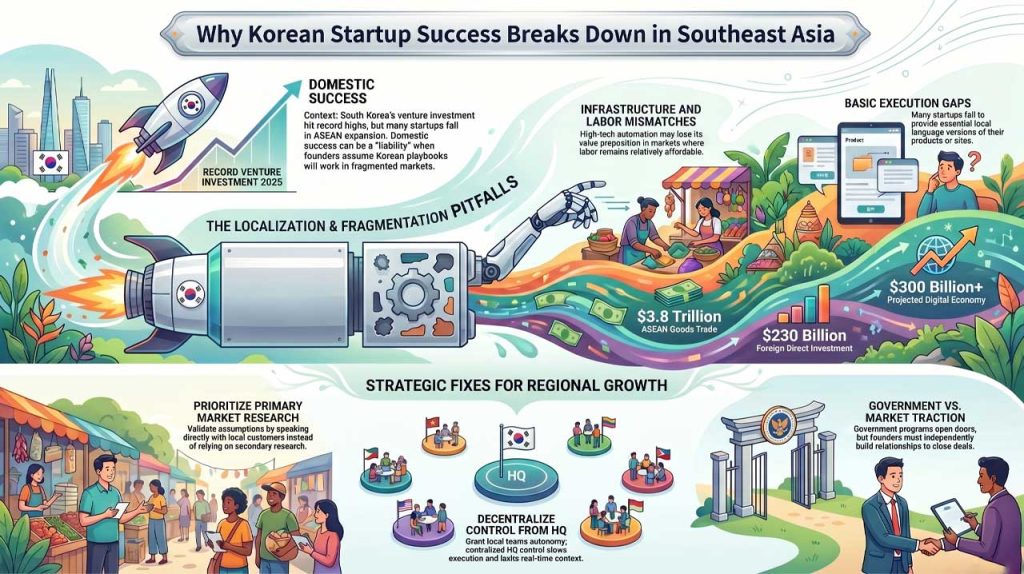
ASEAN’s combined economy continues expanding rapidly. ASEAN statistics show the region reached more than USD 3.8 trillion in goods trade and over USD 230 billion in foreign direct investment in 2024. Google, Temasek, and Bain’s latest e-Conomy SEA report also projected Southeast Asia’s digital economy to surpass USD 300 billion in gross merchandise value.
Still, rapid growth does not remove fragmentation.
“What works in one market often does not resonate in another,”
Gang said.
He explained that many founders underestimate how differently markets inside Southeast Asia operate. Consumer behavior, pricing sensitivity, infrastructure readiness, language expectations, and procurement systems can vary sharply even within the same country.
“What works in Jakarta may not necessarily translate directly to Surabaya or secondary cities,”
he added.

Weak Localization Still Derails Market Entry
Gang said localization failures remain surprisingly common, even among technically strong startups.
“At the most basic level, it starts with fundamental execution gaps.
Some startups enter markets like Singapore without even offering an English version of their product or landing page, or Indonesia without Bahasa Indonesia.”
According to him, these issues often reflect severe organizational problems rather than simple translation oversights.
“This reflects a deeper issue, insufficient localization and a lack of understanding of the end user.”
The challenge becomes even more visible in sectors requiring operational integration. Gang then recalled when he once mentored a Korean MediaTech startup. The company had become a domestic market leader at the time. But then, even with a technically competitive product, the startup still struggled to gain traction in Singapore.
The issue, according to Gang, was not the product quality. It was the market’s readiness instead.
“Adopting the solution required significant changes to existing infrastructure and workforce retraining, and the perceived switching costs outweighed the immediate benefits.”
In other cases, labor economics also reshape the value proposition. Automation technologies that generate strong return on investment in Korea or Singapore may lose urgency in countries where labor remains relatively affordable.
“For the startups to succeed, they must be willing to rethink their product and business model for each market.”

Why Southeast Asia Expansion Often Breaks During Execution
On paper, many startups present highly structured regional expansion strategies. Now, Gang believes the real problem often emerges once those plans encounter operational reality.
“The divergence often begins right at the start.”
According to him, many expansion plans rely too heavily on secondary research and assumptions carried over from the home market. Once founders begin engaging real customers, the differences become immediately visible.
“Customer behavior, purchasing processes, pricing sensitivity, and even problem definitions can differ significantly from what was expected.”
He then emphasized that primary research remains one of the most overlooked requirements in overseas expansion.
“Speaking directly with potential customers, partners, and stakeholders helps validate assumptions early and reduces the risk of costly missteps.”
Gang added that successful expansion strategies tend to share one common trait.
“The strategies that tend to hold up in execution are those built on data-driven decisions, not just structured thinking.”
HQ-Controlled Expansion Can Slow Overseas Growth
Another recurring issue involves organizational structure.
Gang said many Korean startups attempt to control overseas expansion remotely while expecting local teams to execute quickly inside unfamiliar markets.
“A common mistake that many startups make is centralizing control at HQ while expecting the overseas team to execute.”
In practice, this often slows execution and weakens decision-making quality because headquarters lack real-time local context.
“Without sufficient autonomy, even strong local hires become ineffective.”
He also pointed to what he described as a “resource commitment gap.” Because domestic operations usually continue outperforming overseas markets in the early stages, resources and management attention frequently get pulled back to Korea whenever urgent issues emerge at home.
“This creates a pattern of inconsistent focus, which undermines momentum in the new market,”
Gang explained.
According to him, successful overseas expansion usually requires dedicated leadership ownership, protected budgets, and realistic execution timelines that are not constantly interrupted by short-term domestic priorities.
Government Programs Create Access, But Not Market Traction
South Korea has significantly expanded startup globalization initiatives in recent years. In March 2026, the government announced plans to establish Korea’s first overseas global fund-of-funds in Singapore, targeting USD 300 million by 2030 to support AI and deep-tech startups while connecting Korean ventures with international investors across Asia.
K-Startup Center Singapore also supports Korean startups through localization programs, market access initiatives, and regional ecosystem networking.
Gang acknowledged these support systems remain valuable, especially for helping startups enter regional ecosystems more quickly. But he still cautioned against depending too heavily on government-backed expansion frameworks alone.
“Government programmes can only open doors, but they do not close deals.”
He believed that startups still need to build relationships independently, navigate local procurement environments, hire effectively, and adapt their go-to-market strategy based on actual market conditions.
“A common pitfall I observe is some startups have a tendency to plan their activities around the availability of government support,”
he added.
Gang believes the startups achieving stronger regional outcomes are usually the ones already committed to expansion before external support becomes available.
Southeast Asia Expansion Is Not a Copy-Paste Exercise
As Korea deepens economic and startup cooperation with ASEAN, more founders will continue looking south for growth opportunities.
Singapore alone continues attracting around 60% to 70% of Southeast Asia’s venture funding, while Korea and ASEAN recently elevated their relationship into a Comprehensive Strategic Partnership.
Yet Southeast Asia expansion still demands a very different operating mindset compared with scaling domestically inside Korea.
And for Gang, one of the most important mindset shifts is recognizing that international expansion is far from just another milestone, or a mere reward for domestic success.
“Ultimately, the startups that navigate this phase well are those that treat each market not as an extension of their home base, but as a distinct environment requiring localized strategy, partnerships, and sometimes even product adaptation.”
— Gang Chern Sun, Programme Director, KOSME Singapore.
Key Takeaway
- Strong domestic product-market fit in Korea does not guarantee traction across Southeast Asia.
- ASEAN markets remain highly fragmented, with major differences in customer behavior, labor economics, infrastructure readiness, and operational dynamics.
- Weak localization remains a major execution failure, including language support, pricing adaptation, and customer understanding.
- HQ-led decision-making often slows overseas execution, especially when local teams lack autonomy and resources.
- Government support programs help create access, but founders still need strong market validation, relationship-building, and operational commitment.
- Successful cross-border startup scaling depends on treating each Southeast Asian market as a distinct operating environment, not a direct extension of Korea.
– Stay Ahead in Korea’s Startup Scene –
Get real-time insights, funding updates, and policy shifts shaping Korea’s innovation ecosystem.
➡️ Follow KoreaTechDesk on LinkedIn, X (Twitter), Threads, Bluesky, Telegram, Facebook, and WhatsApp Channel.
🤝 Looking to connect with verified Korean companies building globally?
Explore curated company profiles and request direct introductions through beSUCCESS Connect.