

For years, discussions around Korea’s content industry focused on creating the next hit drama, expanding global distribution, or investing in larger storage systems to accommodate rapidly growing video libraries. Today, a different challenge is beginning to shape the industry’s future. Success increasingly depends on how quickly organizations can rediscover and reuse the content they already own.
This shift reflects a broader change across the global media industry. Artificial intelligence is making content production faster, while audience consumption habits continue evolving toward shorter, more personalized formats. As media libraries expand into petabyte-scale archives, the commercial value of existing content is becoming just as important as producing new material.
The Archive Has Become a Business Asset
South Korea’s media industry has accumulated decades of valuable digital assets across broadcasters, entertainment companies, production studios, and public institutions. These collections contain interviews, documentaries, entertainment programs, historical footage, educational content, and production materials that often remain underutilized after their original release.
The challenge is no longer preserving these assets.
Instead, organizations are searching for practical ways to transform dormant archives into resources that support new productions, digital services, and commercial opportunities.
This shift builds on a broader trend KoreaTechDesk explored earlier in our coverage of enterprise AI adoption in Korea’s media industry, where deployment challenges increasingly revolve around integrating AI into real production environments rather than simply adopting new models.
As organizations move beyond implementation, attention is now turning to a different question: how to unlock business value from content they have accumulated over many years.
Seungki Park, Team Lead of the Platform Tech Team at Catenoid, works on the technologies behind the company’s AI-powered media asset management platform, Loomex. Drawing on his experience supporting enterprise media workflows, Park believes the industry’s priorities are fundamentally changing.
“The challenge in the media market has clearly shifted beyond simple storage and preservation to how organizations can extract real value from their accumulated media assets and utilize them in real time.”
His perspective suggests the conversation around media asset management is entering a new phase. Instead of measuring success by storage capacity or preservation alone, organizations are increasingly evaluating how effectively archived content can be rediscovered, reused, and transformed into ongoing business value.

Short-Form Consumption Is Raising the Value of Existing Content
The commercial importance of archive reuse is becoming clearer as audience behavior continues to evolve.
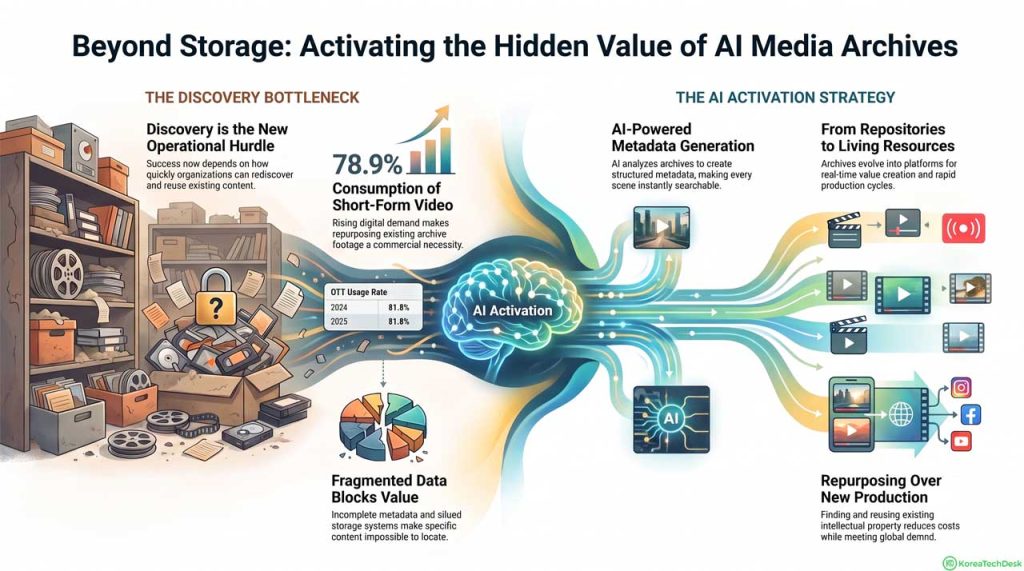
According to the Korea Media and Communications Commission’s 2025 Media Panel Survey, 81.8% of Koreans now use over-the-top (OTT) services. Among those users, short-form video has become the most widely consumed content category, reaching 78.9%, compared with 70.7% a year earlier.
This trend creates a different production environment for media companies.
Rather than producing every piece of content from scratch, broadcasters and entertainment companies can increasingly repurpose existing interviews, performances, documentaries, behind-the-scenes footage, and historical materials into new formats designed for digital audiences.
That opportunity, however, depends on one critical capability: finding the right content quickly.

Why Discovery Has Become the Real Bottleneck
As archives continue expanding, many organizations face an unexpected problem.
Content often exists across multiple storage environments, yet locating a specific scene, person, or event remains difficult because metadata is incomplete, inconsistent, or missing entirely.
Park believes this issue has become a greater operational concern than storage capacity itself.
“The competitive differentiator is no longer simply where to store data, but rather how to quickly discover and utilize the value hidden within vast amounts of data.”
This represents an important change in enterprise thinking.
Storage infrastructure protects information, but searchable information generates business value.
That distinction is becoming increasingly relevant as organizations seek faster production cycles and more efficient use of existing intellectual property.

AI Is Making Existing Libraries More Usable
Across the global media industry, AI discussions often emphasize image generation or automated video creation.
In practice, many organizations are finding greater value in helping employees work with content that already exists.
Deloitte has noted that media companies are increasingly applying AI to metadata generation, archive discovery, localization, and content repurposing rather than limiting adoption to generative content creation alone. Similarly, PwC has argued that structured metadata is becoming a strategic business asset because it strengthens search, recommendations, monetization, and operational decision-making.
Park sees the same transition unfolding inside enterprise media environments.
“Next-generation AI-powered media asset management services are evolving from passive storage repositories into platforms for value creation and real-time utilization. The key lies in transforming data that was previously left unused into living resources that can be instantly activated and accessed whenever needed through AI.”
Park’s observation reflects a broader change in how enterprise media systems are being evaluated. Storage remains essential, but organizations increasingly expect their archives to support faster production, content repurposing, and new commercial opportunities instead of serving solely as long-term repositories.
A Practical Example in Real Production Case
The operational impact becomes clearer when applied to real production environments.
Park shared one example involving an entertainment company whose media assets had become fragmented across multiple storage systems. Rather than physically consolidating every file into one repository, the company adopted a different approach.
“Rather than physically consolidating media assets that had been fragmented across multiple storage systems, the company used Loomex to logically integrate them, improving enterprise-wide asset visibility.”
The company then introduced AI-powered analysis to make those archives more usable across the organization.
“By applying AI-powered analysis, the company enhanced content reusability and significantly improved overall digital asset management workflows.”
The outcome extended beyond better organization. Assets that had previously been difficult to locate became easier to discover and reuse, allowing existing content to contribute more effectively to new production and day-to-day operations.
Global Demand Is Increasing as Production Pressures Grow
The business case for archive reuse is becoming stronger beyond Korea as well.
According to Ampere Analysis, cited by TV Tech, international demand for South Korean television and film continues to expand. At the same time, new commissioning activity has slowed across several markets, increasing pressure on content owners to maximize the value of existing intellectual property.
This creates an important strategic opportunity.
Organizations capable of discovering valuable archive materials quickly may reduce production costs, respond faster to changing audience preferences, and extend the commercial life of existing content libraries.
In that environment, archive management becomes more than an operational function.
It becomes part of the content strategy.
The Next Competitive Advantage May Already Exist
Artificial intelligence is reshaping many aspects of media production, but its most immediate business value may lie in helping organizations better understand and use the assets they already have.
As content libraries continue to grow, the key question is becoming increasingly clear: which organizations can turn decades of accumulated footage into active, usable assets rather than leaving them stored away in digital warehouses?
Because in the end, for Korea’s media technology ecosystem, this shift goes beyond just another application of AI. It signals a broader change in how content itself can generate long-term value for enterprises.
Key Takeaway
- Korea’s media industry is moving beyond archive preservation toward archive activation, making content discovery and reuse increasingly important.
- Short-form consumption continues to increase, creating stronger commercial incentives to repurpose existing media assets rather than relying solely on new production.
- The industry’s competitive focus is shifting toward discovering and utilizing hidden value inside existing archives, redefining how organizations approach content strategy and operations.
- Multimodal AI and intelligent media asset management platforms are enabling organizations to locate, analyze, and reuse content more efficiently across production workflows.
- For founders, investors, and enterprise technology leaders, the opportunity extends beyond AI-generated content to technologies that unlock business value from previously underutilized digital assets.
– Stay Ahead in Korea’s Startup Scene –
Get real-time insights, funding updates, and policy shifts shaping Korea’s innovation ecosystem.
➡️ Follow KoreaTechDesk on LinkedIn, X (Twitter), Threads, Bluesky, Telegram, Facebook, and WhatsApp Channel.
🤝 Looking to connect with verified Korean companies building globally?
Explore curated company profiles and request direct introductions through beSUCCESS Connect.