

Korea’s campuses are already buzzing with entrepreneurial energy. Startup classes fill lecture halls, student venture clubs are multiplying, and commercialization programs backed by universities and government agencies are drawing record participation.
Beneath this surge of activity, however, lies a more fundamental question: Is the university ecosystem cultivating founders who can build enduring companies, or is it becoming exceptionally good at creating startup experiences that end with a presentation slide and a pitch?
Korea’s Universities Are Producing More Startup Activity Than Ever
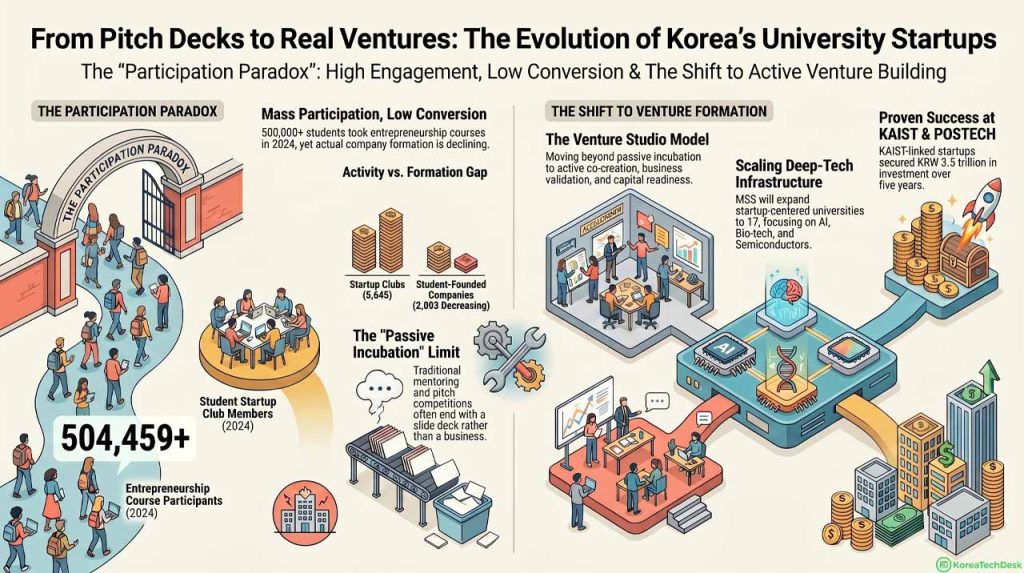
South Korea has spent years turning universities into important pillars of its startup ecosystem. According to the Korea Institute of Startup and Entrepreneurship Development (KISED), Korean universities operated 16,697 entrepreneurship courses with 504,459 participants as of the end of 2024.
Not only that, but campus startup communities have also expanded. KISED recorded 5,645 startup clubs with 42,340 student members nationwide.
These numbers suggest that startup education has moved well beyond a niche activity. Entrepreneurship is becoming a mainstream experience for Korean students and researchers.
At the same time, the conversion into company formation appears more complicated. KISED data showed 2,083 student-founded companies and 409 faculty-founded companies in 2024, both lower than the previous year.
The figures point to a clear disconnect between rising startup participation and actual company formation. As startup participation grows, what does it actually take to help students and researchers become founders capable of building sustainable businesses?

Founder Potential Often Appears Earlier Than Universities Realize
Tanachai Kulsomboonsin, CEO and co-founder of Canvas Ventures International and former innovation strategist at Thailand’s National Innovation Agency believes that universities are uniquely positioned to identify entrepreneurial potential before formal startup activity even begins.
Drawing from his extensive experience of working on university entrepreneurship and venture development programs, Tanachai told KoreaTechDesk during a discussion on startup ecosystem challenges,
“The strongest founders often appear before they know they are founders.”
He believes universities sit at the earliest point of venture creation because they gather students and researchers with technical expertise, creative capability, deep curiosity, and market insight.
And that perspective increasingly aligns with South Korea’s policy direction.
The Ministry of SMEs and Startups (MSS) announced plans to expand startup-centered universities from 11 to 17 and launch three Deep-Tech Specialized Startup-Centered Universities in 2026. The initiative aims to strengthen startup pipelines around advanced technologies, including artificial intelligence, biotechnology, semiconductors, mobility, and other strategic sectors.
This policy expansion reflects an important shift. Universities are no longer being viewed simply as educational institutions. They are increasingly becoming founder-development infrastructure.

Why Passive Incubation Models Have Limits
As universities take on a larger role in founder development, Tanachai argues that many traditional support models still stop short of actual venture formation.
“Traditional university incubation is usually too passive.”
Incubators can provide working space, mentoring, and networking opportunities. Startup competitions and demo days can help founders gain visibility and confidence. However, those activities alone do not necessarily prepare founders for the realities of building companies.
“The university should not be the last stop before a pitch competition. It should be the first place where investable founders are discovered.”
That distinction may become increasingly relevant for South Korea’s deep-tech ambitions.
Deep-tech startups often require longer development timelines, stronger intellectual property strategies, specialized teams, regulatory understanding, and significant capital requirements. These demands can exceed what conventional incubation programs were originally designed to provide.
Why Venture Studios Are Gaining Attention in Founder Development
The venture studio model is attracting attention because it takes a more active role in company creation.
Through Spectrum Labs, Canvas Ventures International works with universities including BUSEM and CCI SWU in Thailand to identify founder potential early and help shape companies through business validation, intellectual property structure, business model development, unit economics, and capital readiness.
“The goal is not to produce more pitch decks,”
Tanachai said.
“The goal is to de-risk early ventures and shorten the path from concept to market.”
Globally, similar approaches are also emerging. In June 2025, MIT launched its Proto Ventures Playbook, describing how venture builders work alongside researchers and graduate students to identify commercial opportunities and co-create new ventures.
The model reflects a broader understanding that startup formation often requires operational support beyond classroom education and mentoring sessions.

Korea Already Has Examples of University-Led Venture Formation
Now, South Korea is definitely not starting from scratch.
KAIST reported in June that startups linked to its research ecosystem secured KRW 3.5 trillion in cumulative domestic and overseas investment over the previous five years. The institute has increasingly positioned itself as a deep-tech startup ecosystem spanning artificial intelligence, semiconductors, bio-health, and future mobility.
POSTECH is also expanding a full-cycle startup support system that covers entrepreneurship education, early investment, global expansion, and alumni networks. According to the university, POSTECH Holdings has invested KRW 55.5 billion in 171 companies and helped attract KRW 648.4 billion in follow-on investment.
These examples suggest that Korean universities can become effective venture formation systems when research capability, investment pathways, commercialization support, and entrepreneurial communities reinforce one another.
The challenge now is whether these approaches can be adopted more broadly across the university ecosystem.
The Next Test Is Founder Readiness
In the end, as startup activity on campus continues to grow, South Korea’s universities already possess substantial startup infrastructure. Students have greater access to entrepreneurship education than ever before, and government support for campus startups continues to expand.
So the next critical challenge now lies in founder readiness.
Universities may increasingly be judged not by the number of startup classes they offer or the number of competitions they organize, but by how effectively they help students and researchers build teams, validate markets, structure intellectual property, understand capital requirements, and create businesses capable of surviving beyond campus.
Because startup ecosystems ultimately need more than mere startup experiences. They need founders who can turn ideas into companies that investors, customers, and markets are willing to trust.
Key Takeaway
- Korean universities recorded more than 16,000 entrepreneurship courses and over 500,000 participants in 2024, showing that startup exposure is already widespread.
- Student-founded and faculty-founded companies declined in 2024 despite growing startup participation, raising questions about venture-formation quality.
- MSS plans to expand startup-centered universities and launch Deep-Tech Specialized Startup-Centered Universities in 2026, further positioning universities as founder-development infrastructure.
- Universities may create greater long-term impact by identifying and developing investable founders early rather than limiting entrepreneurship support to competitions and passive incubation programs.
- The venture studio model focuses on company building through validation, intellectual property strategy, team formation, and capital readiness rather than startup events alone.
- KAIST and POSTECH demonstrate that university ecosystems can generate meaningful venture outcomes when research, commercialization, investment, and founder support operate as an integrated system.
- The next stage of Korea’s university entrepreneurship strategy may depend on its ability to produce venture-ready founders rather than simply increasing startup participation.
– Stay Ahead in Korea’s Startup Scene –
Get real-time insights, funding updates, and policy shifts shaping Korea’s innovation ecosystem.
➡️ Follow KoreaTechDesk on LinkedIn, X (Twitter), Threads, Bluesky, Telegram, Facebook, and WhatsApp Channel.
🤝 Looking to connect with verified Korean companies building globally?
Explore curated company profiles and request direct introductions through beSUCCESS Connect.