
Startup ecosystems across Asia are becoming bigger, louder, and better funded. Governments are announcing new programs, venture funds are expanding again, and startup events continue filling convention halls across the region. But behind the visible momentum, a harder question is starting to emerge for founders and investors alike: how much of this activity is actually producing sustainable companies?
Increasingly, ecosystem operators are now warning that startup ecosystems may be measuring visibility more effectively than they measure conversion, growth, and long-term market outcomes.
Korea’s Startup Ecosystem Is Growing, but the Next Test Is Conversion
South Korea’s startup ecosystem continued recovering in 2025, supported by stronger venture investment activity, expanding fund formation, and sustained unicorn growth reaching 27 companies, according to data from the Ministry of SMEs and Startups (MSS).
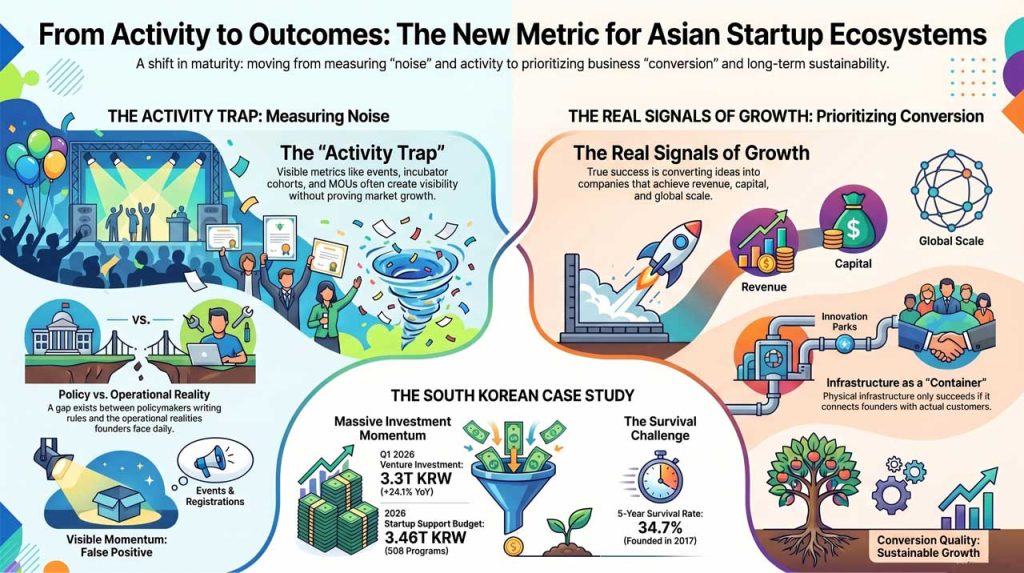
The momentum has also continued into 2026. MSS reported that first-quarter venture investment reached KRW 3.3 trillion, up 24.1% year-on-year, while new venture fund formation climbed to KRW 4.4 trillion, the highest first-quarter level recorded so far.
Government-led startup support has also continued to expand. MSS announced that South Korea’s integrated startup support program for 2026 includes KRW 3.4645 trillion across 508 startup support programs operated by 111 institutions, including central ministries and local governments.
Not only that but Seoul also ranked eighth globally in Startup Genome’s 2025 global startup ecosystem ranking, while placing first globally in knowledge accumulation and first in Asia for funding strength.
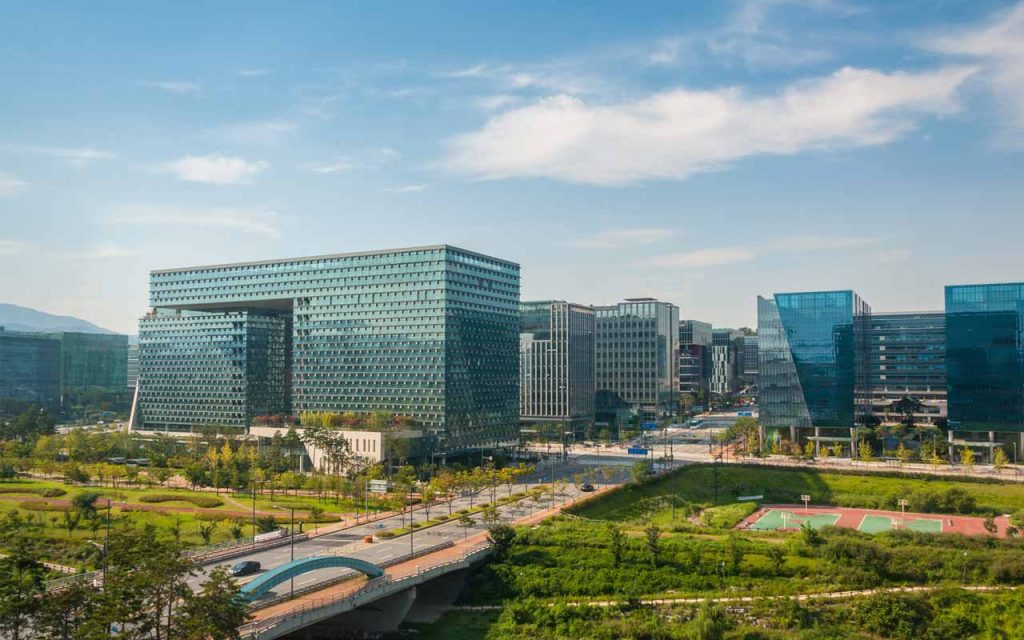
All these data and figures show an ecosystem that is incredibly active and continuously improving. But the expansion of startup infrastructure, public programs, and investment activity is also creating extra pressure to evaluate ecosystems differently.
Because now, the next challenge is no longer only how to generate startup activity, but how to convert that activity into durable business outcomes.
Why Startup Ecosystem Activity Alone Can Become Misleading
According to Tanachai Kulsomboonsin, CEO and co-founder of Canvas Ventures International and a former innovation strategist at Thailand’s National Innovation Agency, where he worked on regional innovation and ecosystem development initiatives, many startup ecosystems still confuse visible activity with measurable progress.
“The biggest false positive is activity without conversion,”
Tanachai told KoreaTechDesk in an exclusive interview.

He argued that those indicators may create visibility, but they do not automatically prove that startups are building customers, raising capital, strengthening teams, or reaching scalable markets.
“For me, the real signal is simple: are we converting talent into founders, ideas into companies, and companies into revenue, capital, and scale?”
he said.
That distinction is becoming increasingly relevant across Asia’s startup ecosystem development strategies. According to the OECD’s Start-up Asia report published in 2025, Asian economies have become more active in startup policy formation, financing support, and ecosystem-building programs.
However, the organization also noted that governments still face challenges in evaluating ecosystem effectiveness, strengthening startup density, and connecting startup measures to real production and market growth.
The report added that startup opportunities across Asia still remain heavily concentrated in capital cities despite increasing public investment in regional ecosystems.
The Gap Between Startup Policy and Startup Reality
Tanachai believes one of the biggest structural problems appears when startup policy is designed too far away from startup operating reality.
“The biggest gap is that people who write startup policy often have never operated startups, while the people who actually build startups are rarely in the room when policy is written,”
he explained.
“That is why policy often looks good on paper but misses execution reality: fundraising, cap tables, ESOP, speed, talent, founder risk, and market access.”
His criticism reflects a broader regional discussion currently happening in Thailand around the country’s proposed Startup Promotion Act. Thailand has been discussing startup-specific legal reforms for several years, including efforts to modernize regulations tied to startup financing, investment structures, and ecosystem coordination.
Public consultation documents published through Thailand’s legal consultation system in late 2025 showed strong support for a dedicated startup law. At the same time, participants also raised concerns about regulatory practicality, implementation speed, and the need for startup policies that reflect real operating conditions faced by founders and investors.
The debate highlights a challenge that extends beyond Thailand. It shows that across Asia, startup ecosystems are becoming more institutionally organized, but founders and investors increasingly expect ecosystem policies to move closer to actual business realities rather than symbolic support structures.

Why Infrastructure Alone Does Not Build Strong Startup Ecosystems
An intriguing caution also came from Tanachai, highlighting the idea that startup ecosystems often overestimate the power of infrastructure itself.
“Infrastructure is only the container. The ecosystem is the operating system.”
Tanachai argued that innovation centers, co-working spaces, grants, and startup programs can help attract attention, but sustainable startup ecosystems only emerge when those systems consistently connect founders with capital, talent, customers, operators, and market access.
The distinction matters because many Asian governments, including South Korea, continue investing heavily in regional startup ecosystems, innovation parks, and entrepreneurship initiatives outside capital cities. While in fact, the long-term success of those projects may depend less on physical infrastructure volume and more on whether ecosystems can continuously produce investable companies capable of surviving beyond early-stage support cycles.
Korea’s own startup statistics already show that startup activity and long-term business durability are not always the same thing. Statistics Korea reported that the five-year survival rate for companies founded in 2017 and still operating in 2022 stood at 34.7%.
Now, this issue does not necessarily suggest ecosystem weakness. Instead, it actually reflects how startup ecosystem maturity increasingly depends on conversion quality rather than activity volume alone.
Bigger Funding Rounds Are Becoming a More Important Ecosystem Signal
For Tanachai, one of the clearest signals of ecosystem improvement is not the number of startup events or registered companies, but the ability of startups to raise larger funding rounds and sustain growth over time.
“The signals I trust most are bigger ticket size and growth.
If an ecosystem is improving, startups should be able to raise larger investment rounds, not only small grants or early-stage support.”
He added that stronger ecosystems eventually attract capital beyond their immediate local environment.
“Ecosystem progress is not measured by the number of events or registered startups.
It is measured by whether companies can raise bigger rounds, grow faster, and attract capital beyond the local ecosystem.”
That perspective is becoming increasingly relevant for Korea as the country pushes toward its goal of becoming one of the world’s top four venture capital powerhouses.
As funding pools expand and startup support systems mature, ecosystem quality may increasingly be judged by long-term company growth, regional expansion capability, and investor confidence rather than ecosystem visibility alone.
The Next Stage of Startup Ecosystem Growth May Depend on Outcome Discipline
Now, Asia’s startup ecosystems are no longer in an early awareness stage. Countries across the region already operate accelerators, startup campuses, innovation agencies, venture funds, incubation programs, and public-private ecosystem initiatives.
So, the harder question now is whether those systems can consistently produce companies capable of surviving competitive markets, raising larger rounds, and scaling beyond local ecosystems.
And that transition may become especially important for South Korea.
The country already possesses strong startup infrastructure, active public support, global technology capability, and deep venture capital momentum. The next stage of its ecosystem maturity may depend less on generating more startup activity and more on measuring which parts of the ecosystem actually convert into sustainable growth.
Key Takeaway
- Startup ecosystem activity does not automatically equal startup ecosystem strength.
- According to MSS, South Korea recorded KRW 13.6 trillion in venture investment in 2025 and KRW 3.4645 trillion in startup support programs for 2026, showing strong ecosystem momentum.
- Tanachai Kulsomboonsin of Canvas Ventures International argues that ecosystems should focus on conversion metrics, including revenue growth, larger funding rounds, customer growth, and market expansion.
- Events, startup registrations, incubator cohorts, and MOUs may increase visibility, but they do not automatically prove ecosystem quality.
- OECD’s 2025 Start-up Asia report also highlighted the need for stronger evaluation frameworks and better links between startup policy and market outcomes across Asian startup ecosystems.
- The next stage of Korea startup ecosystem growth may depend on how effectively public programs, venture capital, universities, and regional hubs convert activity into sustainable companies and scalable businesses.
– Stay Ahead in Korea’s Startup Scene –
Get real-time insights, funding updates, and policy shifts shaping Korea’s innovation ecosystem.
➡️ Follow KoreaTechDesk on LinkedIn, X (Twitter), Threads, Bluesky, Telegram, Facebook, and WhatsApp Channel.
🤝 Looking to connect with verified Korean companies building globally?
Explore curated company profiles and request direct introductions through beSUCCESS Connect.