

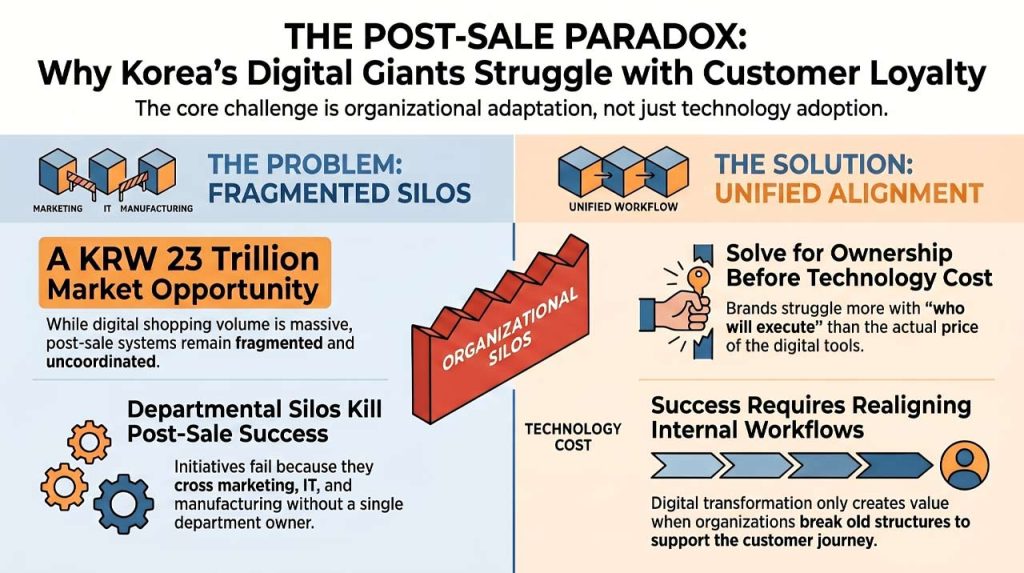
South Korea operates one of the world’s most digitally connected consumer markets. Online shopping transaction value reached KRW 23.03 Trillion in July 2025, according to official government data, while mobile shopping alone accounted for KRW 18.15 Trillion. Yet many Korean companies still struggle to maintain coordinated customer relationships after the sale because the operational systems behind those experiences often remain fragmented across departments.
The Disconnect Inside Korea’s Digital Commerce Market Operation
The digital adoption in South Korea’s consumer market has been rapidly developing. According to Agriculture and Agri-Food Canada, citing Euromonitor data, South Korea became the world’s fifth-largest e-commerce retail market in 2024, generating approximately USD 178.9 billion in e-commerce sales. Mobile commerce alone exceeded USD 100 billion.
But after the transactions are successfully completed, then come the unexpected challenges.
As Korean brands experiment with post-sale engagement systems tied to memberships, digital communities, authenticated products, and connected customer experiences, many companies are discovering that maintaining those systems requires coordination across teams that traditionally operate independently.
Continuing the earlier discussion, Chaeun Jung, Brand Lead at RIBO’s, told KoreaTechDesk that the operational barrier often emerges long before technology deployment becomes the central issue.
“Cost is still an important factor, of course.
But from my experience, many Korean brands are often more concerned with the question of ‘who inside the organization can actually execute this now?’ rather than only the cost itself.”
That question has become increasingly relevant as brands attempt to build longer-term digital relationships tied to physical products and post-sale customer experiences.

Why Post-Sale Customer Infrastructure Crosses Too Many Departments
Many customer-facing digital tools can be launched and managed by a single department. Loyalty applications, social media campaigns, or CRM initiatives are often controlled primarily by marketing or customer management teams.
The post-sale customer systems linked to physical products, in fact, operate differently.
Jung explained that these initiatives frequently require collaboration across product planning, manufacturing, packaging, e-commerce, customer support, IT integration, and marketing operations at the same time.
“Product development timelines and marketing campaign timelines do not align.”
That operational mismatch creates friction inside organizations even when leadership sees strategic value in the initiative itself.
A product team may focus on packaging schedules and manufacturing requirements. Marketing teams prioritize campaign timing and customer engagement metrics. Customer support teams must prepare for operational issues after launch, while IT departments review platform integration and security requirements separately.
As a result, companies can struggle to move beyond pilot projects or isolated campaigns because no single department owns the full post-sale customer journey.
Digital Transformation Often Fails When Companies Keep Old Organizational Structures
The broader problem is not limited to post-sale commerce systems alone.
Boston Consulting Group stated in its 2025 research on end-to-end reinvention that many companies fail to unlock meaningful value from new technologies because they continue applying them to outdated workflows and fragmented governance structures.
BCG also noted that only 4% of more than 1,000 companies studied had developed advanced AI and generative AI capabilities across functions that consistently created substantial value.
The same pattern increasingly appears inside customer engagement infrastructure.
A company may deploy authentication tools, customer engagement platforms, or connected product systems. However, the initiative can still stall operationally if the internal workflow remains divided across disconnected departments with separate KPIs, timelines, and decision structures.
Jung believes this confusion also affects how executives initially evaluate post-sale engagement systems.
“At first, the difference between a simple NFC link and secure ownership-based access is not always clear.”
The distinction matters because ownership-linked systems require ongoing operational management after launch, not just deployment of a digital feature.

Korean Companies Are Still Navigating Uneven Digital Transformation
Research from the Korea Institute for Industrial Economics & Trade (KIET) suggests that South Korea’s industrial digital transformation level still remains uneven despite the country’s strong digital infrastructure and consumer technology adoption.
KIET’s 2024 report stated that digital transformation levels across Korean industries often remain at the introduction or application stage compared with leading global benchmarks. The report also noted substantial variation depending on company size and industry sector.
The Korea Information Society Development Institute (KISDI) similarly found in 2026 research that firms actively using digital technologies showed stronger employment and revenue growth than firms that did not. KISDI also reported that digital technology adoption was associated with higher rates of business restructuring and expansion into new business areas.
Those findings suggest the core challenge may no longer be simple technology adoption. The more difficult issue is organizational adaptation around the technology itself.
Samsung SDS reached a similar conclusion in its analysis of digital transformation strategy. The company stated that successful transformation efforts depend heavily on collaboration systems, cross-functional structures, and synchronization between IT and business operations. It also warned that siloed organizations often weaken internal collaboration and slow execution.
That problem becomes especially visible in post-sale customer systems because the customer relationship no longer ends at the checkout process.
Why This Matters for Startups Entering Korea’s Commerce Infrastructure Market
The issue also carries broader implications for startups building commerce infrastructure tools in South Korea.
Many early-stage companies entering the Korean market focus heavily on product functionality, automation, or technical differentiation. But post-sale engagement systems often require startups to navigate complex internal organizational structures inside enterprise clients.
A technically strong product may still face adoption barriers if the client organization cannot determine which department should manage implementation, ongoing operations, customer support responsibility, or long-term ownership of the initiative.
McKinsey & Company noted in its 2024 organizational transformation analysis that cross-functional team structures can significantly improve operational efficiency when implemented properly. The consulting firm argued that many future-value teams may need to be created specifically around customer or product experiences that did not previously exist inside the company.
That observation aligns closely with the operational reality emerging inside Korean commerce infrastructure projects today.
The technology itself may already be available. The harder transition is reorganizing companies around customer relationships that continue long after the initial transaction.
Korea’s Next Commerce Challenge May Be Organizational, Not Technical
Yes, South Korea already possesses the digital consumer behavior, mobile infrastructure, and e-commerce scale required to support more advanced post-sale customer systems.
That is why the larger challenge now appears increasingly organizational.
As brands attempt to connect physical products with digital experiences, customer communities, authenticated ownership systems, and long-term engagement infrastructure, the question is shifting merely beyond technology adoption alone.
Because now the issue of which startups need to solve is more on: which teams inside the organization are responsible for maintaining the customer relationship after the product has already been sold?
That distinction may ultimately determine which companies successfully build sustainable post-sale customer systems in the next phase of Korea’s commerce infrastructure evolution.
Key Takeaway
- South Korea’s e-commerce market is already highly digitalized, with online shopping transaction value exceeding 23 trillion won in July 2025
- Many Korean companies still struggle operationally with post-sale customer systems because implementation crosses multiple departments simultaneously
- Organizational fragmentation often creates larger barriers than technology cost alone in post-sale customer infrastructure projects
- Product teams, marketing departments, IT units, e-commerce operations, and customer support frequently operate on separate timelines and KPIs
- Research from BCG, McKinsey, KIET, and Samsung SDS suggests digital tools create value only when organizations restructure around them effectively
- Commerce infrastructure startups entering Korea may face internal execution barriers inside client organizations even when product interest is strong
- The next phase of Korea’s commerce infrastructure evolution may depend less on technology availability and more on organizational readiness to manage long-term customer relationships after the sale
– Stay Ahead in Korea’s Startup Scene –
Get real-time insights, funding updates, and policy shifts shaping Korea’s innovation ecosystem.
➡️ Follow KoreaTechDesk on LinkedIn, X (Twitter), Threads, Bluesky, Telegram, Facebook, and WhatsApp Channel.
🤝 Looking to connect with verified Korean companies building globally?
Explore curated company profiles and request direct introductions through beSUCCESS Connect.