
Artificial intelligence adoption is accelerating across global consumer markets, but confidence in AI systems is not growing at the same pace. As startups race to integrate generative AI into beauty apps, recommendation engines, healthcare platforms, financial tools, and consumer services, a new challenge is beginning to emerge underneath the rapid expansion: users are starting to question not only the answers produced by AI systems, but also the credibility of the systems interpreting those answers.
Consumer AI Adoption Is Rising Faster Than Consumer Trust
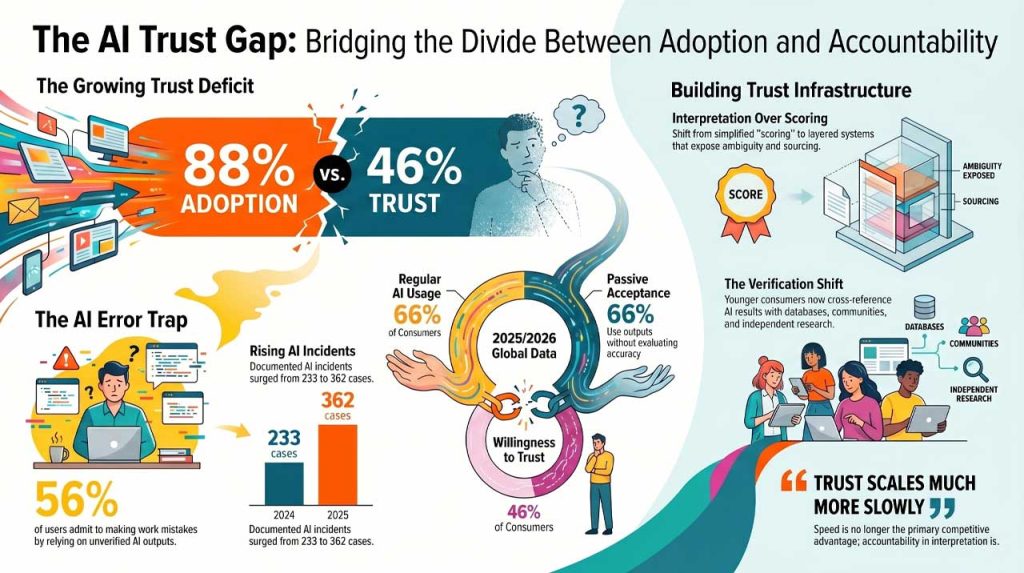
The speed of AI adoption has increased sharply over the past year. Stanford University’s 2026 AI Index Report found that organizational AI adoption reached 88%, while generative AI achieved population adoption faster than the personal computer or internet. At the same time, documented AI incidents rose from 233 cases in 2024 to 362 cases in 2025.
Furthermore, the gap between usage and trust is becoming even more visible globally.
A 2025 global study conducted by KPMG and the University of Melbourne involving more than 48,000 participants across 47 countries found that 66% of respondents now use AI regularly. Yet only 46% said they are willing to trust AI systems. The same study also found that 66% rely on AI outputs without evaluating their accuracy, while 56% admitted making mistakes in their work because of AI.

So for consumer AI startups, the challenge is no longer simply building AI-powered features quickly. The larger issue is how those systems handle ambiguity, verification, accountability, and uncertainty once consumers begin depending on AI-generated interpretations in real-world decisions.
Why Bare Halal Approaches AI as an Interpretation System Instead of a Scoring Tool
Bare Halal founder Ilham Lahreche believes many startups are misunderstanding the difference between AI outputs and trustworthy systems.
“An AI-generated output is only an answer. A trustworthy system is a process,”
Lahreche told KoreaTechDesk in an exclusive interview.
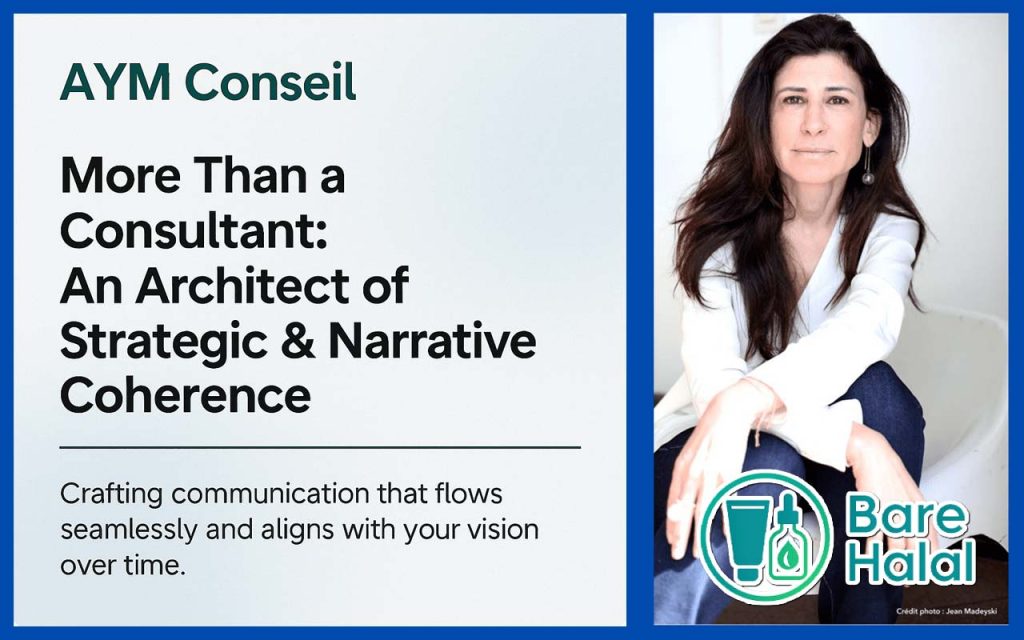
Along with her nearly three decades of experience across journalism, strategic communication, media analysis, and public-interest communication, Lahreche is also a strategic communication consultant at AYM Conseil, where she has worked on media, governance, and communication-related projects involving institutions and international partners including the Council of Europe and the European Union.
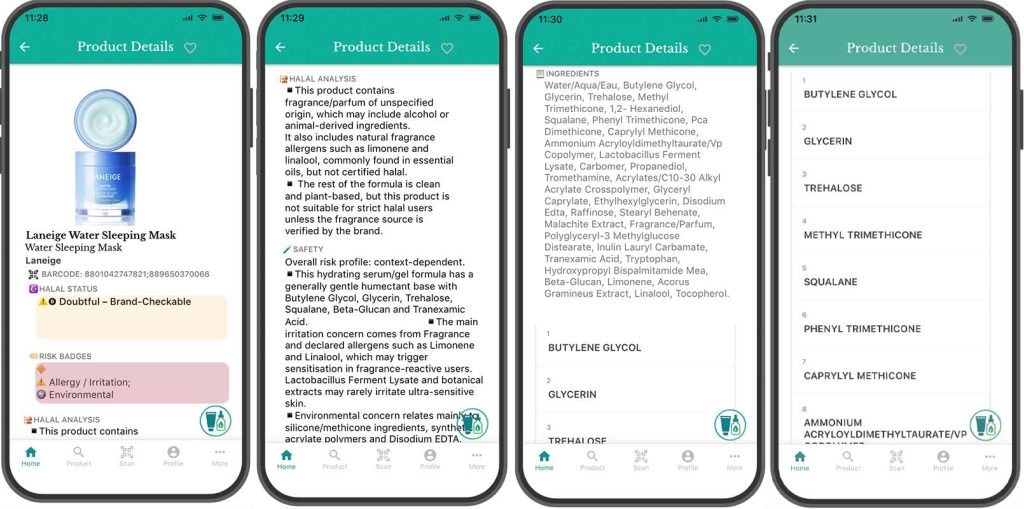
Bare Halal is an ingredient intelligence platform focused on beauty and personal care products. Instead of functioning as a simple recommendation or scoring app, the platform attempts to separate halal interpretation, safety awareness, sourcing ambiguity, and environmental considerations into distinct informational layers.
According to Lahreche, AI can accelerate ingredient parsing and pattern detection, but trust-sensitive systems still require structured interpretation rules and human oversight.
“The biggest risk is confusing output with truth.”
Her concerns has actually reflected a broader issue now affecting many consumer AI startups. As generative AI tools become more accessible, products can appear highly confident even when the underlying information remains incomplete, unverifiable, or context-dependent.
That problem becomes especially visible in consumer sectors involving health, ethics, religion, finance, or personal safety.
Ingredient Transparency Is Becoming More Complex Than Many AI Systems Assume
One of the operational problems Bare Halal faces involves incomplete disclosure and ingredient opacity.
Lahreche explained that many products disclose only partial ingredient information or broad labeling terms such as “Fragrance” or “Parfum,” which may legally represent dozens of undisclosed components inside a formulation.
According to the U.S. Food and Drug Administration, cosmetic fragrance ingredients can legally be grouped under generic labeling terms because fragrance formulas are often treated as trade secrets. At the same time, some fragrance components may still trigger allergies or sensitivities for certain users.
That creates interpretation challenges extending beyond simple ingredient identification.
“In Bare Halal, some ingredients are clearly halal-compatible, some are clearly not halal, but many sit in grey zones,”
Lahreche said.
She explained that ingredient origin, concentration, transformation process, sourcing transparency, and formulation context can all affect how the same ingredient is interpreted. In some cases, even legally compliant labeling may still leave uncertainty unresolved.
“I don’t try to erase ambiguity. I try to make it visible.”
That philosophy increasingly contrasts with many AI-powered consumer products currently competing through simplified scoring systems, instant recommendations, and high-confidence outputs.
Consumer Trust Is Shifting Toward Verification Instead of Passive Acceptance
Lahreche believes younger consumers are becoming far more verification-oriented than previous generations.
“They no longer rely only on beauty marketing, halal logos, or influencer recommendations alone.”
Instead, users now compare information across ingredient databases, AI tools, community discussions, creators, certifications, and independent research simultaneously.
This behavioral shift is creating pressure on startups operating AI-assisted systems.
“Consumers are no longer only evaluating products. They are evaluating the credibility of the systems interpreting those products,”
Lahreche explained.
And that trend is becoming increasingly important as users experience a growing information overload and trust fatigue.
McKinsey’s 2026 AI trust research found that 74% of respondents identified AI inaccuracy as a major risk concern, while 72% pointed to cybersecurity and misuse risks. Yet active mitigation efforts still lag behind the speed of AI deployment across many industries.
The issue is no longer limited to misinformation alone. Consumer-facing AI products are now being evaluated on how transparently they explain limitations, uncertainty, and accountability.

South Korea’s AI Ecosystem Is Entering the Same Trust Challenge
Now, this issue carries increasing relevance for South Korea’s startup ecosystem, especially as the AI adoption accelerates domestically.
Microsoft’s AI Economy Institute reported that South Korea recorded one of the fastest AI adoption growth rates globally in early 2026. KBS, citing Microsoft data, reported that Korea’s AI adoption rate reached 37.1% in the first quarter of 2026, lifting the country’s global ranking from 18th to 16th.
At the same time, South Korea is also moving toward stronger AI governance structures.
The Ministry of Science and ICT has positioned the country’s AI Basic Act as part of a broader framework supporting AI industry growth while strengthening safety, transparency, and oversight obligations for high-impact AI systems.
That direction mirrors what Lahreche believes will become one of the defining competitive differences in the next generation of consumer AI products.
“The real challenge is not only information access anymore.
It is accountability around interpretation.”
The Real AI Race Is Quietly Becoming a Trust Infrastructure Race
In the end, many startups still treat communication, uncertainty management, and transparency as secondary layers added after product development.
But Lahreche argues that the approach is becoming increasingly dangerous in trust-sensitive sectors.
“In sensitive sectors, overconfidence can be more dangerous than uncertainty itself.”
She believes that the AI startups that survive long term will not necessarily be the fastest at generating answers. Instead, they will be the companies capable of building systems, of which users can understand, verify, and responsibly rely on.
“AI can scale information very quickly.
Trust scales much more slowly.”— Ilham Lahreche, Founder of Bare Halal.
Key Takeaways
- Consumer AI adoption is accelerating faster than consumer trust, creating growing pressure around transparency, accountability, and interpretation quality.
- Ilham Lahreche argues that AI-generated outputs alone are insufficient for trust-sensitive consumer systems involving health, ethics, religion, or safety.
- Bare Halal approaches AI as an ingredient intelligence system, separating halal interpretation, safety awareness, sourcing ambiguity, and risk signals instead of reducing products into simplified scores.
- Younger consumers are increasingly verification-oriented, comparing AI outputs against community discussions, databases, certifications, and independent research.
- South Korea’s rapidly expanding AI ecosystem is entering the same trust challenge, as adoption growth begins colliding with governance, transparency, and oversight expectations.
- The next competitive phase for consumer AI startups may center on trust infrastructure, not only model capability or output speed.
– Stay Ahead in Korea’s Startup Scene –
Get real-time insights, funding updates, and policy shifts shaping Korea’s innovation ecosystem.
➡️ Follow KoreaTechDesk on LinkedIn, X (Twitter), Threads, Bluesky, Telegram, Facebook, and WhatsApp Channel.
🤝 Looking to connect with verified Korean companies building globally?
Explore curated company profiles and request direct introductions through beSUCCESS Connect.