

South Korea’s e-commerce product pages often look overwhelming to foreign founders entering the market for the first time. Endless vertical scrolling, dense visual layouts, layered persuasion blocks, and information-heavy product explanations can feel excessive compared to the cleaner structures commonly seen on Amazon or Western direct-to-consumer storefronts.
Yet those pages did not emerge randomly. They have actually evolved inside a very different digital commerce environment, one shaped by mobile-first consumer behavior, search-driven marketplaces, and unusually intense platform competition.
Korea’s Connected Consumer Market Shaped Its Long E-commerce Pages
Most global players wonder why long-form product pages became commercially viable much earlier in Korea than in many other countries. The answer actually stems from the country’s digital infrastructure.
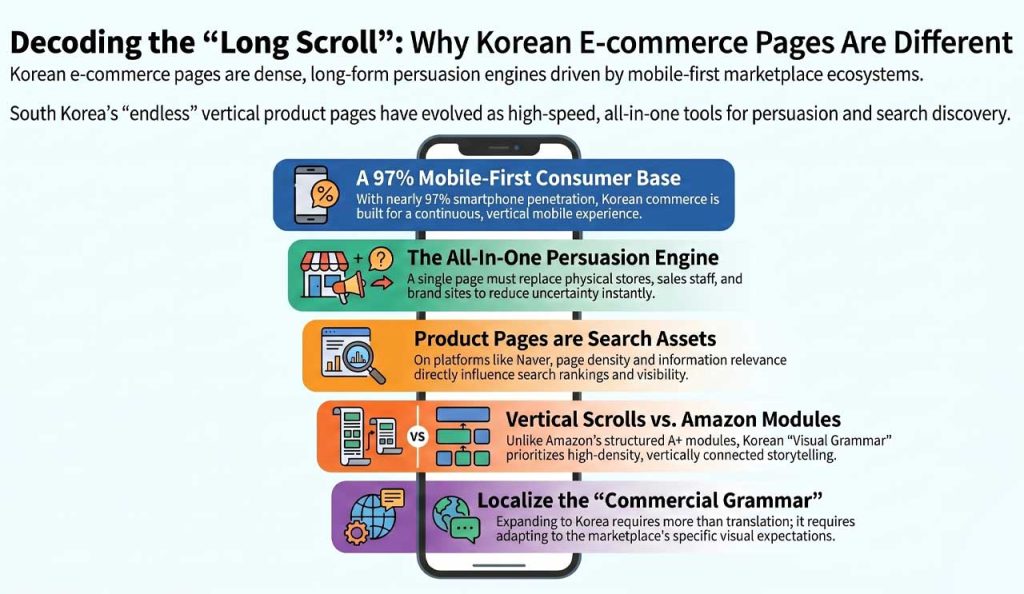
According to the OECD’s 2025 Digital Government Review, Korea recorded internet penetration of roughly 97% in 2023, while smartphone usage reached 97.3% in 2024.
At the same time, Korea’s online shopping market continues to expand rapidly. Statistics Korea (KOSTAT)reported that online shopping transaction value reached KRW 25.577 trillion (approximately USD 17.3 billion) in March 2026 alone, up 13.3% year-on-year. Mobile shopping represented 75.9% of total online shopping transactions during the same month.
That mobile-heavy environment changed how sellers approached persuasion.
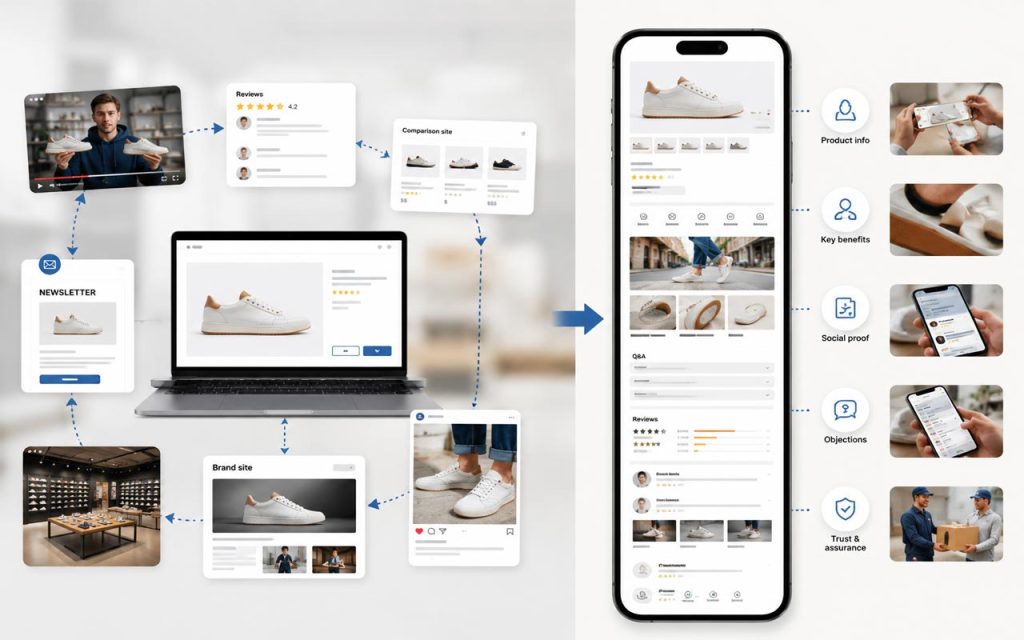
In many Western e-commerce environments, consumers often move across multiple touchpoints before purchasing. They may encounter influencer videos, external reviews, comparison sites, newsletters, physical retail stores, or standalone brand sites before reaching a product page.
On the other hand, Korea’s marketplace-driven commerce structure condensed more of that persuasion burden directly into the detail page itself.
The result was a product-page format designed not only to display information, but also to reduce uncertainty, answer objections, establish trust, and maintain attention within a single continuous mobile-scroll experience.
Naver’s Search-Centered Commerce Culture Changed How Sellers Write Product Pages
Korea’s marketplace ecosystems also developed around search visibility and platform discovery systems in ways that shaped seller behavior.
Naver Shopping’s own documentation shows that product exposure in integrated search results is influenced by factors including relevance between search terms and product information, product clicks, sales performance, reviews, freshness, penalties, and product-name optimization.
Naver’s advertising documentation similarly states that shopping-search visibility depends partly on user response and the relevance of product information.
This matters because Korean product pages function as both sales material and search assets.
Sellers are not only competing on aesthetics. They are competing on discoverability inside highly crowded marketplaces where metadata, descriptions, reviews, and product relevance influence visibility itself.
Woobin Koh, CEO of Fulcrum Technologies, believes this search-centered marketplace culture helped shape Korea’s unusually dense e-commerce presentation style.
“Korean e-commerce product pages are, relative to global norms, unusually elaborate. They are longer, more visually dense, and more persuasion-heavy,”
Koh told KoreaTechDesk during a discussion on Korea’s AI-driven e-commerce infrastructure shift.
He connected this structure to Korea’s broader marketplace environment, where product pages carry much more commercial responsibility inside the customer journey.
“In Korean e-commerce, the product page carries the full commercial weight that a physical store, service staff, and brand environment would otherwise share.”
Korea’s Marketplace Rules Also Created Technical Publishing Behaviors
Contrary to the common assumption, this long format is not just purely cultural. In fact, the marketplace systems themselves also influence how sellers build product pages.
Naver Smart Store maintains publishing restrictions involving HTML compatibility, mobile previews, externally hosted images, and editing structures. Coupang’s seller registration workflows similarly require category-specific metadata, product disclosures, image specifications, shipping structures, option settings, and marketplace compliance formatting.
Those operational rules gradually shaped how sellers organize information visually.
In practice, Korean marketplace product pages evolved into structured persuasion flows that combine product explanation, certification, comparison, social proof, usage demonstrations, pricing logic, reviews, and logistics-related information inside one vertically connected experience.
And this structure differs sharply from the modular systems commonly used in Amazon’s A+ content environment.
Amazon’s official A+ documentation emphasizes structured modules such as comparison charts, Q&A sections, specifications tables, interactive hotspots, lifestyle imagery, and branded storytelling components. The persuasion logic still exists, but it is organized differently.
Koh believes these differences reflect deeper platform behavior patterns rather than simple design preference.
“Amazon A+ rewards comparison charts, lifestyle scenarios, and longer-form benefit modules, whereas Korean marketplaces favor dense vertical scrolls with high information density,”
he said.
“These are not stylistic preferences. They reflect different shopper behavior and different platform algorithms.”
Korean Sellers Are Solving for Throughput and Trust Simultaneously
The pressure inside Korean marketplaces intensified as competition increased and SKU volume expanded.
Many Korean sellers now manage products simultaneously across Naver Smart Store, Coupang, and cross-border channels while competing inside environments where listing speed, freshness, reviews, and optimization directly affect sales performance.
That operational reality has helped fuel the rise of vertical AI startups focused specifically on Korean marketplace workflows.
Koh argues that the challenge is no longer translation alone. The larger issue is adapting to each platform’s commercial language.
“When we expand globally, the first friction point will not be technology. Every market has its own visual grammar.”
And this concept of “visual grammar” increasingly matters for Korean companies entering global marketplaces.
KOSTAT reported that Korea’s online overseas direct sales reached KRW 1.0599 trillion in the first quarter of 2026, up 24.4% year-on-year. Cosmetics accounted for the largest category at KRW 633.6 billion, followed by music, video, and instruments.
As more Korean brands expand internationally, product-page localization becomes more complex than translating Korean copy into English or Japanese. After all, marketplace expectations differ structurally across regions.
A Korean-style persuasion-heavy page optimized for Naver Smart Store may not perform the same way inside Amazon’s modular A+ environment. Likewise, Amazon-native content structures may feel insufficiently persuasive inside Korea’s marketplace ecosystem.
Why Korea’s Product-Page Structure Matters Beyond Korea
Now, global founders often view Korean product pages as visually excessive because they evaluate them through the logic of different commerce systems.
But Korea’s long-form pages evolved around a distinct combination of conditions: high mobile adoption, marketplace-driven discovery, search-centered shopping behavior, dense platform competition, and operational pressure around trust and conversion.
The format reflects the environment that produced it.
That distinction becomes increasingly important as AI-generated commerce content expands globally. Systems trained on one market’s visual and persuasive patterns may struggle to perform effectively in another.
So for cross-border operators, localization may increasingly depend on understanding platform-specific commercial behavior rather than language adaptation alone.
The Real Localization Challenge May Be Commercial Grammar
So, it is crucial to understand once again that Korea’s e-commerce product pages are not simply “long pages.” They are compressed commercial environments designed to persuade, rank, explain, reassure, and convert inside highly competitive marketplaces.
That is why attempts to replicate Korean marketplace strategies globally often produce mixed results. The visual structure alone is not the advantage. The surrounding ecosystem conditions are what make the structure work.
As cross-border commerce accelerates, the companies most likely to adapt successfully may be the ones capable of understanding how each marketplace teaches consumers to buy.
That challenge sits far deeper than design preference.
Key Takeaway
- South Korea’s mobile-first commerce environment helped normalize long-scroll, information-dense product pages across marketplaces such as Naver Smart Store and Coupang.
- Naver Shopping’s search-driven ecosystem ties product visibility to factors such as relevance, clicks, reviews, freshness, and sales performance, making product pages both sales tools and search assets.
- Korean marketplace publishing rules involving metadata, disclosures, image formatting, and platform-specific structures also shaped how sellers organize product information visually.
- Amazon A+ content and Korean marketplace pages solve different commercial problems, despite both focusing heavily on persuasion and conversion.
- Korea’s growing cross-border e-commerce sector is increasing demand for marketplace-specific localization strategies beyond simple language translation.
- The concept of “visual grammar” may become increasingly important as AI-generated commerce content expands globally across marketplaces with different shopper behaviors and ranking systems.
– Stay Ahead in Korea’s Startup Scene –
Get real-time insights, funding updates, and policy shifts shaping Korea’s innovation ecosystem.
➡️ Follow KoreaTechDesk on LinkedIn, X (Twitter), Threads, Bluesky, Telegram, Facebook, and WhatsApp Channel.
🤝 Looking to connect with verified Korean companies building globally?
Explore curated company profiles and request direct introductions through beSUCCESS Connect.