
Korean startup founders preparing to enter the ASEAN market must have already done all the homework. Market reports look promising. Growth numbers are compelling. Investors are paying attention. On paper, everything seems legit, and they all suggest that the timing is just right.
But then, these founders discover something unsettling. And it becomes even clearer only after they begin. Despite strong products and careful planning, traction comes slower than expected. Customers do not respond the way they anticipated. Partnerships take longer to build. And what seemed like a clear opportunity starts to feel…uncertain.
The uncomfortable truth is that this gap often begins before expansion even starts. It is not caused by execution alone, but by their very own assumptions about how markets behave.
The Real ASEAN Expansion Challenge Starts Before Market Entry
South Korea’s startup ecosystem is entering a new phase of international expansion. According to the Ministry of SMEs and Startups (MSS), venture investment and new venture fund formation both rebounded strongly in 2025, reflecting continued confidence in Korean innovation.
At the same time, Korea has deepened its economic cooperation with Southeast Asia through the ASEAN-Republic of Korea Comprehensive Strategic Partnership and new regional investment initiatives.
These developments create more opportunities for Korean startups to explore overseas markets. They do not, however, eliminate one fundamental challenge. Expanding into ASEAN requires understanding how each local market actually works before deciding how to compete.

That distinction emerged repeatedly during a KoreaTechDesk interview with Kyaw Myat Soe, Director and Co-founder of Impact Hub Yangon. Having spent years supporting entrepreneurs, incubators, and startup development programs in Myanmar, he believes many foreign founders underestimate how different emerging markets can be despite appearing to share similar regional characteristics.
“One of the biggest misconceptions is that people think emerging markets can be approached with a one-size-fits-all model,”
he told KoreaTechDesk.
“A lot of ecosystem operators try to replicate Silicon Valley or even Singapore-style startup ecosystems directly into countries like Myanmar.”

And this observation goes far beyond Myanmar and points to a broader challenge facing Korean companies as they expand into Southeast Asia.
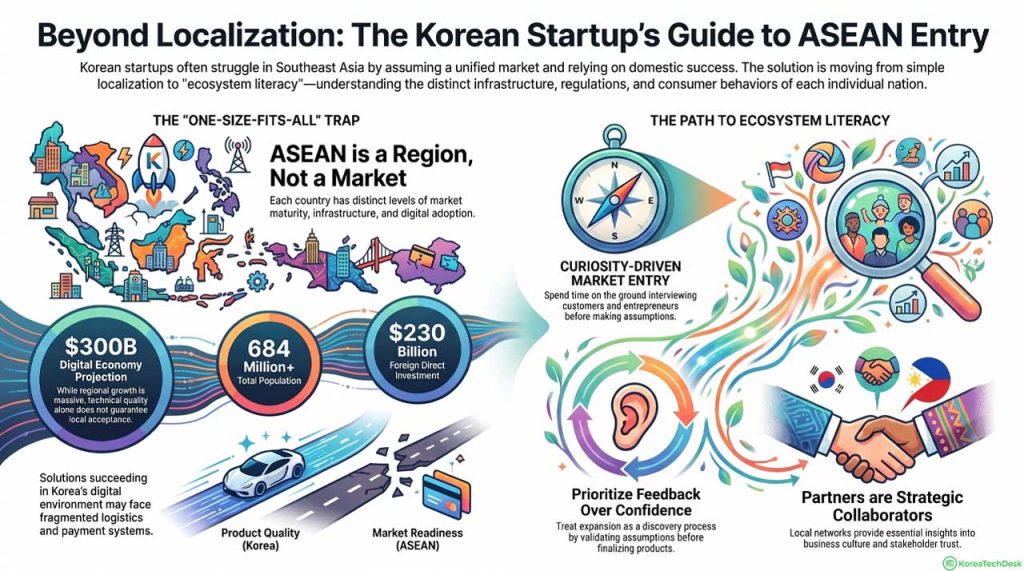
ASEAN Is a Region, Not a Single Startup Market
ASEAN is often talked about as a single, unified opportunity, and the numbers certainly make it easy to see why.
According to ASEAN Statistical Highlights 2025, the region is home to more than 684 million people and recorded over USD 230 billion in foreign direct investment during 2024. Google, Temasek, and Bain & Company’s latest e-Conomy SEA report also projects Southeast Asia’s digital economy to exceed USD 300 billion in gross merchandise value during 2025.
Those figures can easily lead companies to view ASEAN as a single, unified destination.
But Kyaw believes this perspective misses the deeper realities that ultimately shape how customers adopt new products and services.
“Every country has different levels of market maturity, infrastructure, purchasing power, consumer behavior, regulations, and digital adoption,”
he said.
“One of the biggest things they need to assess is whether the market is truly ready for what they want to offer.”
That difference becomes especially important for Korean startups whose products have already achieved strong traction at home.
A solution that succeeds inside Korea’s highly digitalized environment may enter a market where payment systems, logistics networks, purchasing habits, or business practices follow very different patterns. Technical quality alone does not guarantee acceptance.

Product Quality Cannot Replace Customer Understanding
Startup founders often spend months refining their products before taking them overseas, but Kyaw believes many would benefit from spending more time testing their assumptions first.
From his experience working with entrepreneurs and ecosystem programs, he has seen this pattern repeat itself time and again.
“Many startups assume that if a product works in one market, it will solve the same customer needs in the same way elsewhere.”
That assumption frequently becomes the first obstacle to growth.
Successful expansion depends on understanding why customers behave the way they do rather than assuming they will adopt familiar products simply because they appear better.
This perspective also aligns with broader regional research. The e-Conomy SEA 2025 report also notes that Southeast Asia’s digital economy continues evolving through changing consumer habits, trusted creator communities, and localized commerce models instead of following one uniform path across the region.
And for Korean startups, this means product-market fit cannot be exported unchanged. It must be earned again through local validation.

Feedback Loops Matter More Than Confidence
Many discussions about international expansion tend to focus on technology, funding, or execution speed. And yet, Kyaw believes there is another important capability that deserves far more attention.
“The startups that adapt successfully are usually the ones with strong feedback loops,”
he said.
“They spend time listening to customers and validating assumptions rather than becoming attached to a particular product or technology.”
In practice, this requires founders to treat expansion as another discovery process rather than the final stage of a successful domestic business.
Teams willing to revise pricing, customer segments, product features, distribution channels, or even business models often create stronger long-term positions than companies determined to preserve their original assumptions.
And Korean founders who are used to operating in one of Asia’s most advanced startup ecosystems may find that staying flexible is just as important as their technical strengths.
Local Ecosystem Partners Are More Than Introductions
More often, local partners are treated simply as useful business contacts rather than strategic collaborators.
Kyaw, however, sees their role in a much broader and more critical way.
“Local ecosystem builders, community networks, and trusted intermediaries are extremely important because they understand how the market actually works, how entrepreneurs make decisions, and how users respond to new products and services.”
And that insight moves beyond traditional localization.
Local ecosystem operators help founders test assumptions before expensive mistakes occur. They understand which customer problems deserve immediate attention, which partnerships carry credibility, and how trust develops inside local business communities.
Recent Korean discussions point in the same direction. Research supported by KOICA has highlighted that successful overseas technology deployment depends not only on technological capability but also on understanding local institutions, organizational structures, and stakeholder relationships. Industry discussions around Indonesian expansion have similarly emphasized strong local partnerships as a practical advantage during market entry.
These examples point to a simple but important lesson.
Market knowledge is not just an optional advantage. It becomes a crucial part of how a startup operates.
Curiosity Creates Better Expansion Than Confidence
Building on the need for deeper ecosystem understanding, many founders prepare for international expansion by studying reports, market rankings, and investment data.
Kyaw suggests complementing that approach with something far more practical.
“Spend time on the ground before making assumptions,”
he said.
“Talk to entrepreneurs, customers, ecosystem builders, and local businesses.”
And his advice reflects years of working in an ecosystem where entrepreneurs build companies under conditions quite different from those in Korea.
Rather than arriving with a fixed expansion playbook, he encourages founders to come in with curiosity and a willingness to ask questions.
Because those who take the time to understand customer motivations, everyday operational realities, and how decisions are actually made on the ground often uncover opportunities that don’t show up in market reports alone.
Beyond Localization Lies Ecosystem Literacy
In the end, yes, localization remains a crucial part of international expansion.
However, it is not really the first step.
Before founders translate interfaces, recruit distributors, or adjust pricing strategies, they must first understand the ecosystem surrounding their customers. And that includes business culture, trust networks, market readiness, infrastructure, and the everyday constraints influencing purchasing decisions.
Korean startups have earned global recognition for their strong technology and disciplined execution, and these strengths continue to serve them well across Southeast Asia.
But moving forward, their edge may come less from building better technology and more from understanding how local ecosystems influence the way that technology is actually adopted.
Key Takeaway
- ASEAN is not a single startup market. Each country has distinct customer behavior, infrastructure, regulations, and market maturity.
- Ecosystem literacy comes before localization. Founders must understand local market conditions before adapting products or expansion strategies.
- Customer validation outweighs assumptions. Strong technology cannot replace direct understanding of local needs and purchasing behavior.
- Local ecosystem operators reduce expansion risk. Trusted intermediaries help startups validate assumptions, build credibility, and navigate market realities.
- Korean startups entering Southeast Asia should treat expansion as a new discovery process, not a repeat of domestic success.
– Stay Ahead in Korea’s Startup Scene –
Get real-time insights, funding updates, and policy shifts shaping Korea’s innovation ecosystem.
➡️ Follow KoreaTechDesk on LinkedIn, X (Twitter), Threads, Bluesky, Telegram, Facebook, and WhatsApp Channel.
🤝 Looking to connect with verified Korean companies building globally?
Explore curated company profiles and request direct introductions through beSUCCESS Connect.