

A Korean founder lands in Singapore, meets investors, signs partnership agreements, and returns home believing Southeast Asia is within reach. Months later, progress stalls. The problem is often not the product, the team, or the funding. It is the assumption that ASEAN behaves like a single market. In reality, the region rewards startups that understand its differences more than those that simply recognize its size.
Southeast Asia’s Scale Can Hide Its Complexity
Southeast Asia continues attracting attention from Korean startups seeking growth beyond their home market.
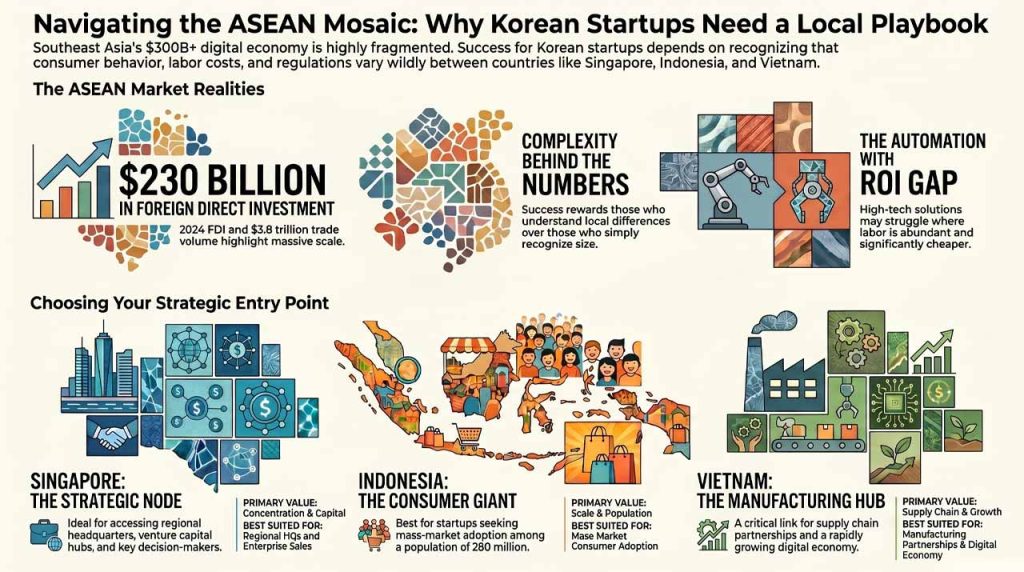
According to ASEAN statistics, the region attracted more than USD 230 billion in foreign direct investment in 2024 while goods trade exceeded USD 3.8 trillion. The region’s digital economy is also projected to surpass USD 300 billion in gross merchandise value.
Those figures help explain why ASEAN remains a priority destination for founders, investors, and policymakers. Yet the numbers can also create a misleading impression that the region operates as a unified market.
While ASEAN governments continue pursuing deeper economic integration, business realities remain highly fragmented. Consumer behavior, infrastructure maturity, labor costs, regulatory environments, and buying processes can vary significantly between countries and even between cities within the same country.
For startups, this means regional expansion often requires market-specific strategies rather than a single ASEAN playbook.

Why Singapore Is Not Always the First Market
Singapore frequently serves as the starting point for Korean companies entering Southeast Asia. The city-state hosts regional headquarters for thousands of multinational corporations and remains the region’s leading venture capital hub.
Gang Chern Sun, Programme Director at KOSME Singapore and a veteran ecosystem builder who helped establish BLOCK71 during his time at NUS Enterprise, believes founders should think more carefully about why they choose Singapore.
“Singapore may be viewed as a strategic node, not a default gateway,”
he told KoreaTechDesk.
According to Gang, the first question should not be where a company wants to enter, but where customers, decision-makers, and operational value actually exist.
“The decision should be anchored on where your customers are, and where is value created.”
Singapore’s value often comes from concentration rather than scale. Regional executives, investors, and corporate buyers are frequently based there, giving startups easier access to key decision-makers. Yet the largest customer base, manufacturing activity, or deployment opportunities may actually exist elsewhere.

Indonesia and Vietnam Solve Different Problems
Many Korean founders group Indonesia, Vietnam, and other ASEAN markets together under a single regional strategy. But actually, the reality is more complicated.
Indonesia offers scale. With a population exceeding 280 million, it provides one of the world’s largest consumer markets. However, operating conditions vary substantially across regions, creating challenges in distribution, customer acquisition, and service delivery.
Vietnam presents a different opportunity set. The country has become increasingly important within global manufacturing supply chains while also developing a rapidly growing digital economy. Market dynamics, purchasing behavior, and competitive conditions differ considerably from Indonesia.
The distinction matters because startups often enter Southeast Asia looking for growth without clearly identifying what kind of growth they seek.
A company pursuing regional headquarters relationships may find Singapore ideal. A startup seeking mass-market consumer adoption may prioritize Indonesia. Another focused on manufacturing partnerships could see stronger opportunities in Vietnam.
The optimal entry point depends on business objectives rather than geography alone.

Labor Economics Can Reshape Market Priorities
Moreover, another reason Southeast Asia resists a single expansion playbook is that economic conditions differ substantially across the region.
Gang pointed to automation technology as an example.
“Automation solutions that deliver strong ROI in Korea or Singapore may struggle in markets like Indonesia, where labor is more abundant and significantly cheaper,”
he said. And that observation highlights an important reality for founders evaluating ASEAN opportunities. One possible business opportunity that appears compelling in one market may generate less urgency in another because the underlying cost structure is different.
And labor costs represent only one part of the equation. Infrastructure maturity, procurement practices, industry development, and operational requirements can also influence how buyers assess new technologies.
As a result, market attractiveness cannot be measured by population size alone. Startups need to understand the economic conditions that shape purchasing decisions in each market.

Singapore-First or Direct-to-Market?
Now, these differences also influence market-entry strategy.
Gang believes founders should think carefully about where decisions are made and where solutions will ultimately be deployed.
“There are typically two approaches: Singapore-first strategy and direct-to-market strategy,”
he explained.
A Singapore-first approach can make sense when regional headquarters, investors, or enterprise buyers are concentrated in the city-state. Direct market entry may be more effective when success depends on local distribution networks, operational integration, or close engagement with end users.
The choice is less about geography and more about business structure.
“Proximity to customers is more than a logistical advantage,”
Gang said. According to him, closer customer access enables faster feedback, stronger commercial relationships, and a better understanding of local market dynamics.
Southeast Asia Rewards Precision More Than Scale
Ultimately, it is perfectly understandable why ASEAN remains one of the most appealing destinations in the global expansion strategy for most startups. After all, the region combines economic growth, rising digital adoption, expanding consumer markets, and increasing investor interest.
Yet Gang’s experience across BLOCK71, NUS Enterprise, and KOSME suggests that successful expansion often begins with a different question. Instead of asking how to enter Southeast Asia, founders may achieve better results by asking which Southeast Asian market best matches their business objectives.
Singapore, Indonesia, and Vietnam each offer meaningful opportunities. They also operate under different economic conditions, customer structures, and growth drivers.
Therefore, the startups most likely to succeed are often those that recognize these differences early and build their regional strategy around them.
Key Takeaway
- ASEAN is a large economic region, but it remains a collection of distinct markets rather than a single operating environment.
- Singapore functions as a regional decision-making and venture capital hub, but it is not automatically the best first market for every startup.
- Indonesia, Vietnam, and other Southeast Asian markets present different customer behaviors, economic structures, and growth opportunities.
- Labor economics can significantly affect product-market fit, particularly for automation and productivity-focused technologies.
- Market readiness often determines adoption outcomes as much as product quality or market size.
- Successful expansion strategies align market entry decisions with customer location, decision-making power, and operational value creation.
- For Korean startups, regional success depends on understanding Southeast Asia’s differences rather than treating ASEAN as a single market.
– Stay Ahead in Korea’s Startup Scene –
Get real-time insights, funding updates, and policy shifts shaping Korea’s innovation ecosystem.
➡️ Follow KoreaTechDesk on LinkedIn, X (Twitter), Threads, Bluesky, Telegram, Facebook, and WhatsApp Channel.
🤝 Looking to connect with verified Korean companies building globally?
Explore curated company profiles and request direct introductions through beSUCCESS Connect.