
South Korea’s venture market is recovering again, and startup funding is no longer frozen the way it was during the peak downturn years. Yet inside many startup leadership rooms, a quieter pressure is intensifying. Founders are being pushed to show speed, traction, and confidence while operating in a market where capital has become far more selective. As fundraising pressure rises alongside AI-driven growth expectations, some startups are beginning to optimize for how momentum looks to investors before fully testing whether the underlying decision is actually strong.
Korea’s Venture Recovery Is Real, but So Is Investor Selectivity
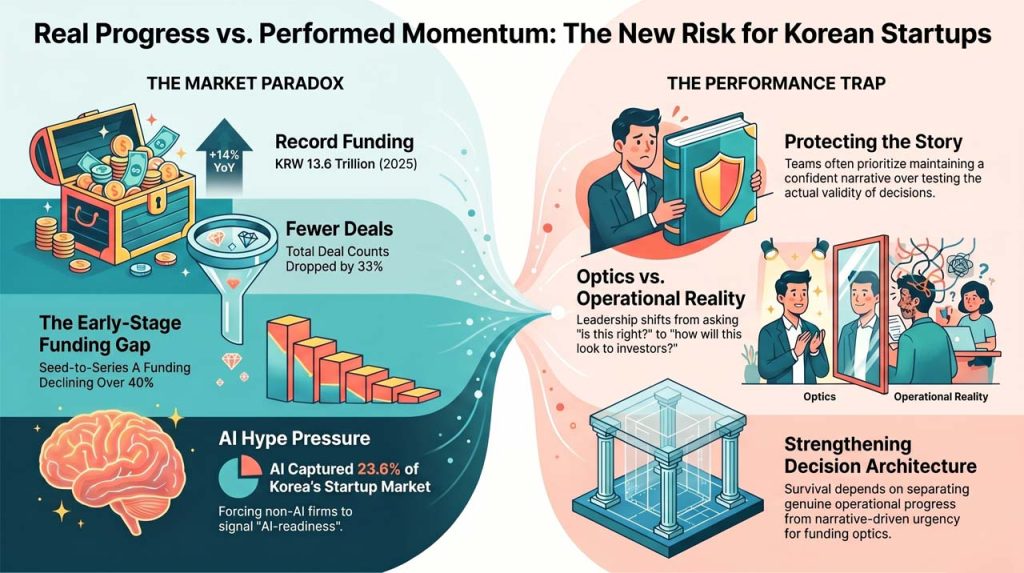
South Korea’s startup funding environment improved significantly in 2025. According to the Ministry of SMEs and Startups (MSS), venture investment reached KRW 13.6 trillion last year, up 14% year-on-year and the country’s second-highest annual total on record. New venture fund formation climbed even faster, reaching KRW 14.3 trillion.
The recovery has also continued into 2026. MSS reported that first-quarter venture investment reached KRW 3.3 trillion, while new fund formation hit a record KRW 4.4 trillion for a first quarter.
But the recovery is uneven underneath the headline numbers.
Startup investment platform TheVC, cited by Platum, found that Korea’s startup and SME investment deal count fell 33.2% in 2025 despite overall capital remaining relatively stable. Average investment size rose sharply to KRW 9.26 billion per deal, while early-stage funding dropped significantly.
Seed-to-Series A investment declined more than 40%, while pre-IPO investment expanded strongly. The data suggests that capital is concentrating around fewer companies perceived as safer, more validated, or closer to scale.
This creates a different type of pressure inside startup leadership teams.
The challenge is no longer simply raising capital. Increasingly, founders must convince investors that they belong to the small group of startups capable of surviving tighter capital discipline and slower fundraising cycles.

AI Hype Is Raising the Pressure to Look Fast
Artificial intelligence is accelerating that pressure further.
OECD analysis found that AI companies captured 61% of global venture capital investment in 2025, equivalent to USD 258.7 billion. In Korea, TheVC data showed AI investment reaching KRW 1.55 trillion last year, while AI’s share of Korea’s startup investment market climbed to 23.6%.
Yet AI investment is also becoming more concentrated.
The number of Korean AI investment deals actually fell while total capital increased, suggesting investors are focusing larger bets on fewer companies. This creates strong incentives for startups to appear fast-moving, scalable, and AI-ready even when internal uncertainty remains unresolved.
Valerie Won Lee, Award-winning Global Impact Strategist, former Head of Communications for the UN Global Platform on Big Data, and author of Decision Shapers, believes this pressure is beginning to reshape how startup leadership teams make decisions.
While discussing Decision Shapers framework with KoreaTechDesk, Won Lee explained:
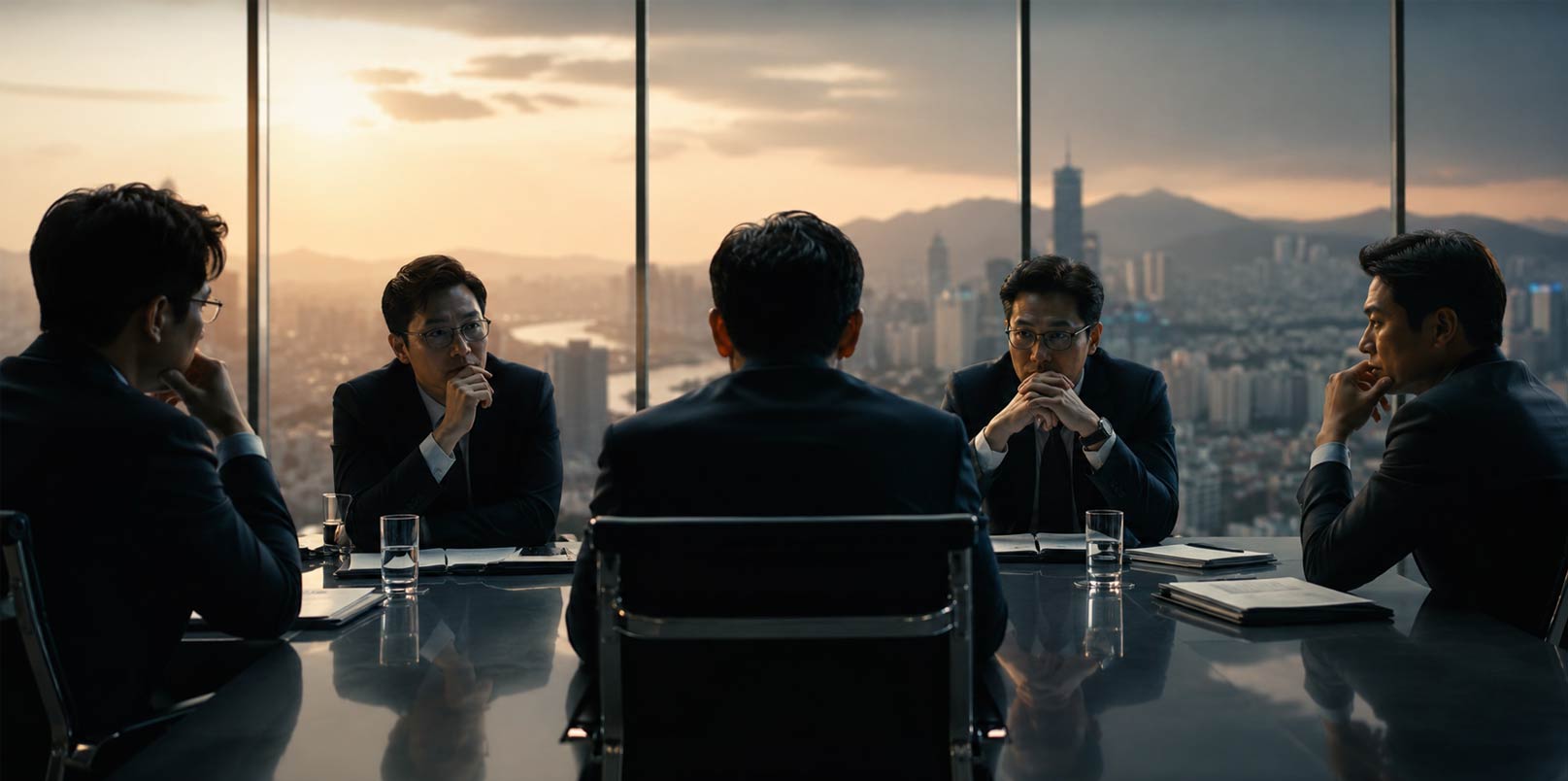
“When founders are under pressure from investors, limited runway, growth expectations, or board scrutiny, the room often becomes less reflective and more performative.”
This pressure changes the emotional structure of startup decision-making itself.
According to Won Lee, leadership teams increasingly begin asking not only whether a decision is correct, but also how it will appear externally to investors, boards, or future funding rounds.
“People are no longer only asking, ‘What is the right decision?’ They are also asking, sometimes silently: ‘How will this look to investors?’”
Startups Can Quietly Begin Protecting the Narrative
The distortion often happens gradually.
A startup preparing for fundraising may feel pressure to demonstrate expansion plans, AI integration, customer growth, or international traction earlier than internal readiness actually supports. Product teams may still see unresolved risks. Operations teams may worry about execution capacity. Yet leadership may feel compelled to maintain confidence externally.
Won Lee warned that these environments can unintentionally suppress disagreement inside the room itself.
“The room may start protecting the story instead of testing the decision.”
This dynamic becomes especially dangerous because it rarely looks irrational in the moment.
In selective funding markets, founders are expected to project confidence. Investors want momentum. Boards expect progress. Teams fear appearing divided. Under those conditions, challenging assumptions may begin to feel politically risky even inside startups that previously operated openly.
Won Lee explained that founders themselves may unintentionally narrow internal discussions while believing they are providing leadership clarity.
“Founders may think they are showing leadership, but they may actually be narrowing the room.”
This can weaken the quality of strategic decisions long before problems become visible operationally.
Runway Pressure Is Quietly Reshaping Startup Behavior
Investor expectations around financial discipline have also changed.
Korean financial media outlet EDaily reported that venture investors are paying much closer attention to burn rate, cash reserves, labor costs, and runway sustainability than during previous growth cycles. Some investors now reportedly expect startups to secure more than two years of operational runway instead of the older 12-to-18-month assumption.
This creates competing pressures inside startups.
Founders must simultaneously demonstrate ambition, growth potential, operational discipline, and survivability. Decisions around hiring, overseas expansion, product launch timing, and AI integration are increasingly evaluated not only strategically, but through how they influence investor confidence.
The result is that startup leadership teams can become psychologically trapped between maintaining momentum narratives and confronting operational reality.
This tension is already visible in Korea’s startup closure data.
TheVC reported that 88 funded Korean startups and SMEs closed during the first half of 2025 alone. Most had last raised at seed stage, while roughly 69% were three years old or younger.
Even several startups selected for Korea’s TIPS program eventually shut down, showing that technical credibility and institutional backing do not automatically protect startups operating under prolonged capital pressure.

Startup Governance Is Becoming More Sensitive
The issue is not simply emotional pressure. It is structural.
Research by legal scholar Elizabeth Pollman argues that startup governance differs significantly from traditional corporate governance because founders, venture investors, executives, and employees operate under overlapping incentives and unequal control structures.
As startups mature, boards gain greater influence over strategic decisions, funding timelines, hiring, expansion, and leadership direction. National Bureau of Economic Research (NBER) research similarly found that investor influence inside startup boards typically increases after multiple financing rounds, often shifting decision control away from founders alone.
This means investor pressure is not necessarily explicit or aggressive. Often, it becomes embedded into how startup teams frame risk, growth, and acceptable uncertainty.
The pressure then reshapes how decisions are discussed before anyone formally demands a specific outcome.
The Real Risk Is Confusing Performed Momentum With Real Progress
South Korea’s startup ecosystem remains highly ambitious, globally connected, and increasingly AI-driven. Government support, venture capital recovery, and global expansion opportunities continue creating major opportunities for founders.
But tighter capital conditions are also exposing a new leadership challenge.
Fast execution and strong storytelling can help startups survive investor scrutiny in the short term. Yet organizations that continuously optimize decisions around appearance, valuation signaling, or fundraising optics may quietly weaken their own judgment process underneath.
Won Lee believes stronger startups will increasingly be defined by their ability to separate genuine progress from narrative-driven urgency.
“Better decision architecture helps founders and investors separate real momentum from performed momentum.”
That distinction may become increasingly important as Korean startups operate inside a venture market where speed still matters, but disciplined judgment matters even more.
Key Takeaways
- Korea’s venture market is recovering, with venture investment reaching KRW 13.6 trillion in 2025, but funding has become significantly more selective.
- Early-stage startups face growing pressure as investment becomes concentrated around fewer, more validated companies.
- AI hype is intensifying investor expectations, especially around speed, scalability, and growth signaling.
- Valerie Won Lee warns that investor pressure can make startup decision rooms “less reflective and more performative.”
- Startup teams may begin “protecting the story instead of testing the decision,” especially during fundraising cycles.
- Increasing board scrutiny, runway pressure, and selective funding conditions are reshaping how startup leaders discuss risk and growth internally.
- The long-term challenge for Korean startups may not be generating momentum alone, but distinguishing real operational progress from performed momentum designed for investor confidence.
– Stay Ahead in Korea’s Startup Scene –
Get real-time insights, funding updates, and policy shifts shaping Korea’s innovation ecosystem.
➡️ Follow KoreaTechDesk on LinkedIn, X (Twitter), Threads, Bluesky, Telegram, Facebook, and WhatsApp Channel.
🤝 Looking to connect with verified Korean companies building globally?
Explore curated company profiles and request direct introductions through beSUCCESS Connect.