
South Korea’s startup ecosystem is rapidly integrating AI into daily operations, investor workflows, and corporate innovation programs. Yet as AI tools make analysis, communication, and execution faster, a quieter challenge is emerging inside leadership teams. Many organizations are discovering that access to more information does not automatically improve judgment, especially when pressure, hierarchy, and speed begin shaping how decisions are made.
Korea’s AI Push Is Accelerating Across the Startup Ecosystem
South Korea is moving aggressively to position itself as a global AI economy.
According to Microsoft’s Q1 2026 Global AI Diffusion report, South Korea recorded one of the fastest AI adoption growth rates globally, with AI usage rising 43% since mid-2025. KBS, citing Microsoft AI Economy Institute data, reported that Korea’s AI adoption rate reached 37.1% in the first quarter of 2026, lifting the country’s global ranking from 18th to 16th.
The policy environment is accelerating alongside it. Korea’s National AI Strategy Committee announced a record KRW 9.9 trillion AI budget for 2026, covering 741 AI-related projects across 41 ministries. The package includes funding for AI computing infrastructure, startup support, and AI transformation initiatives across industries.
At the same time, venture capital has also begun concentrating around AI.
South Korea’s Ministry of SMEs and Startups (MSS) reported that AI models and infrastructure attracted KRW 1.3 trillion in venture investment in 2025, accounting for nearly 20% of investment flowing into the country’s designated “new industries” sectors.
At the operational level, adoption is spreading quickly. AWS-backed research reported by ETNews found that 48% of Korean companies had adopted AI tools, while Korean startups were moving even faster into AI-enabled services and workflows.
Despite this massive movement towards its top 3 global AI powerhouse vision, deep integration remains uneven in South Korea.
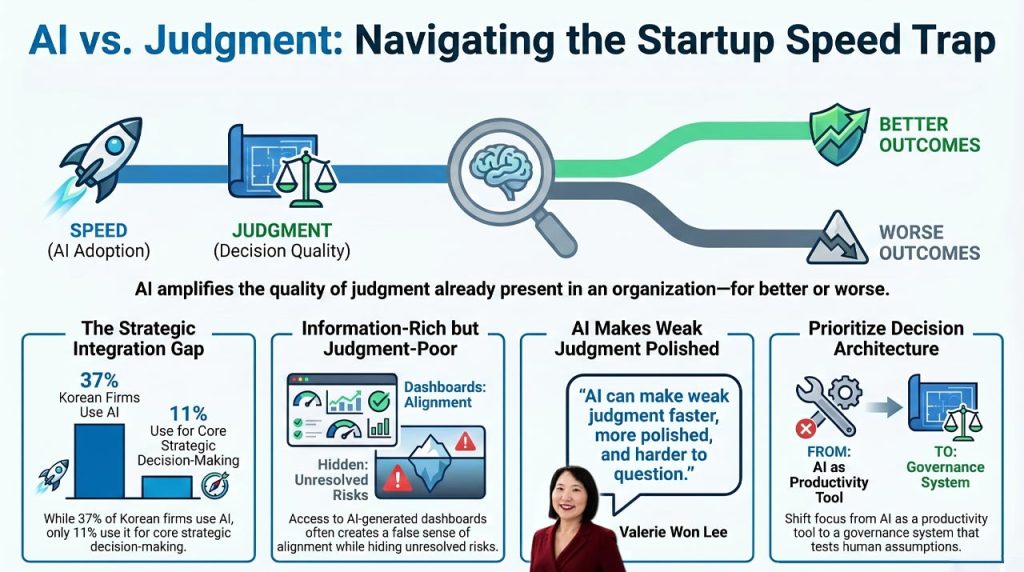
The same AWS findings showed that 70% of Korean companies were still using AI mainly for efficiency-oriented tasks such as scheduling, automation, and productivity assistance. Only 11% had integrated AI into core operational decision-making, including strategic planning, product development, and business-model design.
This gap is becoming increasingly important inside startup environments where speed and judgment are both under pressure.
Decision Shapers Examines How AI Changes Collective Judgment
Award-winning Global Impact Strategist and former Head of Communications for the UN Global Platform on Big Data, Valerie Won Lee, recently released Decision Shapers, a framework-focused book examining how groups make decisions under pressure.
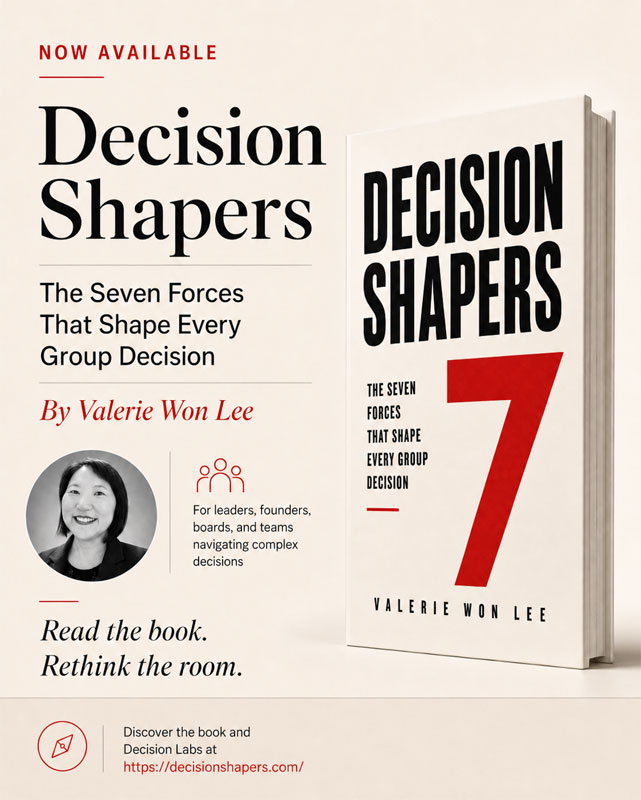
In Decision Shapers, Won Lee outlines a framework built around seven recurring forces that shape collective decision-making inside organizations, including the Driver, Challenger, Integrator, Systems Thinker, and Constraint Holder.
This model examines how pressure, hierarchy, speed, and group dynamics influence judgment inside leadership environments, particularly in fast-moving organizations where alignment and execution often happen under compressed timelines.
Now, drawing on her cross-sector experience spanning international organizations, corporate negotiation, humanitarian initiatives, and collective intelligence work across multicultural environments, Won Lee argues that many organizations are beginning to mistake operational acceleration for stronger judgment.
As KoreaTechDesk exclusively discussed the Decision Shapers framework and how it intersects with decision-making challenges across Korean startup and innovation ecosystem, Won Lee stated,
“AI can make weak judgment faster, more polished, and harder to question.”
The problem, she explained, is often structural rather than technical.
“The problem is often not a lack of intelligence, data, dashboards, collaboration tools, or AI-generated insights. It is a lack of decision structure.”

AI Adoption Is Rising Faster Than Organizational Judgment
Won Lee’s observation actually reflects a growing tension emerging across startup ecosystems globally.
AI tools can now generate investor summaries, market analysis, product strategies, competitive reports, and customer insights within minutes. However, teams still need to decide which assumptions matter, which risks are being ignored, and whether the organization is interpreting the information correctly.
That distinction is becoming increasingly important as startups operate under compressed timelines, fundraising pressure, and expanding stakeholder expectations.
McKinsey’s 2025 State of AI survey found that 88% of organizations now use AI regularly in at least one business function. Yet only about one-third have scaled AI adoption effectively across the enterprise.
The same survey also found that more than half of organizations using AI reported at least one negative consequence, including problems tied to inaccurate outputs and poor oversight.
So, we can see that the issue is no longer simply AI adoption.
It is whether organizations have the internal processes needed to turn faster information into better collective judgment.
Startups Are Becoming Information-Rich but Judgment-Poor
Won Lee argues that many startup teams now operate inside environments saturated with dashboards, AI-generated insights, investor feedback, and collaborative tools, while still struggling to reach real clarity.
“Many organizations become information-rich but judgment-poor because they assume that better tools will automatically create better judgment.”
She described a common startup scenario where founders, investors, product teams, and operations leads all examine the same information but interpret it through different pressures.
Founders may prioritize momentum and fundraising visibility. Product teams may see unresolved risks. Operations teams may worry about execution capacity. Junior employees may notice trust or customer issues but hesitate to raise them strongly.
In those situations, quick agreement can create the appearance of alignment without resolving the underlying differences shaping the decision.
The risk becomes more severe once AI enters the workflow.
AI-generated summaries, strategic recommendations, and polished reports can make organizations appear more aligned than they actually are. Teams may move faster without fully testing assumptions or surfacing disagreement.
Won Lee noted:
“AI often amplifies the judgment that is already there.”
That dynamic is particularly relevant in startup environments where leadership teams are already operating under pressure to demonstrate growth, speed, and execution capability.

Korea’s Execution Strength Creates a New AI Challenge
South Korea’s startup ecosystem is widely recognized for disciplined execution once decisions are finalized internally.
However, as Korean startups expand internationally and integrate AI into leadership workflows, the challenge is shifting toward how decisions are formed before execution begins.
This becomes especially visible in cross-border collaboration environments.
AI systems can standardize communication, summarize meetings, and streamline coordination across multicultural teams. Yet they can also flatten nuance and create false alignment.
Won Lee warned that operational synchronization does not necessarily produce shared understanding.
“The earliest warning sign is usually that everyone is using the same words but not meaning the same thing.”
That distinction matters for Korean startups operating globally.
Terms such as “approval,” “commitment,” “risk,” “launch,” or “partnership” may carry different assumptions across investors, international partners, headquarters teams, and local operators. AI-generated summaries may capture visible agreement while missing unresolved uncertainty underneath.
As Korean startups become increasingly international, interpretive alignment may become as important as operational efficiency.
AI Governance Is Becoming a Startup Leadership Issue
Beyond the operational challenge, regulatory factors also emerge as another barrier to overcome.
South Korea’s AI Basic Act, which recently entered implementation stages, requires human oversight for certain high-impact AI systems and introduces transparency obligations around AI-generated outputs.
At the same time, Gartner reported that organizations conducting regular AI assessments and governance reviews were more than three times more likely to achieve high GenAI value compared to those without structured oversight processes.
This then offers clear implication for startups, showing that AI is no longer only a productivity layer. AI is now becoming part of organizational governance, leadership judgment, and strategic decision-making.
That means startup leaders increasingly need systems capable of testing assumptions, surfacing disagreement, and tracking how decisions are actually made over time.
Won Lee believes this will create growing importance around what she calls “decision architecture.”
“The future will not only belong to organizations that use AI well.
It will belong to organizations that know how to structure human and AI intelligence together.”
Korea’s Next AI Advantage May Depend on Judgment, Not Just Speed
South Korea has already established itself as one of the world’s fastest-moving AI adoption environments. But this also means that the country will face tougher challenges next.
As startups integrate AI deeper into operations, investor relations, product strategy, and cross-border expansion, the real competitive gap may no longer depend on who has access to AI tools first.
Instead, it may depend on which organizations can maintain clarity, challenge assumptions safely, and make better collective decisions while operating under increasing speed and pressure.
So, yes, AI may indeed accelerate workflows quickly.
But inside the startup ecosystems, acceleration without stronger judgment may simply allow organizations to move faster in the wrong direction.
Key Takeaways
- Korea’s AI adoption is accelerating rapidly, supported by major government investment, growing venture capital concentration, and expanding startup integration.
- Many Korean companies still use AI mainly for efficiency-focused tasks, while deeper integration into strategic decision-making remains limited.
- According to Valerie Won Lee, author of Decision Shapers, AI can amplify existing organizational judgment rather than improve it automatically.
- “Information-rich but judgment-poor” environments are becoming a growing startup risk as leadership teams rely more heavily on dashboards, AI-generated summaries, and fast workflows.
- AI-generated alignment can hide unresolved disagreement, especially inside multicultural, cross-border startup environments.
- Decision structure, governance, and collective judgment are becoming critical competitive factors as AI moves deeper into startup leadership and operational workflows.
- The next major startup advantage may not come only from AI adoption itself, but from how effectively organizations structure human and AI intelligence together.
– Stay Ahead in Korea’s Startup Scene –
Get real-time insights, funding updates, and policy shifts shaping Korea’s innovation ecosystem.
➡️ Follow KoreaTechDesk on LinkedIn, X (Twitter), Threads, Bluesky, Telegram, Facebook, and WhatsApp Channel.
🤝 Looking to connect with verified Korean companies building globally?
Explore curated company profiles and request direct introductions through beSUCCESS Connect.