
Market entry between Korea and France is becoming more structured. Public programs, corporate partnerships, and bilateral initiatives have expanded access across both ecosystems.
But access alone does not determine outcomes.
The startups that successfully scale between Korea and France follow a different logic. They do not rely on visibility or entry pathways. They build credibility through local anchors, operate through trusted intermediaries, and position themselves inside the ecosystem rather than outside it.
Korea – France Startup Scaling Requires a Different Operating Model
Cross-border expansion between Korea and France is no longer defined by how startups enter a market. It is defined by how they establish trust after entry.
This distinction is becoming more relevant as both countries deepen cooperation through institutional programs and corporate partnerships. Initiatives such as the K-Startup Center (KSC) in Paris and La French Tech Seoul continue to expand access, while government-led programs increasingly connect startups with global companies and investors.
However, the structure of these programs reflects a clear boundary. They facilitate entry, but they do not replace execution.
As discussions on Korea – France startup partnership continues, Kian Ban, Global Partner at MYSC and Senior Expert at Impulse Partners, describes the difference in operational terms.
“The primary differentiator is the shift from market discovery to industrial integration.”
This shift defines what scaling actually requires. Startups must move beyond ecosystem participation and position themselves within real commercial and industrial systems.

Industrial Anchors Define Credibility in Foreign Markets
In both Korea and France, credibility is rarely established through standalone market entry. It is typically built through association with established institutions, corporates, or strategic partners.
Kian Ban emphasizes that successful expansion depends on securing this type of validation early.
“Successful firms move beyond general networking to secure an Industrial Anchor, for example a strategic partnership with a national champion, that validates their technology.”
The structure of Korea – France cooperation increasingly reflects this pattern.
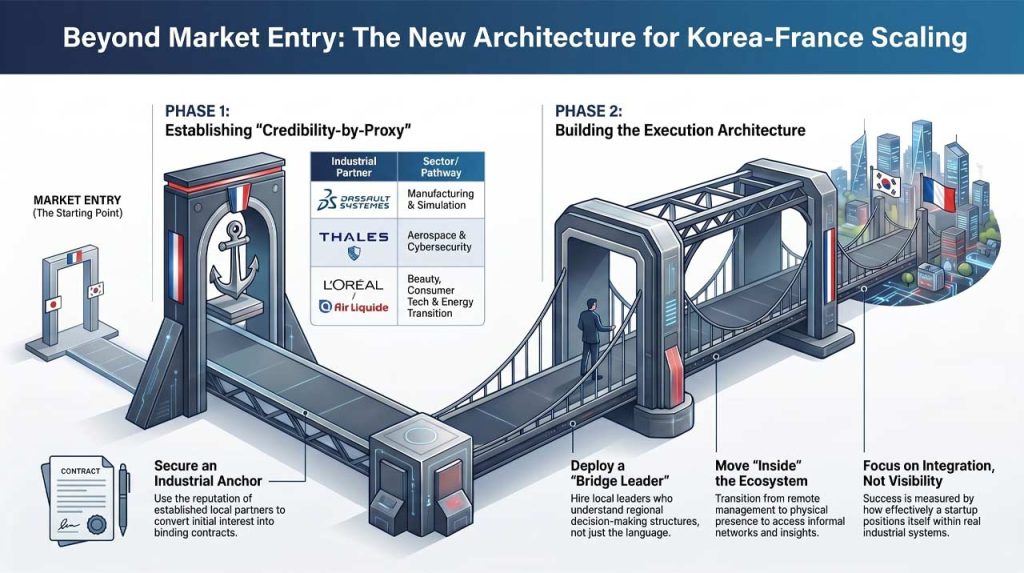
The Ministry of SMEs and Startups (MSS) has expanded collaboration programs that directly connect startups with global companies. In its global corporate partnership initiatives, companies such as Dassault Systèmes, Thales, L’Oréal Korea, and Air Liquide have participated as industry partners supporting startup development and international expansion.
Each of these participants actually represents a specific industrial pathway. Dassault Systèmes connects to manufacturing and simulation. Thales operates across aerospace and cybersecurity. L’Oréal Korea anchors beauty and consumer technology. Air Liquide supports energy transition and industrial systems.
So this structure changes how startups engage with foreign markets. Instead of approaching a market independently, they enter through relationships that already carry local credibility.
“Credibility-by-Proxy” Shapes Commercial Conversion
The role of industrial anchors extends beyond access. It determines whether initial interest converts into binding business outcomes.
In Korea and France, both markets operate with strong emphasis on trust, institutional alignment, and proven capability. This creates a condition where startups must often rely on external validation before being taken seriously.
Kian Ban describes this mechanism directly.
“Without ‘credibility-by-proxy’ provided by a local partner or a recognized industrial anchor, they will struggle to convert initial interest into a binding contract.”
This explains why many startups fail to progress after initial engagement.
Meetings, introductions, and program participation generate visibility. But contracts, pilots, and long-term partnerships require endorsement from actors already embedded in the ecosystem.
Examples of this dynamic are visible in ongoing Korea – France cooperation.
The Seoul Metropolitan Government announced in 2025 that French quantum company Pasqal would establish a research hub in Seoul, with plans to develop a quantum computing system locally. The project is supported through institutional cooperation and local integration, rather than standalone entry.
Similarly, L’Oréal has expanded its engagement with Korean startups through collaboration programs and previous partnerships with MSS, while also integrating Korean innovation into its global portfolio through acquisitions such as Dr.G.
In both cases, scaling is not driven by entry alone. It is supported by alignment with established industrial players.
Bridge Leaders Translate Markets, Not Just Language
Industrial anchors provide credibility. But execution still depends on how startups operate inside the market.
This is where local leadership becomes critical.
Kian Ban introduces the concept of the Bridge Leader as a defining factor in successful expansion.
“A startup is ready for expansion when it has secured a local industrial anchor… and has a ‘Bridge Leader’ on the ground.”
The role extends beyond translation or local representation.
A Bridge Leader understands how decisions are made, how partnerships are structured, and how risks are evaluated within the host market. They manage follow-up, align expectations, and maintain continuity across different stakeholders.
This becomes particularly important in the Korea–France corridor, where decision-making structures and operating conditions differ significantly.
Without this layer, startups often misinterpret signals, misalign timelines, or fail to maintain momentum after initial engagement.
Scaling Requires Being “Inside” the Ecosystem
Another recurring pattern in successful expansion is physical and operational presence within the target market.
Programs and delegations have increasingly emphasized this point.
La French Tech’s recent missions to South Korea and Japan focused on establishing long-term footholds and building industrial partnerships, rather than short-term exposure. Business France has similarly organized delegations of 40 French companies to position them within Northeast Asia’s industrial and technology ecosystems.
These initiatives reflect a shared understanding: proximity matters.
Kian Ban frames this requirement clearly.
“Founders often treat these markets as export destinations that can be managed remotely, but the reality is that long-term execution requires being ‘inside’ the ecosystem.”
Operating remotely limits visibility, slows relationship-building, and weakens follow-up.
In contrast, startups that build local presence gain access to informal networks, decision-makers, and operational insights that are not available through structured programs alone.
From Entry Strategy to Execution Architecture
Taken together, these elements form a consistent operating model for Korea–France startup scaling.
Market entry is no longer the primary barrier. The challenge is building an execution structure that can sustain growth after entry.
That structure typically includes:
- A credible industrial anchor that validates the startup’s technology
- A Bridge Leader who navigates local decision-making and relationships
- A level of ecosystem integration that supports long-term execution
This reflects a shift in how cross-border expansion should be approached.
Instead of treating entry as the objective, startups must treat it as the starting point of a longer process of integration and validation.
What This Means for Global Founders and Investors
The Korea–France corridor continues to develop as a structured pathway for cross-border expansion. Programs, partnerships, and policy alignment have improved access across both ecosystems.
What is becoming clearer, however, is that scaling depends on factors that sit beyond institutional frameworks.
For founders, this means that expansion decisions must be grounded in execution readiness, not just opportunity.
As for investors, it directly signals that startups demonstrating local credibility, industrial alignment, and operational presence are more likely to convert cross-border expansion into measurable growth.
In both cases, success depends less on entering the corridor and more on how effectively startups position themselves within it.
Key Takeaway
- Industrial anchors determine whether startups gain real market credibility in Korea–France expansion
- “Credibility-by-proxy” is essential to convert introductions into contracts and partnerships
- Bridge Leaders enable execution by navigating local decision-making structures and relationships
- Local ecosystem presence is critical, as scaling requires operating “inside” the market, not remotely
- Corporate partnerships (MSS programs, global companies like L’Oréal, Thales, Air Liquide) act as practical scaling pathways
- Cross-border startup success depends on execution architecture, not just entry strategy
- Korea–France startup scaling is shaped by trust, integration, and industrial alignment, not visibility or access alone
– Stay Ahead in Korea’s Startup Scene –
Get real-time insights, funding updates, and policy shifts shaping Korea’s innovation ecosystem.
➡️ Follow KoreaTechDesk on LinkedIn, X (Twitter), Threads, Bluesky, Telegram, Facebook, and WhatsApp Channel.
🤝 Looking to connect with verified Korean companies building globally?
Explore curated company profiles and request direct introductions through beSUCCESS Connect.