
Meetings are becoming one of the biggest hidden productivity drains inside modern companies. Teams now sit through constant video calls across time zones, languages, and collaboration platforms, while key decisions still disappear into scattered notes and forgotten recordings. With Knoi, Korean AI company Buzzni believes the next battleground in workplace software is no longer transcription alone, but how organizations retain and reuse knowledge created during meetings.
Buzzni Pushes Knoi Beyond Basic AI Meeting Transcription
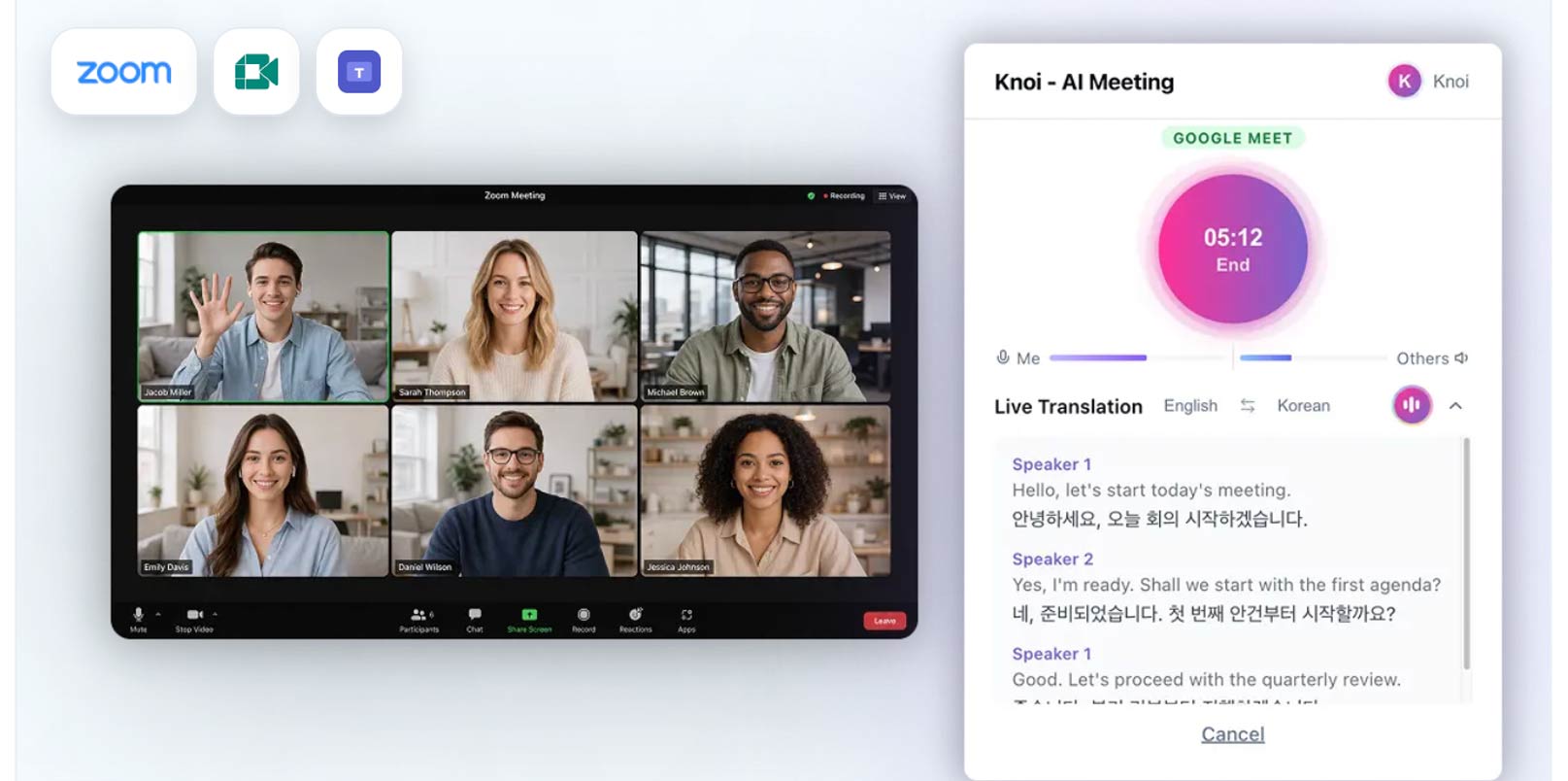
Buzzni recently launched a Chrome extension for its AI meeting tool Knoi, allowing users to run the service directly during browser-based meetings on platforms such as Google Meet, Zoom, and Microsoft Teams.
The release intended to reduce friction in day-to-day meeting workflows while making Knoi easier to use inside existing collaboration environments.
The move comes as AI meeting software is becoming increasingly crowded. Major platforms including Microsoft Teams, Google Meet, and Zoom have already integrated AI-powered summaries, note generation, and meeting recap functions into their own ecosystems.
At the same time, standalone AI meeting tools are competing aggressively on transcription accuracy, workflow integration, and enterprise usability.
But Buzzni is placing Knoi around a different operational argument.
Rather than focusing only on recording meetings, the company is attempting to turn meeting activity into searchable and reusable organizational workflow data.
Buzzni said in correspondence with KoreaTechDesk,
“Internally, we frame this not as a simple meeting-notes tool, but as a ‘team collaboration hub,’”
Why Knoi Is Focusing on Workflow Continuity Instead of Raw Recording
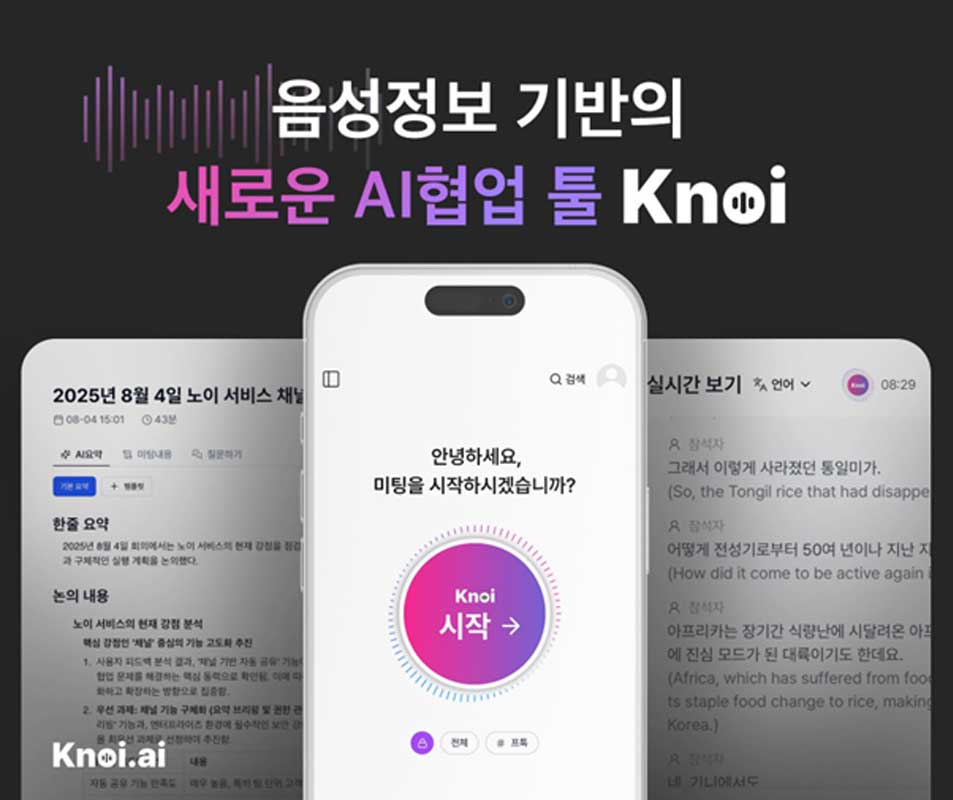
One of Knoi’s central product features is “Ask Knoi,” a natural-language question function that allows users to search accumulated meeting histories conversationally. The feature is built on the company’s long-running search-domain experience developed through its broader AI and commerce businesses.
The company also significantly emphasized summary structure rather than simple speech-to-text conversion. According to Buzzni, Knoi recognizes around 20 meeting contexts, including interviews, lectures, seminars, board meetings, and panel discussions, then reorganizes summaries differently depending on the format.
For example, interview sessions can separate “strong answers” and “weaker answers,” while board meetings prioritize decisions and action items.
Buzzni told KoreaTechDesk,
“We continue to see users moving from other meeting tools to Knoi because of summary quality and transcription accuracy,”
The company also argues that workflow continuity matters as much as the recording itself.
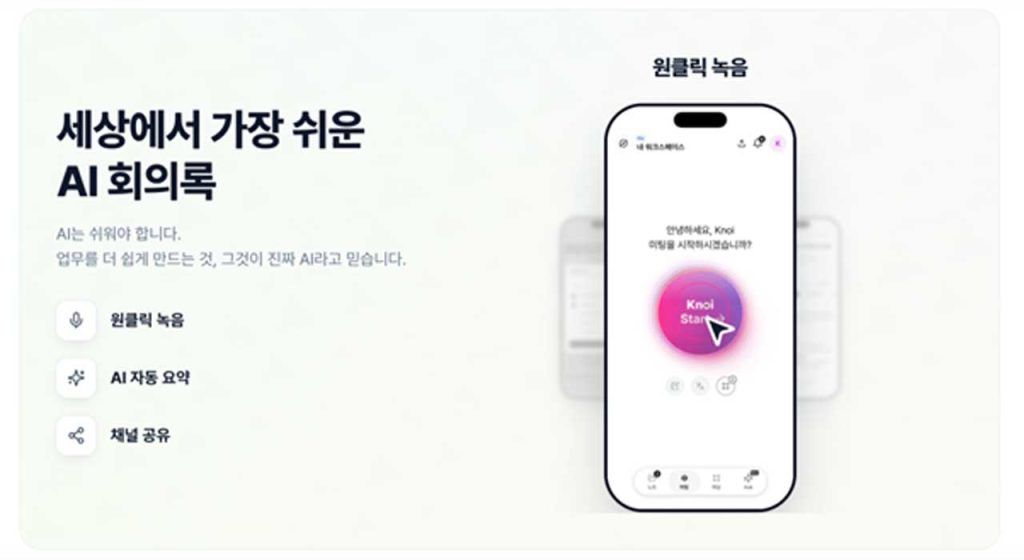
Hence, Knoi combines AI-generated summaries, one-click channel sharing, and AI-generated task management features that automatically organize deadlines and responsibilities during meetings.
The Strategic Logic Behind Bot-Free Meeting Recording
The Chrome extension also reflects another strategic choice. Buzzni is heavily promoting Knoi’s “bot-free” recording approach.
Instead of adding a visible AI participant into a meeting room, Knoi records meetings through the browser layer itself. The company believes removing visible bots reduces psychological friction during external meetings and client discussions.
The broader AI meeting software market is also beginning to explore similar approaches. Recent reporting by TechCrunch highlighted increasing interest in “botless” meeting recording as some users push back against visible AI bots appearing inside meetings.
At the same time, invisible recording approaches also create additional scrutiny around consent, transparency, and privacy compliance.
Buzzni acknowledged this directly in its correspondence with KoreaTechDesk, particularly regarding the US market. The company said,
“In the US, recording and consent regulations vary by state, and user sensitivity around privacy is meaningfully different from Korea.
Consent flows, notification, and data-handling policies will need to be designed more carefully for the US context.”
The issue is becoming increasingly important as workplace AI software expands into global enterprise environments.
According to the Reporters Committee for Freedom of the Press, recording consent laws in the United States vary depending on jurisdiction, creating operational complexity for software companies building recording-based collaboration tools.
Multilingual Collaboration Is Emerging as a Key Use Case
Buzzni is also positioning multilingual collaboration as a major Knoi use case.
The company says the Chrome extension currently supports real-time translated subtitles in eight languages, including English, Japanese, Chinese, and Russian. Earlier Knoi launch materials referenced broader multilingual translation support across the platform.
Buzzni also shared examples of Knoi being used during conferences in the United States.
“At the same time, we were able to summarize the on-site sessions immediately and share them with team members in Korea, which allowed collaboration across both time-zone and language barriers.”
The company also said some overseas client meetings had already been conducted without separate interpreters by relying on Knoi’s live translation features.
That positioning aligns with broader workplace trends.
Microsoft’s 2025 Work Trend Index reported that 30 percent of meetings now involve multiple time zones, while after-hours meetings continue increasing as companies operate across distributed global teams.
For Korean startups attempting to scale internationally, multilingual meeting infrastructure is becoming less of a convenience feature and more of a workflow requirement.
Buzzni Says Korea Product-Market Fit Is Stronger Than Its US Position
Buzzni appears relatively confident about Knoi’s position in Korea, particularly among enterprise users.
The company told KoreaTechDesk that it evaluates product-market fit less through topline signup figures and more through behavioral signals. For instance, retention, repeated usage patterns, and accumulated organizational knowledge inside the platform.
“Once an organization adopts Knoi, the company’s various knowledge assets naturally accumulate inside the product, and a strong lock-in emerges over time.”
The company added that Pro-tier retention remains stable and that some enterprise contracts were signed after direct demonstrations of Ask Knoi.
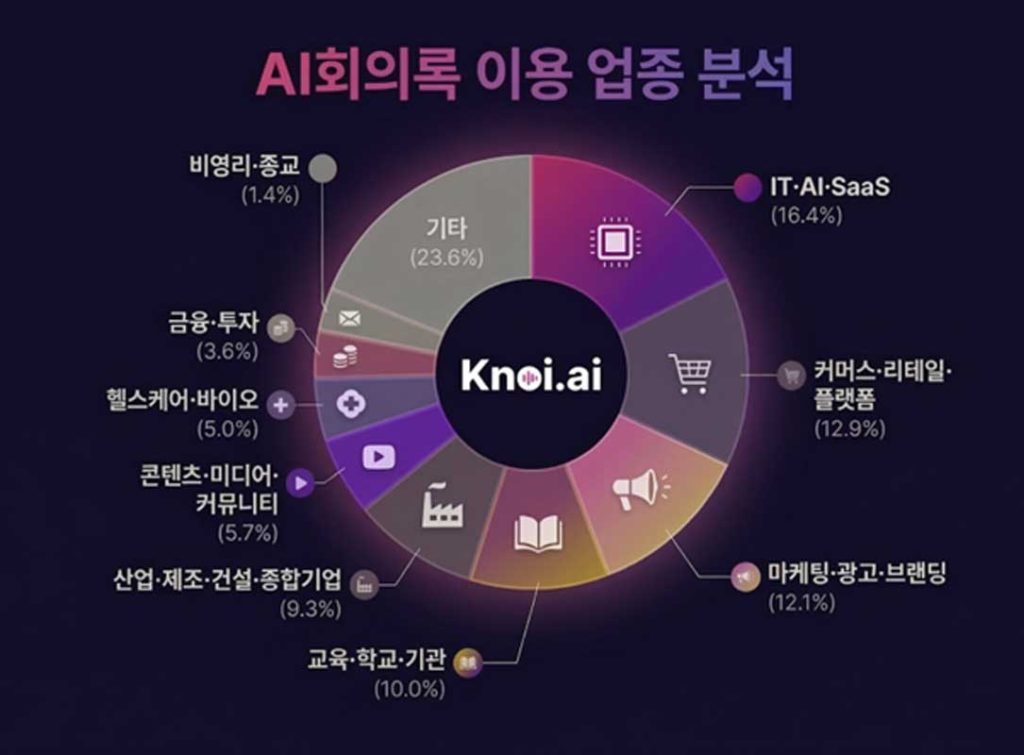
Buzzni’s March analysis also showed Knoi adoption spreading across multiple sectors rather than remaining concentrated inside one industry.
The company said the most active user categories included IT, AI, and SaaS at 16.4 percent, followed by commerce and retail at 12.9 percent, marketing and branding at 12.1 percent, education and institutions at 10 percent, and industrial sectors at 9.3 percent.
Outside Korea, however, the company’s tone becomes noticeably more cautious.
“The more honest answer is that we are still defining our own benchmark,”
Buzzni told KoreaTechDesk regarding the US market.
“Rather than transplanting what worked in Korea, we believe we first need to understand the pain points and usage contexts US users actually experience.”
And this admission may ultimately strengthen the company’s credibility more than aggressive expansion claims would.
Buzzni says Knoi launched on Product Hunt in April and surpassed 10,000 cumulative downloads within one month, with a significant share of users reportedly coming from the United States.
Still, the company acknowledges the challenge. The US market already contains deeply entrenched competitors and different operational expectations around privacy, workflow behavior, and collaboration culture.
The Real Challenge Is Not Downloads but Habit Formation
Chrome extensions, AI summaries, multilingual subtitles, and workflow automation are no longer unusual on their own inside the global productivity software market.
The harder challenge now is building software that becomes embedded deeply enough into organizational behavior that teams continue using it daily without friction.
And this is the direction Buzzni is attempting to pursue with Knoi.
The company’s strongest signal now lies in the belief that meeting software becomes more valuable once users stop treating recordings as isolated files and start treating them as continuously searchable operational memory.
Key Takeaway
- Buzzni launched a Chrome extension for its AI meeting tool Knoi to support browser-based workflows across Google Meet, Zoom, and Microsoft Teams.
- Knoi is positioned as an AI collaboration platform focused on workflow continuity, searchable meeting history, and organizational knowledge accumulation.
- The company emphasizes bot-free meeting recording, arguing that removing visible AI bots can reduce friction during external business meetings.
- Knoi supports real-time translated subtitles in eight languages through its Chrome extension workflow.
- According to Buzzni’s March 2026 analysis, 68.5 percent of users shared AI-generated summaries, while 32.3 percent used Ask Knoi for meeting retrieval and follow-up questions.
- Buzzni believes Knoi has achieved stronger product-market fit in Korea, particularly among enterprise users, based on retention and repeated workflow usage.
- The company says it is still defining what product-market fit should look like in the United States, where privacy expectations, consent rules, and collaboration habits differ significantly from Korea.
- Knoi’s broader challenge is building enough trust and usability for teams to adopt AI meeting capture as a persistent daily workflow habit.
🤝 Looking to connect with verified Korean companies building globally?
Explore curated company profiles and request direct introductions through beSUCCESS Connect.
– Stay Ahead in Korea’s Startup Scene –
Get real-time insights, funding updates, and policy shifts shaping Korea’s innovation ecosystem.
➡️ Follow KoreaTechDesk on LinkedIn, X (Twitter), Threads, Bluesky, Telegram, Facebook, and WhatsApp Channel.