KoreaTechDesk | Korean Startup and Technology News

Tue, June 16, 2026

Sign in

Virtual Demo Day
Menu
  • Home
  • Startup News
    • AI & Big Data
    • AR & VR
    • Blockchain
    • Clean Technology
    • Content & Games
    • Cybersecurity
    • Enterprise & SaaS
    • FinTech
    • Gadgets & Electronics
    • Health & Bio
    • Manufacturing
    • Press Release
    • IoT
    • Marketplaces & E-commerce
    • Robotics
    • Transportation
    • Investments
    • Ecosystem & Lists
  • Governments
    • Artificial Intelligence Industry Cluster Agency
    • Daegu Technopark
    • GANGNAM-GU
    • Gyeonggido Business & Science Accelerator
    • Hwaseong Industry Promotion Agency
    • Invest Seoul
    • Korea Creative Content Agency
    • Korea Internet & Security Agency
    • Korea Information Security Industry Association
    • Korea Institute of Startup & Entrepreneurship Development
    • Korea Tourism Organization
    • Korea Trade-Investment Promotion Agency
    • Ministry of Culture, Sports and Tourism
    • Ministry of SMEs & Startups
    • National IT Industry Promotion Agency
    • Pangyo Techno Valley
    • Seoul Business Agency
    • Seoul FinTech Lab
    • South Gyeongsang Province
    • Seoul Metropolitan Government
  • Events
    • COMEUP
    • Korea Fintech Week
    • K-Content Expo
    • NextRise
    • Try Everything
  • Interviews
    • Investors’ interviews
    • Founders’ interviews
  • Programs
    • Asan Voyager
    • CAPA Global Program
    • Campus Town Program
    • SGSC Global Bootcamp
    • Gangnam-gu Global Roadshow
    • Global SaaS Marketplace Support Project
    • LAUNCHPAD
    • COMEUP STARS 120
    • K-Startup Grand Challenge
    • TIPS X beSUCCESS Global Project
    • SFL Global Program
    • KTO Global Showcase
    • Yonsei Univ Global Class
    • KOSME Global Program
  • Partner With Us
    • Press Release
    • Startup Scouting
    • Business Agencies
    • Global Mentorship Program
    • Investment Opportunities
    • K-Scouter Program
  • Lists
  • Home
  • Startup News
    • AI & Big Data
    • AR & VR
    • Blockchain
    • Clean Technology
    • Content & Games
    • Cybersecurity
    • Enterprise & SaaS
    • FinTech
    • Gadgets & Electronics
    • Health & Bio
    • Manufacturing
    • Press Release
    • IoT
    • Marketplaces & E-commerce
    • Robotics
    • Transportation
    • Investments
    • Ecosystem & Lists
  • Governments
    • Artificial Intelligence Industry Cluster Agency
    • Daegu Technopark
    • GANGNAM-GU
    • Gyeonggido Business & Science Accelerator
    • Hwaseong Industry Promotion Agency
    • Invest Seoul
    • Korea Creative Content Agency
    • Korea Internet & Security Agency
    • Korea Information Security Industry Association
    • Korea Institute of Startup & Entrepreneurship Development
    • Korea Tourism Organization
    • Korea Trade-Investment Promotion Agency
    • Ministry of Culture, Sports and Tourism
    • Ministry of SMEs & Startups
    • National IT Industry Promotion Agency
    • Pangyo Techno Valley
    • Seoul Business Agency
    • Seoul FinTech Lab
    • South Gyeongsang Province
    • Seoul Metropolitan Government
  • Events
    • COMEUP
    • Korea Fintech Week
    • K-Content Expo
    • NextRise
    • Try Everything
  • Interviews
    • Investors’ interviews
    • Founders’ interviews
  • Programs
    • Asan Voyager
    • CAPA Global Program
    • Campus Town Program
    • SGSC Global Bootcamp
    • Gangnam-gu Global Roadshow
    • Global SaaS Marketplace Support Project
    • LAUNCHPAD
    • COMEUP STARS 120
    • K-Startup Grand Challenge
    • TIPS X beSUCCESS Global Project
    • SFL Global Program
    • KTO Global Showcase
    • Yonsei Univ Global Class
    • KOSME Global Program
  • Partner With Us
    • Press Release
    • Startup Scouting
    • Business Agencies
    • Global Mentorship Program
    • Investment Opportunities
    • K-Scouter Program
  • Lists
2026-02-25_AIS 2026_Conference Banners_1920x480
Home Startup AI & Big Data

Korea Is Buying More GPUs. The Bigger Question Is How Many Are Actually Being Used

by Zee Cindy
June 8, 2026
in AI & Big Data
0

Across the world, governments and technology companies are racing to secure more GPUs as artificial intelligence becomes a strategic national priority. South Korea is no exception. Yet as billions of dollars flow into AI infrastructure, a deeper question is emerging beneath the hardware race: does competitiveness depend solely on owning more compute, or on how effectively existing compute is actually used?

Korea’s AI Strategy Is Increasingly Focused on Compute Capacity

South Korea has made AI infrastructure expansion a national priority. The Ministry of Science and ICT (MSIT) recently proposed securing an additional 15,000 advanced GPUs through its 2026 budget plan, bringing the country’s cumulative target to 37,000 GPUs across multiple national initiatives.

The broader strategy extends beyond hardware procurement. The government is also pursuing the National AI Computing Center project while expanding support for AI startups, researchers, and enterprises that require access to large-scale computing resources.

The reasoning behind this move stems from the AI development that has been increasingly depending on access to computing power. Training models, deploying applications, and supporting inference workloads all require substantial infrastructure. So, it is widely believed countries that managed to secure reliable access to compute may gain advantages in research, commercialization, and industrial competitiveness.

However, the growing focus on hardware acquisition raises another question. How much of this infrastructure will ultimately becomes real usable capacity?
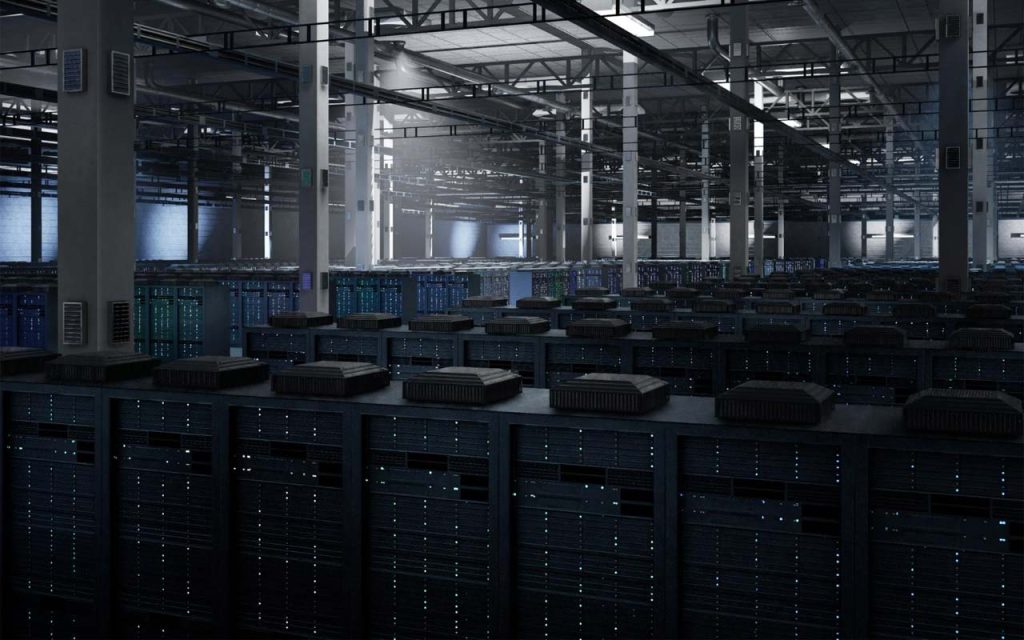
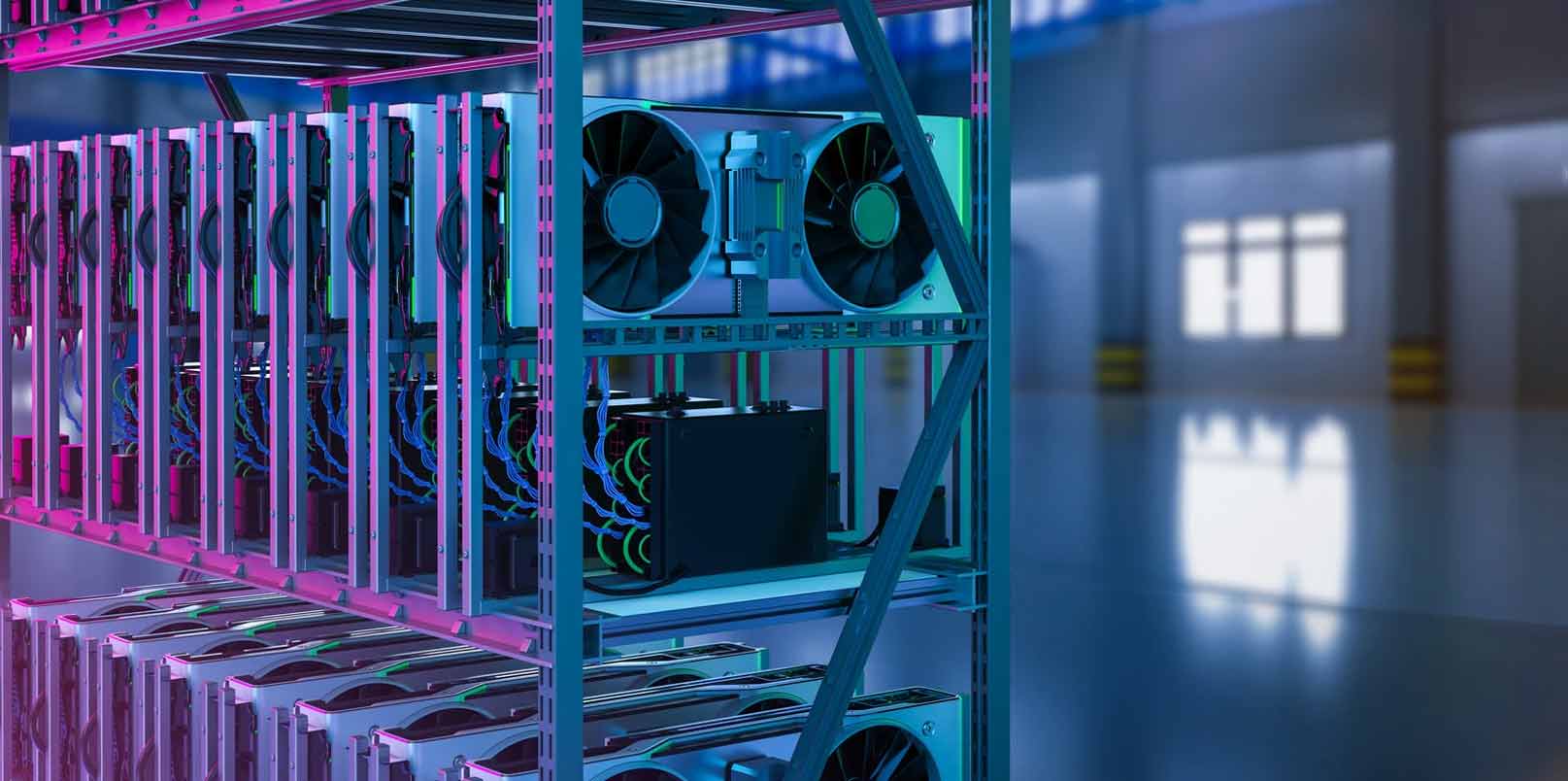
Illustration of data center. | Stock Photos

The Difference Between Owning Compute and Utilizing Compute

According to Greg Osuri, the AI industry may be paying too much attention to GPU ownership while underestimating utilization challenges.

“GPU supply only touches the surface of the bottleneck, and it is not the only factor contributing to the scarcity and complexity of compute.”

As the founder of Akash Network, a decentralized cloud computing marketplace, and CEO of Overclock Labs, Greg Osuri has spent years working on compute infrastructure and resource allocation challenges.

In an exclusive interview with KoreaTechDesk, he argues that discussions about AI infrastructure often focus on chip shortages while overlooking broader constraints across the technology stack.

“The AI industry keeps framing the boom as a chip shortage, but if you observe the entire supply chain, from GPUs through memory and into the underlying energy infrastructure, such as transformers, turbines, and grid capacity, and you factor in growing public resistance to new data center construction, the picture is one of a broader infrastructure crisis for AI.”

Greg Osuri, founder of Akash Network and CEO of Overclock Labs. | LinkedIn

Now, his observation aligns with a growing body of research suggesting that utilization remains a significant challenge even within sophisticated AI environments.

In a 2024 study, Microsoft Research analyzed 400 production deep learning jobs and identified 706 GPU underutilization issues. The researchers found that average GPU utilization often remained at 50% or lower, with common causes including data loading delays, checkpoint operations, non-GPU processing tasks, and software inefficiencies. The study also concluded that nearly 85% of the identified issues could be mitigated through relatively modest code or configuration changes.

In other words, adding more GPUs does not automatically translate into more usable AI capacity.

Why Idle Capacity Matters

One of Osuri’s central arguments is that significant compute resources already exist but remain fragmented and underutilized.

“Massive amounts of GPU power already exist across idle consumer hardware, independent data centers, and fragmented global infrastructure,”

he said.

“The problem is that centralized cloud models can’t efficiently orchestrate or distribute it.”

The idea is increasingly relevant as AI shifts toward inference-heavy workloads. Unlike large-scale frontier model training, many inference tasks can operate independently, creating opportunities to distribute workloads across diverse computing resources.

The challenge becomes one of orchestration rather than procurement.

This distinction is particularly important for policymakers and ecosystem builders. Procuring additional GPUs may increase national capacity on paper, but effective allocation, scheduling, and accessibility ultimately determine how much value those resources generate.

Interestingly, South Korea’s own infrastructure plans appear to recognize this issue. The OECD’s policy tracking of Korea’s AI GPU initiative notes that idle resources are expected to be dynamically reassigned through centralized platforms designed to improve overall utilization rates.
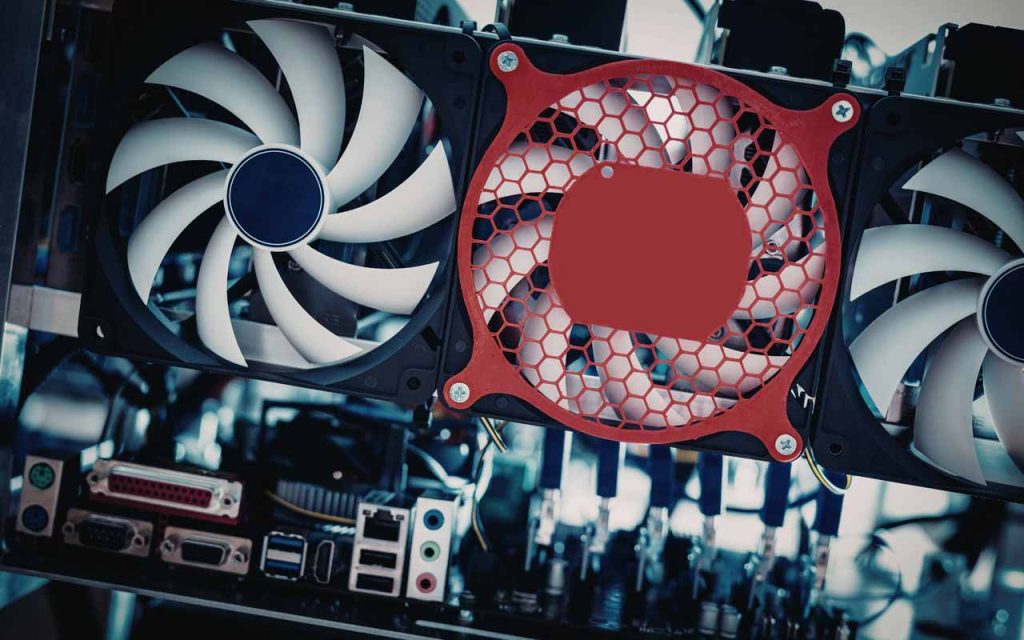
Illustration of GPU. | Stock Photos

A Real-World Test of Utilization Economics

One example cited by Osuri involved Razer’s AVA Mini campaign, which used Akash-powered infrastructure for AI image generation.

According to Razer’s published campaign information, the system generated more than 11,000 images, averaged approximately 3.24 seconds per image, and achieved peak throughput of roughly 30 images per minute.

The campaign reportedly reduced inference costs to approximately US$0.01 per image.

Osuri attributes part of the result to infrastructure that can tap dormant computing resources that would otherwise remain unused.

“Akash’s distributed infrastructure taps into dormant compute that has traditionally been locked away in homes and data centers owned by individuals and companies with no practical way to put it to use.”

It is still important to note that the example does not prove that decentralized infrastructure is suitable for every AI workload. However, it does illustrate a broader point: infrastructure efficiency can sometimes be improved by better matching workloads to available capacity rather than continuously adding new hardware.

Infrastructure Competitiveness May Depend on More Than Hardware Counts

The AI infrastructure conversation is now entering a new phase.

The first phase focused on acquiring GPUs. But the next phase may focus on maximizing the value extracted from those GPUs.

This does not diminish the importance of South Korea’s investments. Large-scale infrastructure remains essential for supporting AI development, research, and commercialization. Yet infrastructure competitiveness increasingly appears tied to operational questions involving scheduling, utilization, accessibility, and workload allocation.

And as AI adoption accelerates, the countries that gain the greatest advantage may not simply be those that own the most hardware. They may be the ones that can deploy, share, and utilize that hardware most effectively.

AI illustration of infrastructure competitiveness in Korea.

Beyond the GPU Race

Finally, Korea’s AI ambitions are often discussed through the lens of capacity: how many GPUs are being purchased, how much money is being invested, and how quickly infrastructure can be expanded.

Yes, those metrics matter, and they are also easy to measure unlike utilization that may be more challenging to evaluate.

However, at some point, this utilization may ultimately determine how much innovation, research, and startup activity an infrastructure investment actually produces.

And as governments and companies continue expanding AI capacity, the next competitive benchmark may not be the number of GPUs installed, but the actual percentage of those GPUs doing real useful work.
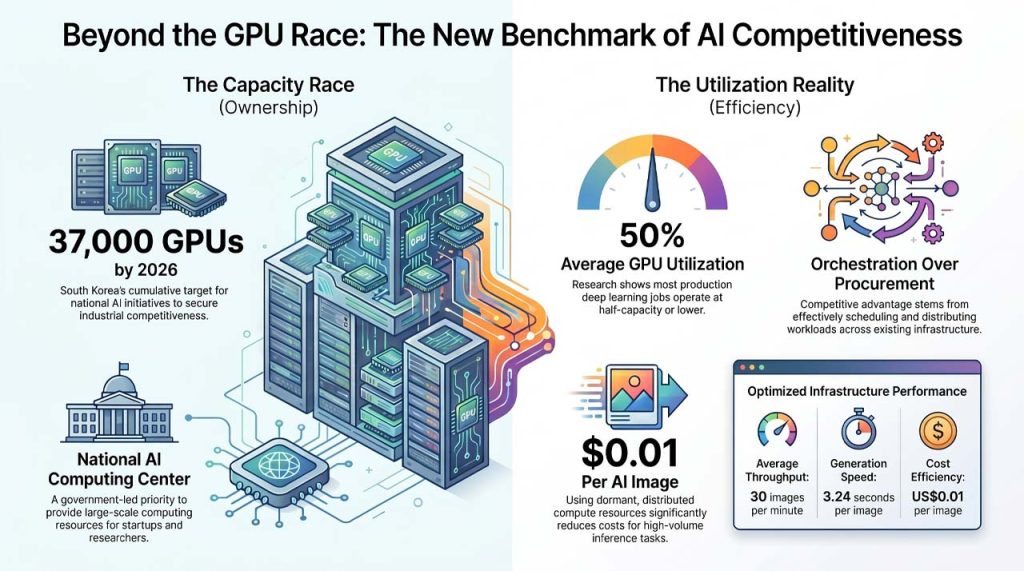
Understanding the benchmark of AI competitiveness. | AI infographic

Key Takeaway

  • South Korea is rapidly expanding national AI compute capacity through large-scale GPU investments and the National AI Computing Center initiative.
  • Infrastructure competitiveness depends on utilization and orchestration, not only GPU ownership, according to Greg Osuri.
  • GPU underutilization remains a real operational challenge, according to findings from Microsoft Research.
  • The Razer AVA Mini deployment provides a practical example of how dormant compute resources can be used for high-volume inference tasks.
  • AI infrastructure strategy is increasingly becoming a question of usable capacity rather than installed capacity alone.
  • Access, allocation, and utilization may become as important as hardware acquisition for startups, policymakers, and ecosystem operators.

🤝 Looking to connect with verified Korean companies building globally?
Explore curated company profiles and request direct introductions through beSUCCESS Connect.


– Stay Ahead in Korea’s Startup Scene –
Get real-time insights, funding updates, and policy shifts shaping Korea’s innovation ecosystem.
➡️ Follow KoreaTechDesk on LinkedIn, X (Twitter), Threads, Bluesky, Telegram, Facebook, and WhatsApp Channel.

Tags: AI Compute AccessibilityAI Compute InfrastructureAI GPU CapacityAI Inference InfrastructureAI infrastructure investmentAI sovereignty KoreaAI Workload OrchestrationAkash NetworkGPU UtilizationGreg Osurikorea ai infrastructureKorea AI PolicyNational AI Computing CenterSovereign AIsovereign AI development Korea
Previous Post

Why Sell-Through, Not Sell-In, Decides Korean Brand Survival in the Middle East

Next Post

The Real Challenge Behind Korea’s RMR Boom Is Not Taste but Translation

Next Post

The Real Challenge Behind Korea’s RMR Boom Is Not Taste but Translation

MOST READ ARTICLE OF THE WEEK

1.
Why Korea Is Becoming a Stress Test for Context-Aware AI
9 Jun 2026
2.
The Real Challenge Behind Korea’s RMR Boom Is Not Taste but Translation
9 Jun 2026
3.
Razer AVA Mini Shows Why AI Cost May Decide Which Consumer Features Reach Users
10 Jun 2026
4.
Why Good Startups Still Fail the Venture Capital Test
10 Jun 2026
5.
Korean VCs Are Entering Japan Through LP Investments Instead of Startup Deals — Why?
11 Jun 2026
Register for Event

AIS-2026 Conference

AIS 2026 Conference

List Article

1.
Why Good Startups Still Fail the Venture Capital Test
10 Jun 2026
2.
The Hardest Part of Korea Market Entry: Staying in The Game
3 Jun 2026
3.
Why M&A Value Is Lost After the Deal Closes
30 May 2026
4.
Foreign Companies Budget for Korea Entry, but the Real Costs Start After Hiring
23 May 2026
5.
Why Fast Korea Entry Structures Can Become Expansion Traps
16 May 2026

Similar Articles

AI & Big Data

The Real Reason AI Projects Fail After the Pilot: Lessons From Korea’s Industrial Deployments

More
AI & Big Data

The New Phase of AI Adoption in Korea’s Media Industry: A Signal from Loomex by Catenoid

More
AI & Big Data

Razer AVA Mini Shows Why AI Cost May Decide Which Consumer Features Reach Users

More

Topics

Menu
  • AI & Big Data
  • AR & VR
  • Blockchain
  • Clean Technology
  • Content & Games
  • Cybersecurity
  • Enterprise & SaaS
  • FinTech
  • Gadgets & Electronics
  • Health & Bio
  • IoT

Program

Menu
  • Asan Voyager
  • CAPA Global Program
  • SGSC Global Bootcamp
  • LAUNCHPAD
  • COMEUP STARS 120
  • K-Startup Grand Challenge
  • TIPS X beSUCCESS Global Project
  • SFL Global Program
  • KTO Global Showcase
  • Yonsei Univ Global Class
  • KOSME Global Program

About

Menu
  • About Us
  • all articles
  • Terms of Use
  • Privacy
  • Cookie-policy
  • twitter

Subscribe and be informed first hand about actual Korean startup news.

All the day’s headlines and highlights, direct to you every morning.

[mc4wp_form id="3766"]

Contact us : [email protected]

Topics

Menu
  • AI & Big Data
  • AR & VR
  • Blockchain
  • Clean Technology
  • Content & Games
  • Cybersecurity
  • Enterprise & SaaS
  • FinTech
  • Gadgets & Electronics
  • Health & Bio
  • IoT

Program

Menu
  • Asan Voyager
  • CAPA Global Program
  • SGSC Global Bootcamp
  • LAUNCHPAD
  • COMEUP STARS 120
  • K-Startup Grand Challenge
  • TIPS X beSUCCESS Global Project
  • SFL Global Program
  • KTO Global Showcase
  • Yonsei Univ Global Class
  • KOSME Global Program

About

Menu
  • About Us
  • all articles
  • Terms of Use
  • Privacy
  • Cookie-policy
  • twitter

Subscribe and be informed first hand about actual Korean startup news.

All the day’s headlines and highlights, direct to you every morning.

[mc4wp_form id="3766"]

© 2023 Koreantech News & Media Korea Zrt. All rights reserved.

Our Spring Sale Has Started

You can see how this popup was set up in our step-by-step guide: https://wppopupmaker.com/guides/auto-opening-announcement-popups/

Our Spring Sale Has Started

You can see how this popup was set up in our step-by-step guide: https://wppopupmaker.com/guides/auto-opening-announcement-popups/

We hope you enjoy our content, May you please give us Feedback regarding our website!

[gravityform id=”17″]

dgdfgfdgdf

What you think about Koreatechdesk, Share your idea with us!

[gravityform id=”16″]

Invitation submission has been closed