The Gulf’s retail market is becoming larger, faster, and far more competitive for international brands. Korean companies entering the region are no longer competing only for distributor access or shelf placement. They are now competing for consumer attention inside highly digitized retail ecosystems where pricing, brand visibility, replenishment speed, and in-store execution increasingly determine whether products continue moving after launch.
As GCC retail modernizes across malls, pharmacies, e-commerce, and quick commerce platforms, many Korean brands are discovering that listing products is only the beginning of the real challenge.
Gulf Retail Modernization Is Raising the Bar for Korean Consumer Brands
The UAE and broader Gulf region have rapidly evolved into omnichannel retail environments where physical stores, e-commerce, loyalty platforms, delivery systems, and digital promotions now operate together. This shift is creating stronger opportunities for Korean brands, but it is also increasing the operational burden required to sustain retail performance.
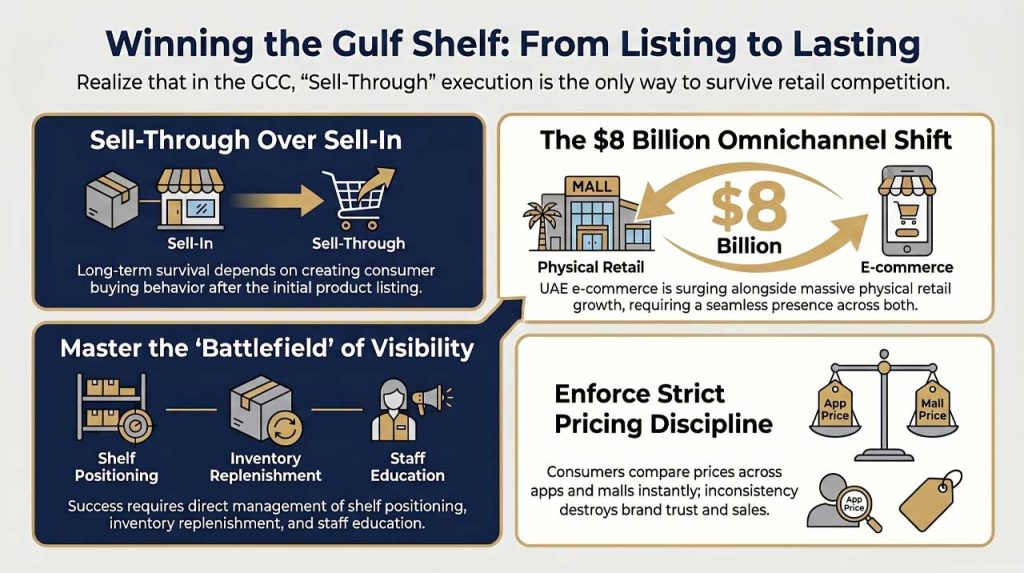
According to the U.S. International Trade Administration (ITA), the UAE’s e-commerce market was projected to reach approximately USD 8 billion by 2025, supported by high smartphone penetration, digital payment adoption, and growing consumer preference for online shopping across categories such as consumer electronics, cosmetics, appliances, and fashion.
Large Gulf retail operators have also continued expanding their omnichannel capabilities. Majid Al Futtaim, one of the region’s largest retail and mall operators, reported AED 35.9 billion (approximately USD 9.8 billion) in revenue for 2025, while e-commerce revenue grew 20% and quick commerce revenue rose 38%.
LuLu Retail similarly reported USD 7.9 billion in revenue for 2025, alongside 38.6% e-commerce growth and continued regional store expansion.
That transformation has significantly changed how Korean brands compete after entering Gulf retail channels.
Taegyun (James) Lim, founder and CEO of KOMEA Group, said many Korean companies still underestimate how execution-driven Gulf retail environments have become. Lim has spent decades overseeing retail-facing operations across Middle Eastern consumer markets, including sales execution, merchandising, channel management, and in-store performance for global consumer brands.
In a previous KoreaTechDesk interview examining why Korean brands struggle after entering Middle Eastern markets, Lim argued that long-term survival increasingly depends on what happens after products reach retail shelves.
“Sell-through is not simply about placing products on shelves. It is about creating consumer buying behavior.”
Shelf Visibility Has Become a Commercial Battlefield Inside GCC Retail
As Gulf retail competition intensifies, shelf positioning itself has become a major operational factor affecting sales performance.
According to the ITA, retailers in the UAE increasingly require brands and distributors to manage merchandising, product facing, inventory replenishment, and category planning directly. Retailers may also charge additional shelf-space and merchandising-related costsdepending on turnover performance and visibility requirements.
That environment creates pressure for Korean brands that previously relied heavily on distributor-led sales structures.
“Successful sell-through requires proper shelf positioning, regular staff training, in-store promotions, sampling, pricing consistency, inventory monitoring, and fast replenishment,”
Lim explained.
Many Korean companies still focus heavily on getting products listed inside major Gulf retailers while underestimating what happens afterward. Products may secure initial placement inside pharmacies, electronics chains, department stores, or hypermarkets, but poor visibility or inconsistent execution can quickly reduce sales momentum.
“A product may be listed in a major retailer, but if it is placed poorly, if sales staff cannot explain it, if the price is inconsistent across channels, or if replenishment is slow, the product will not move,”
Lim said.
That challenge has become increasingly relevant as Korean consumer brands expand across categories such as beauty devices, wellness products, skincare, appliances, and smart electronics, all of which require stronger consumer education and in-store conversion.
K-Beauty Expansion Is Increasingly Dependent on Retail Execution
The Gulf’s growing appetite for Korean beauty products has already become visible across pharmacy chains, beauty retailers, and omnichannel commerce platforms.
KITA data showed Korean cosmetics exports to the UAE reached approximately USD 260 million in 2025, rising 65% year-on-year. Korean beauty companies have also expanded partnerships with major Gulf retail and pharmacy operators.
Earlier this year, Korean skincare brand Goongbe entered the UAE through Aster Pharmacy, securing placement across dozens of retail locations while also joining the MyAster online platform. CJ Olive Young also partnered with UAE-based Life Healthcare Group to expand Korean beauty distribution across Life Pharmacy’s regional retail network.
Still, Gulf retail competition has also become far more sophisticated.
Retailers increasingly expect participating brands to contribute not only products, but also category development, promotional activity, staff education, customer engagement, and omnichannel visibility. That shift is changing how Korean beauty companies must approach Gulf expansion strategies.
The challenge is no longer simply introducing Korean products into the market. It is sustaining consumer movement after the initial launch cycle fades.

Omnichannel Retail Is Making Pricing Discipline More Important
The Gulf’s digital retail growth has also made pricing consistency harder to maintain across channels.
Consumers now regularly compare prices between mall retailers, pharmacy chains, online marketplaces, quick-commerce apps, and social commerce platforms before making purchases. According to the ITA, UAE consumers increasingly prioritize pricing, customer service, and shopping convenience when evaluating products online.
That creates new pressure on Korean brands trying to balance distributor margins, retailer expectations, promotional campaigns, and online competition simultaneously.
Lim noted that inconsistent pricing across channels can directly weaken sell-through performance, particularly when products move slowly or consumers lose confidence in perceived value.
The issue becomes even more sensitive in categories where Gulf consumers already have broad access to global alternatives from Europe, the United States, Japan, and China.
Gulf Retail Is Quietly Testing Korean Operational Discipline
The Gulf’s retail transformation is also exposing a broader structural challenge for Korean overseas expansion strategies.
Korean companies often enter the region with strong product competitiveness and growing brand recognition, particularly in beauty, electronics, and wellness categories. However, Gulf retail ecosystems increasingly reward operational consistency rather than product novelty alone.
Retailers now expect faster replenishment, stronger merchandising coordination, localized promotions, better after-sales support, and closer integration across online and offline channels.
According to the ITA, after-sales service and staff training remain important success factors in UAE retail operations, especially for electronics and consumer devices.
“In practical terms, sell-through is where strategy becomes execution,”
Lim said.
That reality is becoming increasingly important as Gulf retailers modernize into data-driven omnichannel ecosystems rather than simple product distribution channels.
Gulf Retail Is Becoming a Long-Term Operational Test for Korean Brands
In the end, the Gulf’s retail market continues creating meaningful opportunities for Korean consumer brands. Rising digital adoption, expanding retail infrastructure, growing beauty demand, and strong consumer spending across the GCC are all contributing to stronger regional visibility for Korean products.
Still, Gulf retail is also becoming an operational stress test that quietly exposes weaknesses in merchandising discipline, retail coordination, pricing management, and consumer conversion strategies.
For many Korean brands, survival in Gulf retail may no longer depend on securing distribution alone. It increasingly depends on how effectively companies manage what happens after products reach the shelf.
Key Takeaways
- Gulf retail markets are becoming highly omnichannel, combining malls, pharmacies, e-commerce, loyalty systems, and quick-commerce platforms into integrated retail ecosystems.
- Sell-through performance is becoming more important than initial product listing, especially for Korean beauty, electronics, wellness, and consumer brands.
- Shelf positioning, merchandising, replenishment speed, and staff education now directly affect retail survival inside GCC markets.
- Retailers increasingly expect active operational participation from brands, including promotions, category management, inventory coordination, and customer engagement.
- K-beauty expansion across the Gulf is accelerating, but sustained consumer movement depends heavily on execution quality after launch.
- Pricing consistency across physical and digital channels has become critical as Gulf consumers compare products across omnichannel retail platforms.
- Gulf retail modernization is exposing operational weaknesses in Korean overseas expansion strategies, particularly around retail execution and post-launch management.
- Successful Korean brands increasingly behave like retail operators, not only product suppliers, inside GCC markets.
– Stay Ahead in Korea’s Startup Scene –
Get real-time insights, funding updates, and policy shifts shaping Korea’s innovation ecosystem.
➡️ Follow KoreaTechDesk on LinkedIn, X (Twitter), Threads, Bluesky, Telegram, Facebook, and WhatsApp Channel.
🤝 Looking to connect with verified Korean companies building globally?
Explore curated company profiles and request direct introductions through beSUCCESS Connect.