
The Middle East is attracting growing attention from Korean brands, startups, and SMEs searching for new growth markets beyond East Asia. Trade agreements, government-backed programs, and rising demand for Korean consumer products have opened more doors across the Gulf region. Yet many companies still struggle after launch, even after securing distributors, attending exhibitions, or shipping products into the market for the first time.
Korea-UAE CEPA Expands Access, but Access Alone Does Not Build a Market
South Korea and the United Arab Emirates officially brought the Korea-UAE Comprehensive Economic Partnership Agreement (CEPA) into force on May 1, 2026, creating Korea’s first FTA-type agreement with an Arab country in the Middle East. The agreement covers tariff liberalization across approximately 91.2% of tariff lines over time and is expected to support Korean exports across sectors including cosmetics, food, automotive products, medical devices, and consumer electronics.
The momentum has already become visible in trade and expansion activity. According to Korea International Trade Association (KITA) data, the UAE became Korea’s largest export market among Middle Eastern countries in 2025, with exports reaching approximately USD 5.7 billion. Korean cosmetics exports to the UAE also rose sharply, reaching around USD 260 million in 2025, up 65% year-on-year.
At the same time, Korean startups and SMEs have increasingly joined Middle East-focused business roadshows, expansion programs, and partnership initiatives. Earlier this year, KOTRA’s Middle East ICT Roadshow in Dubai brought together 26 Korean technology companies across sectors including AI, robotics, cybersecurity, and smart city solutions.

Still, the growing pipeline of Korean companies entering the region has also exposed a recurring problem. Market entry itself is becoming easier, but sustainable commercial traction remains far more difficult.
Taegyun (James) Lim, founder and CEO of KOMEA Group, said many Korean companies still misunderstand the difference between entering a market and actually operating one. Lim has spent more than two decades managing regional distribution, retail operations, and go-to-market execution across the Middle East and Asia, including leadership roles at Samsung Electronics, Garmin, and Amer Sports.
“Market entry and commercial traction are two completely different stages,”
Lim told KoreaTechDesk in an exclusive interview.
“Many Korean companies consider participation in exhibitions, signing MOUs, or appointing a distributor as evidence of successful entry. However, in the Middle East, the real business begins only after that point.”
Why “Push” Distribution Often Fails Across GCC Retail Markets
The Gulf region’s logistics and trade infrastructure have become increasingly favorable for international companies. Dubai’s Jebel Ali Free Zone hosts more than 11,000 companies and over 650 logistics firms, while Jebel Ali Port connects with more than 150 global ports through more than 80 weekly shipping services.
That accessibility has made the UAE an important regional gateway for Korean companies entering the GCC.
Still, distribution access alone does not guarantee actual retail movement.
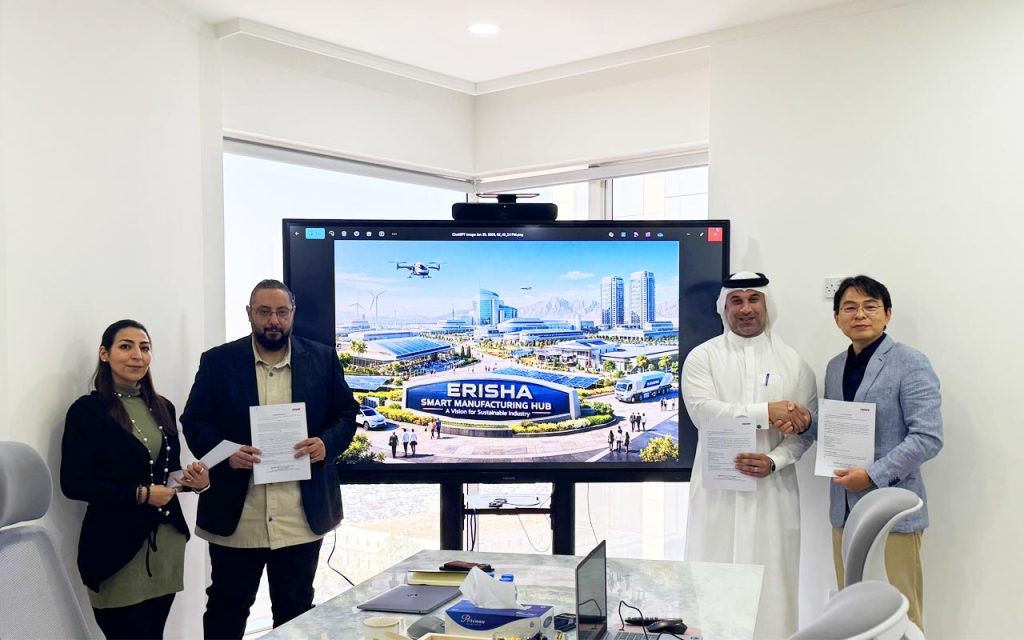
According to Lim, many Korean brands still operate using what he described as a “push” model, where products are shipped into distributor warehouses without creating enough local consumer demand.
“Simply pushing products into a distributor’s warehouse does not create a market,”
Lim said.
“Long-term traction begins when a company creates a pull mechanism where consumers actively seek the product, retailers see movement, and distributors reorder based on actual demand.”
Many companies have been continuously measuring success through shipment volume or distributor agreements instead of sell-through performance inside stores. Little did they realize that products may have entered retail channels but still failed to generate sustainable reorder cycles.
Lim then explained that successful brands usually remain directly involved in operational execution, including merchandising, promotions, pricing, inventory monitoring, and retail visibility.
“The real difference is between companies that merely supply products and companies that actively operate the market.”
Distributor Selection Has Become a Structural Risk for Korean SME Expansion
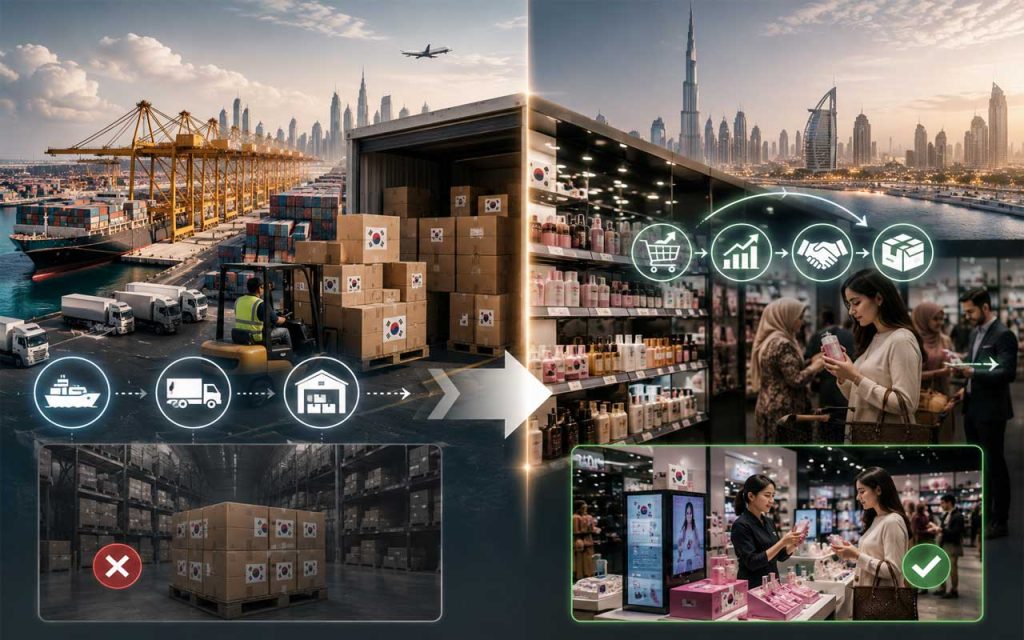
Not only that, but distributor selection remains one of the most underestimated challenges for Korean SME expansion into the Middle East.
The UAE and broader GCC region continue relying heavily on distributor and agency-led commercial structures. According to the U.S. International Trade Administration, local distributors often handle product registration, inventory replenishment, merchandising, retail coordination, and in-store promotions.
Now, many Korean companies still prioritize large distributor names or regional market presence during partner selection. Lim believes that approach can create long-term problems.
“Large distributors often manage hundreds of brands, and a new Korean brand can easily become a low-priority item.”
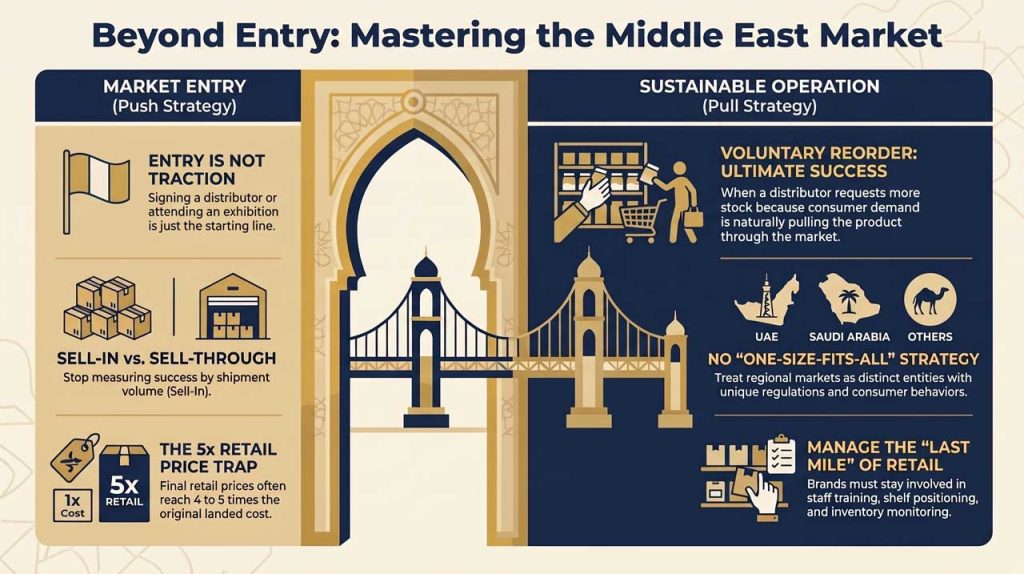
The problem becomes even more sensitive once pricing structures are layered across logistics, customs duties, distributor margins, retailer margins, and marketing costs. Lim noted that final retail prices can sometimes rise to four or five times the original landed cost by the time products reach consumers.
“If Korean companies set export prices without considering this structure, the product may lose price competitiveness as soon as it reaches the shelf.”
This challenge has become increasingly important as Korean brands expand across categories such as K-beauty, smart devices, wellness products, and consumer electronics, all of which face intense competition inside Gulf retail environments.
Why Sell-Through Execution Matters More Than Initial Shipments
Middle Eastern retail markets have also become far more execution-driven than many Korean companies initially expect.
The UAE alone has developed into one of the GCC’s largest e-commerce and modern retail markets, with Dubai Chamber projecting UAE e-commerce activity to reach approximately USD 8 billion. Consumers across Gulf markets are increasingly exposed to global brands, omnichannel retail experiences, and aggressive promotional competition.
Now, Lim said many Korean companies still focus too heavily on sell-in strategies while underestimating what happens after products reach stores.
“Many companies focus on sell-in, meaning getting products into retail channels, but they fail to manage sell-through, meaning actual consumer sales.”
According to Lim, shelf positioning, in-store activation, staff education, replenishment speed, pricing consistency, and inventory turnover all directly affect whether products continue moving after launch.
“A product may be listed in a major retailer, but if it is placed poorly, if sales staff cannot explain it, if the price is inconsistent across channels, or if replenishment is slow, the product will not move.”
He then added that shipment volume itself can often create misleading signals for Korean headquarters.
“Products may be shipped but not sold.
What matters is the actual consumer movement.”
The Middle East Is Not One Market Despite Regional Growth Momentum
The Gulf’s economic diversification efforts continue creating new opportunities for Korean companies. Saudi Arabia’s Vision 2030 strategy has accelerated investment across retail, manufacturing, smart infrastructure, healthcare, and digital transformation. The UAE has also continued strengthening its position as a regional logistics, technology, and investment hub.
Still, Lim warned against treating the Middle East as a single unified market.
“The UAE is an important hub, but success in the UAE does not automatically translate into success in Saudi Arabia, Iraq, Jordan, Lebanon, or other markets.
Each country requires its own strategy, partner network, regulatory understanding, and pricing structure.”
That complexity increasingly matters as more Korean brands attempt to scale beyond initial GCC entry points.
The Middle East Is Testing More Than Korean Product Competitiveness
In the end, the Gulf’s appetite for Korean brands is clearly growing. CEPA, retail expansion, logistics infrastructure, and regional diversification policies have all lowered barriers for Korean companies looking beyond traditional Asian and Western markets.
Still, the region is quietly exposing a deeper weakness inside many overseas expansion strategies. And for many Korean companies, the real challenge is no longer how to enter the Middle East.
Instead, it is staying visible long enough to become part of the market itself, just as Lim described,
“The strongest signal is the voluntary reorder from the distributor.
If the distributor requests additional orders without being pushed by the Korean headquarters, then it means the product is actually moving in the market.”
Key Takeaways
- Korea-UAE CEPA has improved formal market access, but operational execution still determines long-term commercial success.
- Many Korean companies still confuse market entry with sustainable commercial traction.
- Distributor selection, pricing structure, and retail execution remain the three biggest post-entry risk areas.
- Gulf retail markets increasingly depend on sell-through performance, not shipment volume alone.
- Strong logistics infrastructure in Dubai and the UAE makes entry easier, but it also increases competition for shelf space and consumer attention.
- Sustainable Middle East expansion often depends on inventory turnover, reorder behavior, merchandising, retail visibility, and long-term local engagement.
- The Middle East should not be treated as one unified market because Saudi Arabia, the UAE, Iraq, Jordan, and Lebanon operate under different retail, pricing, and partnership dynamics.
- Korean companies that succeed long term are usually the ones that actively operate the market instead of simply supplying products into it.
– Stay Ahead in Korea’s Startup Scene –
Get real-time insights, funding updates, and policy shifts shaping Korea’s innovation ecosystem.
➡️ Follow KoreaTechDesk on LinkedIn, X (Twitter), Threads, Bluesky, Telegram, Facebook, and WhatsApp Channel.
🤝 Looking to connect with verified Korean companies building globally?
Explore curated company profiles and request direct introductions through beSUCCESS Connect.