
KoreaTechDesk | Korean Startup and Technology News

Sat, June 13, 2026

Sign in

Virtual Demo Day
Menu
  • Home
  • Startup News
    • AI & Big Data
    • AR & VR
    • Blockchain
    • Clean Technology
    • Content & Games
    • Cybersecurity
    • Enterprise & SaaS
    • FinTech
    • Gadgets & Electronics
    • Health & Bio
    • Manufacturing
    • Press Release
    • IoT
    • Marketplaces & E-commerce
    • Robotics
    • Transportation
    • Investments
    • Ecosystem & Lists
  • Governments
    • Artificial Intelligence Industry Cluster Agency
    • Daegu Technopark
    • GANGNAM-GU
    • Gyeonggido Business & Science Accelerator
    • Hwaseong Industry Promotion Agency
    • Invest Seoul
    • Korea Creative Content Agency
    • Korea Internet & Security Agency
    • Korea Information Security Industry Association
    • Korea Institute of Startup & Entrepreneurship Development
    • Korea Tourism Organization
    • Korea Trade-Investment Promotion Agency
    • Ministry of Culture, Sports and Tourism
    • Ministry of SMEs & Startups
    • National IT Industry Promotion Agency
    • Pangyo Techno Valley
    • Seoul Business Agency
    • Seoul FinTech Lab
    • South Gyeongsang Province
    • Seoul Metropolitan Government
  • Events
    • COMEUP
    • Korea Fintech Week
    • K-Content Expo
    • NextRise
    • Try Everything
  • Interviews
    • Investors’ interviews
    • Founders’ interviews
  • Programs
    • Asan Voyager
    • CAPA Global Program
    • Campus Town Program
    • SGSC Global Bootcamp
    • Gangnam-gu Global Roadshow
    • Global SaaS Marketplace Support Project
    • LAUNCHPAD
    • COMEUP STARS 120
    • K-Startup Grand Challenge
    • TIPS X beSUCCESS Global Project
    • SFL Global Program
    • KTO Global Showcase
    • Yonsei Univ Global Class
    • KOSME Global Program
  • Partner With Us
    • Press Release
    • Startup Scouting
    • Business Agencies
    • Global Mentorship Program
    • Investment Opportunities
    • K-Scouter Program
  • Lists
  • Home
  • Startup News
    • AI & Big Data
    • AR & VR
    • Blockchain
    • Clean Technology
    • Content & Games
    • Cybersecurity
    • Enterprise & SaaS
    • FinTech
    • Gadgets & Electronics
    • Health & Bio
    • Manufacturing
    • Press Release
    • IoT
    • Marketplaces & E-commerce
    • Robotics
    • Transportation
    • Investments
    • Ecosystem & Lists
  • Governments
    • Artificial Intelligence Industry Cluster Agency
    • Daegu Technopark
    • GANGNAM-GU
    • Gyeonggido Business & Science Accelerator
    • Hwaseong Industry Promotion Agency
    • Invest Seoul
    • Korea Creative Content Agency
    • Korea Internet & Security Agency
    • Korea Information Security Industry Association
    • Korea Institute of Startup & Entrepreneurship Development
    • Korea Tourism Organization
    • Korea Trade-Investment Promotion Agency
    • Ministry of Culture, Sports and Tourism
    • Ministry of SMEs & Startups
    • National IT Industry Promotion Agency
    • Pangyo Techno Valley
    • Seoul Business Agency
    • Seoul FinTech Lab
    • South Gyeongsang Province
    • Seoul Metropolitan Government
  • Events
    • COMEUP
    • Korea Fintech Week
    • K-Content Expo
    • NextRise
    • Try Everything
  • Interviews
    • Investors’ interviews
    • Founders’ interviews
  • Programs
    • Asan Voyager
    • CAPA Global Program
    • Campus Town Program
    • SGSC Global Bootcamp
    • Gangnam-gu Global Roadshow
    • Global SaaS Marketplace Support Project
    • LAUNCHPAD
    • COMEUP STARS 120
    • K-Startup Grand Challenge
    • TIPS X beSUCCESS Global Project
    • SFL Global Program
    • KTO Global Showcase
    • Yonsei Univ Global Class
    • KOSME Global Program
  • Partner With Us
    • Press Release
    • Startup Scouting
    • Business Agencies
    • Global Mentorship Program
    • Investment Opportunities
    • K-Scouter Program
  • Lists
2026-02-25_AIS 2026_Conference Banners_1920x480
Home Lists and Guides

Foreign Companies Budget for Korea Entry, but the Real Costs Start After Hiring

by KoreaTechDesk Writer
May 23, 2026
in Lists and Guides
0

Many foreign companies approach South Korea with a clear expansion budget. They calculate office setup, salaries, marketing, and launch costs. Then operations begin, and a second layer of expenses starts to appear. In Korea, the real cost of market entry often emerges after the first employee is hired, when payroll obligations, statutory protections, audit exposure, and slower execution begin shaping the business.

Why Korea Expansion Budgets Often Miss the Real Cost Layer

South Korea remains an attractive market for global companies seeking advanced consumers, strong digital infrastructure, and access to Northeast Asia. Unfortunately, market-entry budgets are often built around visible costs only, such as incorporation, office rent, staffing plans, and initial go-to-market spending.

What many firms underestimate is the operating burden that begins once the company starts functioning as a real employer and regulated corporate entity.

As discussion on Korea expansion playbook continues, Chris Song, Founder and Managing Partner at Hyesung Accounting & Advisory Corporation, told KoreaTechDesk that this is a recurring pattern among foreign entrants.

“The actual cost of hiring employees is significantly higher than base salary alone.”

That observation goes beyond mere payroll. It reflects how Korea’s business environment shifts costs into compliance, long-term obligations, and management readiness after launch.

Hiring in Korea: Salary Is Only the Starting Point

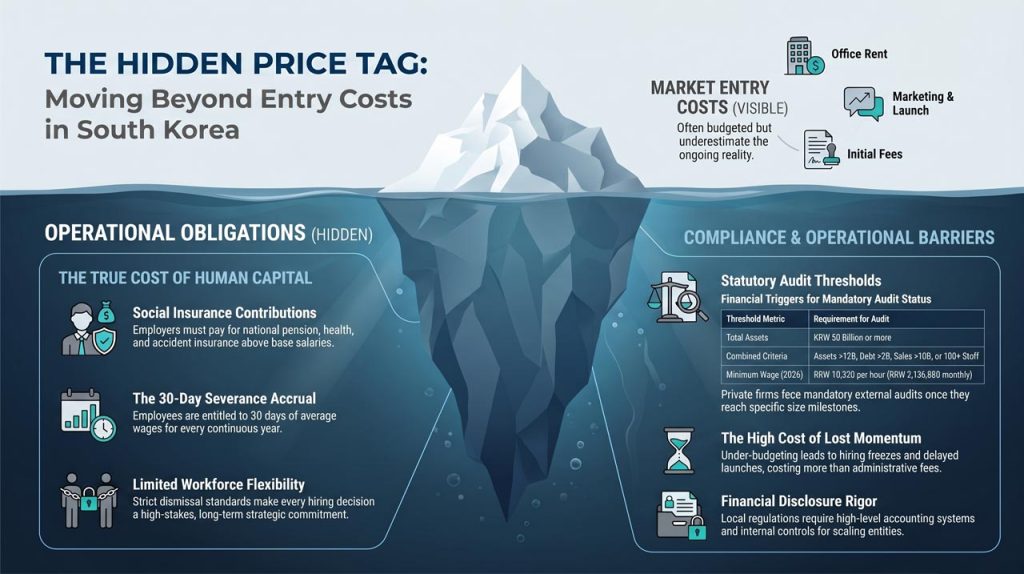
Korea’s 2026 minimum wage was set at KRW 10,320 per hour, with a monthly equivalent of KRW 2,156,880 based on the standard monthly working-hour calculation, according to the Ministry of Employment and Labor.

That figure is only the visible layer. Employers must also contribute to statutory social insurance systems, including national pension, health insurance, long-term care insurance, employment insurance, and industrial accident compensation insurance.

These obligations mean the real cost of one employee is materially higher than headline salary figures suggest. And for overseas startups or mid-sized firms entering Korea for the first time, that difference can distort hiring plans if budgets were built using only gross wage assumptions.

The issue becomes sharper when companies scale quickly. A team of five or ten employees can create a very different monthly cost base than expected if employer-side contributions were not modeled early.

Korea Severance Pay Creates a Cost That Builds Quietly

Illustration of salary. | Freepik

Another cost many foreign firms fail to model correctly is severance.

Under Korea’s labor framework, eligible employees are entitled to at least 30 days of average wages for each year of continuous service, according to official labor guidance. This means labor cost is not limited to monthly payroll. Part of the obligation accumulates over time.

Now for growing companies, this changes runway planning. Headcount expansion may look manageable during the first months of operation, but deferred obligations rise in the background.

Song noted,

“If these ‘human capital retention costs’ are not properly factored in from the outset, they can create unexpected pressure on initial budgets.”

That makes Korea hiring decisions more strategic than many founders initially assume.

Workforce Flexibility Is Different in Korea

Many global firms are accustomed to treating hiring plans as adjustable. But South Korea requires a more deliberate approach.

Labor protections and dismissal standards mean staffing decisions often carry more operational weight than in highly flexible employment markets. This means companies need stronger planning discipline before expanding headcount aggressively.

This is especially relevant for startups entering Korea with uncertain revenue timing. If growth takes longer than expected, labor cost can become a structural pressure point rather than a temporary expense.

Audit and Disclosure Requirements Can Surprise Private Foreign Firms

Another hidden transition occurs when a Korea entity grows beyond a modest operating size.

Under Korea’s external audit framework, certain companies become subject to statutory external audit requirements once they cross defined scale thresholds.

These include companies with total assets of KRW 50 billion or more, or those that meet multiple criteria such as assets above KRW 12 billion, liabilities above KRW 7 billion, annual sales above KRW 10 billion, or more than 100 employees, according to Korea’s external audit regulations.

And for some foreign private companies, this can be an unfamiliar shift.

Song described this as another common surprise for overseas entrants.

“Another area that often comes as a surprise to foreign companies is financial disclosure and audit requirements.”

Many founders assume private-company reporting norms from their home markets will apply in Korea. In practice, scaling can bring a higher level of formal financial scrutiny.

That means finance operations in Korea cannot remain an afterthought. Accounting systems, internal controls, and reporting readiness become part of expansion execution.

The Most Expensive Cost May Be Lost Momentum

Some costs appear on invoices. But others show up in missed time.

When budgets prove incomplete, companies often need to slow hiring, revise internal approvals, revisit finance systems, or delay commercial plans while new obligations are addressed. None of those items may look like a massive issue individually. But together, they can reduce momentum during the most important growth phase.

Song identified this clearly to KoreaTechDesk.

“The most significant impact is often the opportunity cost.”

That may be the most important lesson in Korea expansion planning. A delayed market move, slower team build, or postponed launch can cost more than many visible administrative fees.

Korea Is Not Unusually Expensive. It Is Operationally Structured

Now, it doesn’t necessarily mean that Korea is a “high-cost market.” Many advanced economies impose employer obligations and reporting standards. But the difference is that these Korea’s obligations become critical quickly once a company begins hiring and scaling.

That is why for foreign operators, success does not just depend on reducing costs. They must also forecast them accurately.

Because in the end, companies that plan for payroll load, severance accrual, reporting readiness, and disciplined hiring tend to adjust smoothly. And those that budget only for entry often learn the hard lesson. Because only after launch, they realize that expansion economics will significantly change.
Hidden cost in Korea expansion. | AI infographic

Why Operating Costs, Not Entry Costs, Define Korea Expansion Success

The common mistake in Korea market entry is assuming setup cost is the main hurdle. It is often only the first payment.

Once hiring begins, Korea’s structured labor and reporting environment starts shaping cash flow, execution speed, and management priorities.

So for foreign companies expanding into one of Asia’s most strategic markets, the smarter question is no longer how much it costs to enter Korea. It is how much it costs to operate properly after arrival.

Key Takeaway

  • Base salary is not total labor cost in Korea. Employer-side insurance contributions materially raise payroll expense.
  • Severance obligations accumulate over time, making headcount planning more strategic than it first appears.
  • Workforce flexibility differs by market, so hiring decisions often carry greater long-term weight.
  • Statutory audit and disclosure thresholds can affect growing private foreign companies.
  • Opportunity cost may exceed visible fees when incomplete budgeting slows hiring, launches, or expansion plans.
  • Korea rewards prepared operators who budget for real operating conditions, not just market entry.

🤝 Looking to connect with verified Korean companies building globally?
Explore curated company profiles and request direct introductions through beSUCCESS Connect.


– Stay Ahead in Korea’s Startup Scene –
Get real-time insights, funding updates, and policy shifts shaping Korea’s innovation ecosystem.
➡️ Follow KoreaTechDesk on LinkedIn, X (Twitter), Threads, Bluesky, Telegram, Facebook, and WhatsApp Channel.

Tags: doing business in koreaforeign companies in koreahiring employees in koreakorea business compliancekorea employment costKorea expansionkorea expansion costskorea labor laws for foreign companieskorea payroll costskorea severance paykorea social insurance contributionsKorea startup expansionkorea statutory audit requirements
Previous Post

Why Korean Brands Struggle in the Middle East After Market Entry

Next Post

Why Korean Food Startups Fail After the Recipe Stage

Next Post

Why Korean Food Startups Fail After the Recipe Stage

MOST READ ARTICLE OF THE WEEK

1.
Can Your Startup Scale Without You? AsiaStartupExpo Q2 2026 Opens, Spotlighting Scalable Execution
7 Jun 2026
2.
Why Early Warning Signals Rarely Reach Decision-Makers in Korean Firms
7 Jun 2026
3.
Korea Is Buying More GPUs. The Bigger Question Is How Many Are Actually Being Used
8 Jun 2026
4.
Why Sell-Through, Not Sell-In, Decides Korean Brand Survival in the Middle East
8 Jun 2026
5.
Why Korea Is Becoming a Stress Test for Context-Aware AI
9 Jun 2026
Register for Event

AIS-2026 Conference

AIS 2026 Conference

List Article

1.
Why Good Startups Still Fail the Venture Capital Test
10 Jun 2026
2.
The Hardest Part of Korea Market Entry: Staying in The Game
3 Jun 2026
3.
Why M&A Value Is Lost After the Deal Closes
30 May 2026
4.
Foreign Companies Budget for Korea Entry, but the Real Costs Start After Hiring
23 May 2026
5.
Why Fast Korea Entry Structures Can Become Expansion Traps
16 May 2026

Similar Articles

Lists and Guides

Why Good Startups Still Fail the Venture Capital Test

More
Lists and Guides

The Hardest Part of Korea Market Entry: Staying in The Game

More
Lists and Guides

Why M&A Value Is Lost After the Deal Closes

More

Topics

Menu
  • AI & Big Data
  • AR & VR
  • Blockchain
  • Clean Technology
  • Content & Games
  • Cybersecurity
  • Enterprise & SaaS
  • FinTech
  • Gadgets & Electronics
  • Health & Bio
  • IoT

Program

Menu
  • Asan Voyager
  • CAPA Global Program
  • SGSC Global Bootcamp
  • LAUNCHPAD
  • COMEUP STARS 120
  • K-Startup Grand Challenge
  • TIPS X beSUCCESS Global Project
  • SFL Global Program
  • KTO Global Showcase
  • Yonsei Univ Global Class
  • KOSME Global Program

About

Menu
  • About Us
  • all articles
  • Terms of Use
  • Privacy
  • Cookie-policy
  • twitter

Subscribe and be informed first hand about actual Korean startup news.

All the day’s headlines and highlights, direct to you every morning.

[mc4wp_form id="3766"]

Contact us : [email protected]

Topics

Menu
  • AI & Big Data
  • AR & VR
  • Blockchain
  • Clean Technology
  • Content & Games
  • Cybersecurity
  • Enterprise & SaaS
  • FinTech
  • Gadgets & Electronics
  • Health & Bio
  • IoT

Program

Menu
  • Asan Voyager
  • CAPA Global Program
  • SGSC Global Bootcamp
  • LAUNCHPAD
  • COMEUP STARS 120
  • K-Startup Grand Challenge
  • TIPS X beSUCCESS Global Project
  • SFL Global Program
  • KTO Global Showcase
  • Yonsei Univ Global Class
  • KOSME Global Program

About

Menu
  • About Us
  • all articles
  • Terms of Use
  • Privacy
  • Cookie-policy
  • twitter

Subscribe and be informed first hand about actual Korean startup news.

All the day’s headlines and highlights, direct to you every morning.

[mc4wp_form id="3766"]

© 2023 Koreantech News & Media Korea Zrt. All rights reserved.

Our Spring Sale Has Started

You can see how this popup was set up in our step-by-step guide: https://wppopupmaker.com/guides/auto-opening-announcement-popups/

Our Spring Sale Has Started

You can see how this popup was set up in our step-by-step guide: https://wppopupmaker.com/guides/auto-opening-announcement-popups/

We hope you enjoy our content, May you please give us Feedback regarding our website!

[gravityform id=”17″]

dgdfgfdgdf

What you think about Koreatechdesk, Share your idea with us!

[gravityform id=”16″]

Invitation submission has been closed