
A growing number of global companies are entering South Korea with confidence, backed by strong market signals and expanding investment flows. Yet, many discover that the real challenge begins after the decision is made. The issue is no longer access. It is in the execution. Because what looks standardized on the surface often becomes complex when global assumptions meet local reality.
Korea Is Attracting Global Capital. Execution Is Where It Gets Tested
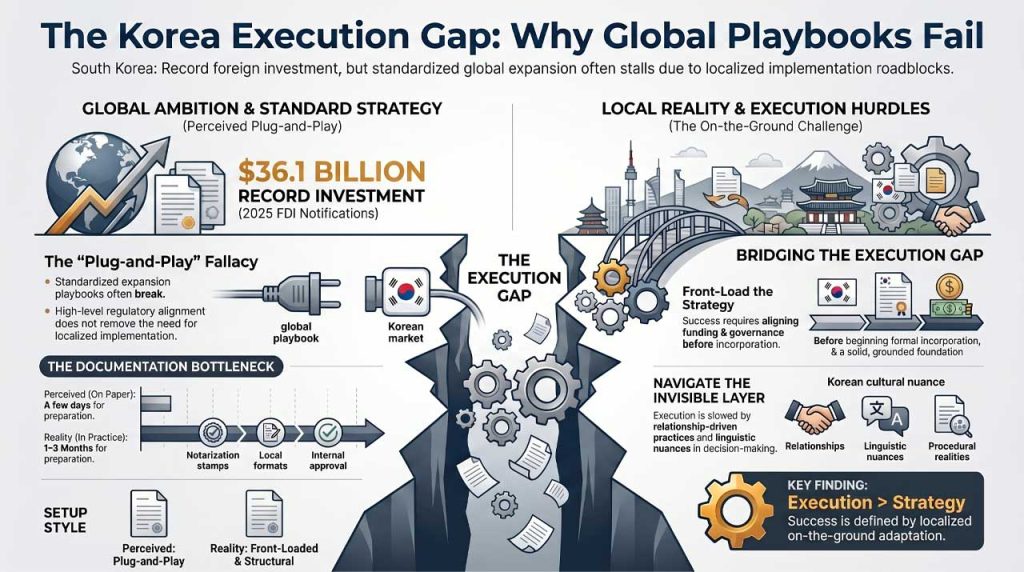
South Korea is no longer a peripheral market in global expansion strategies. According to the Ministry of Trade, Industry and Energy, foreign direct investment (FDI) notifications have reached approximately USD 36.1 billion in 2025, the highest level on record. The trend continued into early 2026, with Q1 FDI notifications reaching USD 6.41 billion and actual investment arrivals rising sharply year-on-year.
Large-scale commitments further reinforce this positioning as well. During the same period, global companies including Amazon Web Services and Siemens Healthineers announced multi-billion-dollar investment plans, with total pledged projects reaching around USD 9 billion during major investment events.
This level of inbound interest creates a natural assumption among foreign companies. If global capital is flowing and regulatory frameworks are aligning, entry should certainly be straightforward.
But in practice, this is where the first misalignment begins.

The Assumption That Global Standards Will Translate Directly
Many companies approach Korea with a global expansion playbook that has worked across multiple markets. And they have a set expectation: if systems, governance models, and operational frameworks are already standardized, they should function similarly in Korea.
Chris Song, Founder and Managing Partner at Hyesung Accounting & Advisory Corporation, pointed this as the most common breakdown in an interview with KoreaTechDesk.
“The most common assumption that breaks down for global companies entering Korea is that global standards should work as-is.”

Korea’s regulatory environment has indeed become more aligned with global standards. Its workforce is also increasingly international. And these factors contribute to the general perception of accessibility.
However, alignment at a high level does not remove the need for localized execution.
“The core issue is that a strategy that works globally does not automatically translate into effective execution in Korea,”
Song explained.
This gap is subtle but critical in practice. It may not appear at the strategy stage, but it emerges during implementation.
Where Execution Actually Slows Down
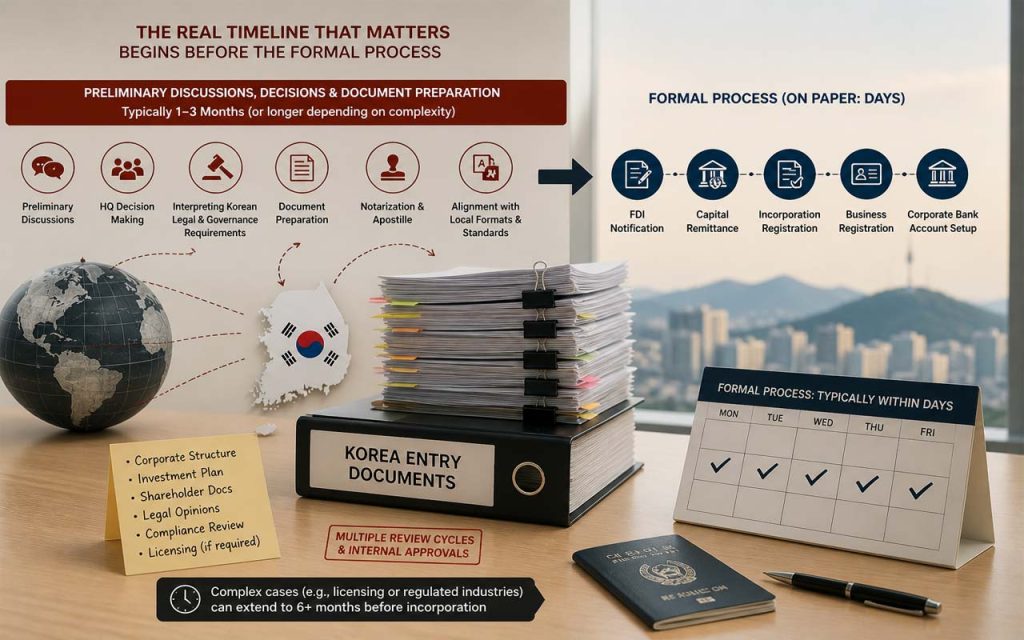
Official investment frameworks in Korea present a structured and transparent process. Foreign companies typically follow a sequence that includes foreign direct investment notification, capital remittance, incorporation registration, business registration, and corporate bank account setup.
On paper, these steps look like they can just be completed within days. However, this view reflects only the formal process. According to Song, the actual timeline that matters begins much earlier.
“In practice, it generally takes at least about one month to complete preliminary discussions, key decision-making, and document preparation.
Depending on the complexity, this phase can extend to two to three months.”
The cause of the delay is not in regulatory opacity. It is within the interaction between headquarters decision-making and local requirements.
Foreign executives often need to interpret Korean legal structures, governance rules, and documentation standards that differ from their home markets. This then creates a translation layer that slows internal approvals. Corporate documents may require notarization, apostille certification, and alignment with local formats.
In more complex cases, particularly those involving licensing or regulated industries, the timeline can even extend significantly. Song cited an example of a Hong Kong-based venture capital firm that spent over six months evaluating regulatory requirements and structural options before moving to incorporation.
The delay, in this context, is not procedural inefficiency. It is the result of misalignment between global assumptions and local execution demands.
Korea’s Process Is Predictable. It Is Not Plug-and-Play
Comparisons with other Asian markets often create the wrong expectations. Singapore, for example, is widely known for fast company incorporation. So many global companies assume a similar experience across the region.
But Korea follows a different sequence. Key requirements such as foreign direct investment reporting are built into the early stage of the setup process. This means companies spend more time upfront aligning documentation, approvals, and funding structure before incorporation is completed.
As a result, the process can feel slower at the beginning. However, once these requirements are properly handled, later steps such as opening a corporate bank account tend to move more smoothly.
This difference is not about speed alone. It is about structure. Companies that apply the same entry approach used in other markets often struggle because they are not prepared for this sequencing.
So, for global operators, expanding into Asia cannot rely on a single standardized playbook. Each market requires its own execution approach.
The Invisible Layer: Culture, Language, and Business Practice
Beyond regulatory processes, execution challenges extend into less visible areas.
“Korea still presents cultural and linguistic barriers, along with invisible hurdles that arise during business execution,”
Song said.
These factors rarely appear in initial market assessments. Instead, they emerge during hiring, internal coordination, negotiations, and day-to-day operations.
Even as Korea becomes more globalized, its business environment remains relationship-driven in many sectors. Local expectations around communication, decision-making, and coordination can differ from global headquarters practices.
This then creates a second layer of misalignment. Companies may have the correct legal structure and regulatory approvals yet still face operational friction if local practices are not fully understood.
Korea Recognizes the Gap. The System Is Still Evolving
Korea’s policy framework increasingly acknowledges that execution challenges persist beyond formal market entry. The Foreign Investment Ombudsman, operated under KOTRA, is tasked with handling practical difficulties reported by foreign-invested companies, covering areas such as taxation, labor, foreign exchange, and regulatory interpretation.
In 2025, the Ministry of Trade, Industry and Energy, together with the Ombudsman, initiated a regulatory review process targeting 40 foreign investment-related cases, including rules considered restrictive or misaligned with international business practices. This followed direct input collected from foreign companies operating in Korea, reflecting ongoing friction at the execution stage rather than at the entry decision itself.
Yes, these efforts signal that the challenge is not ignored. However, they also reinforce a key point: if execution friction is being actively addressed at the policy level, it remains a real factor for companies on the ground.
The Real Shift: From Market Access to Execution Capability
The global narrative around Korea has evolved. Access is no longer the primary constraint. Distribution channels, digital platforms, and investment pathways are already established.
The constraint has now shifted to execution capability.
Song clearly explained,
“Success is less about the strategy itself, and more about how well that strategy is localized and executed on the ground.”
Entering Korea is no longer a question of whether the market is open. It is a question of whether the organization is prepared to operate within its specific execution environment.
Companies that recognize this early tend to approach market entry with a more localized execution mindset, investing in on-the-ground insight while adjusting internal processes and aligning headquarters expectations with Korea’s operational realities.
Meanwhile, those that do not adjust tend to experience delays that are difficult to diagnose. The strategy appears sound. The market demand is real. Yet progress slows because execution was never fully localized.
Why Execution, Not Market Access, Now Defines Success in Korea
South Korea’s position in the global startup and investment ecosystem continues to strengthen. The rise in foreign direct investment and the entry of global players confirm its strategic importance.
At the same time, the experience of companies on the ground tells a more nuanced story. The challenge is no longer gaining access to Korea. It is translating global ambition into local execution.
Because in the end, for global operators, this shift defines the difference between entering the market and actually operating within it.
Key Takeaway
- Korea is attracting record levels of foreign direct investment, confirming strong global demand for market entry.
- The primary challenge has shifted from access to execution, particularly during the transition from strategy to implementation.
- Global expansion playbooks often fail when applied directly, as local regulatory, documentation, and governance requirements require adaptation.
- Execution delays typically occur during internal decision-making and preparation, not during formal registration processes.
- Korea’s system is structured and predictable, but not plug-and-play, requiring market-specific operational design.
- Cultural, linguistic, and business practice differences remain critical execution factors, even in a globalized environment.
- Success in Korea depends on localization of execution, not just strength of global strategy.
– Stay Ahead in Korea’s Startup Scene –
Get real-time insights, funding updates, and policy shifts shaping Korea’s innovation ecosystem.
➡️ Follow KoreaTechDesk on LinkedIn, X (Twitter), Threads, Bluesky, Telegram, Facebook, and WhatsApp Channel.
🤝 Looking to connect with verified Korean companies building globally?
Explore curated company profiles and request direct introductions through beSUCCESS Connect.