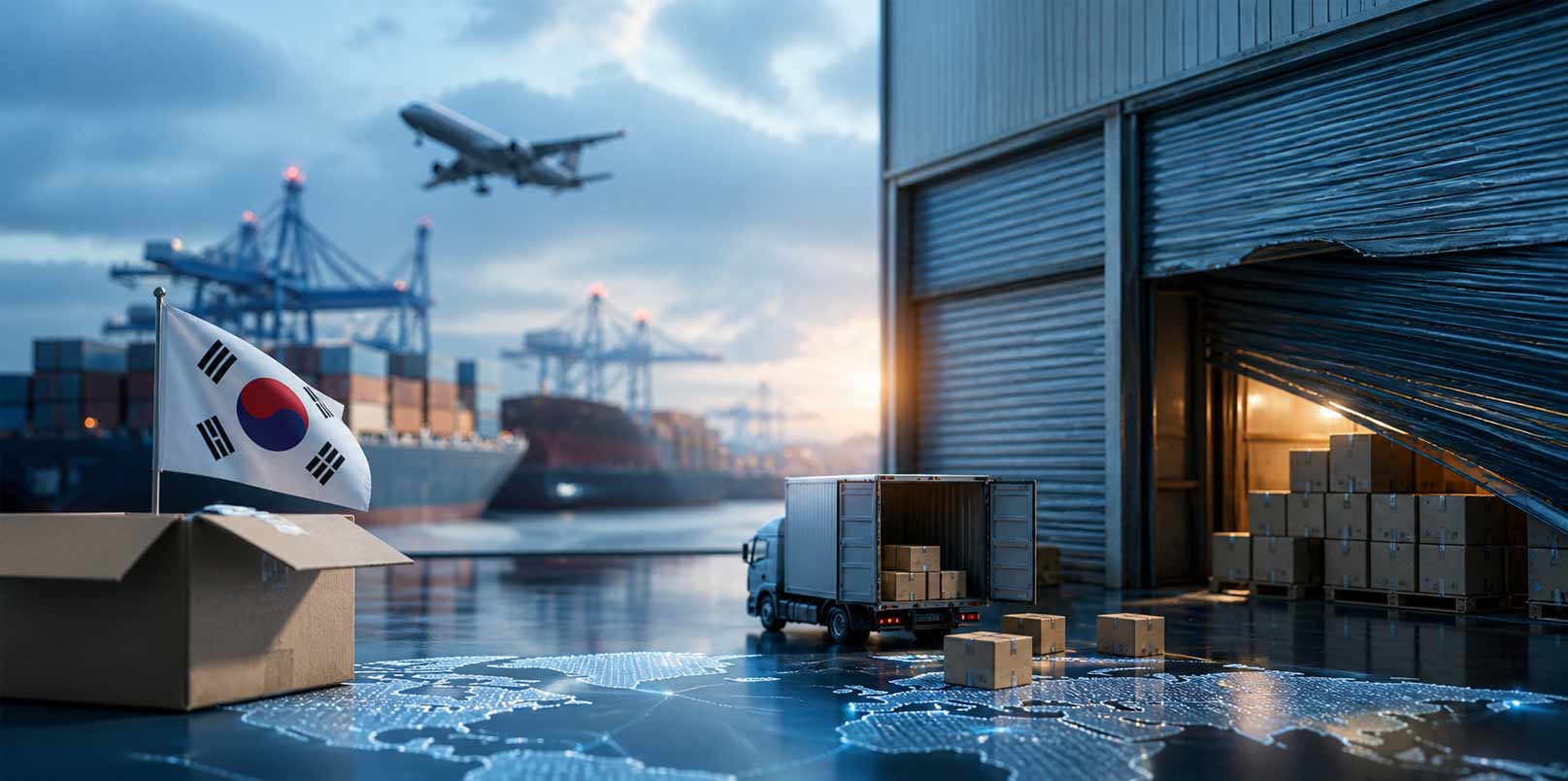
A Korean brand had already done what most expansion playbooks aim for. Products were shipped, inventory was positioned, and local operations had begun. Then the warehouse stopped operating. What followed was not a delay in delivery but a breakdown in coordination. The Middle East situation is now revealing a deeper vulnerability in Korea’s global startup expansion model, one that sits inside the operator layer.
Middle East Expansion: When Market Entry Is No Longer the Hard Part
Korea’s startup expansion into the Middle East has been framed around access, demand, and logistics. Previously, KoreaTechDesk has discussed how shipping routes, costs, and mobility constraints disrupted execution across the region.
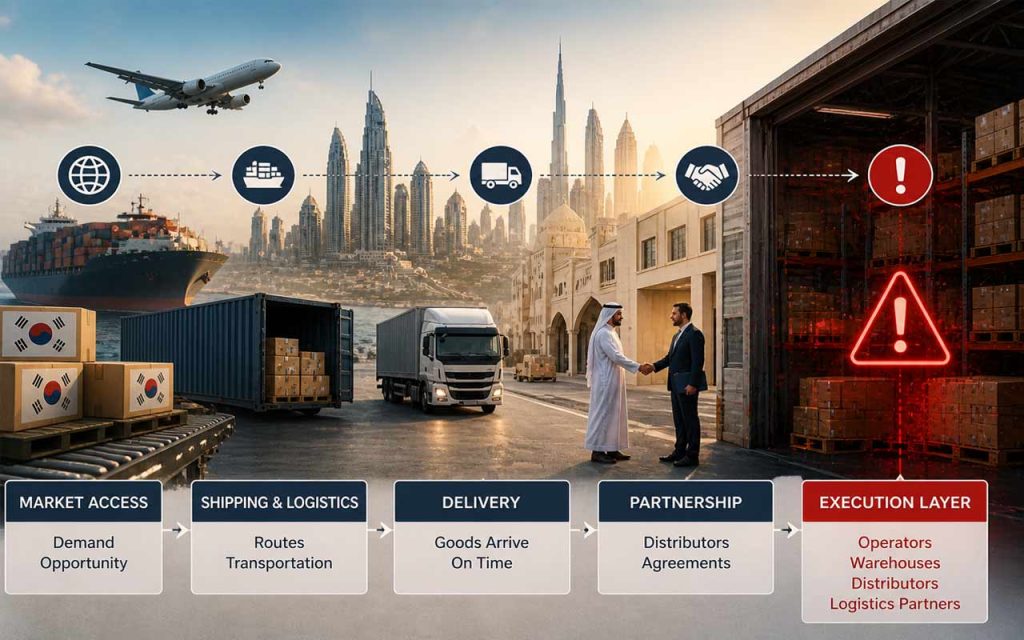
What is emerging now is more granular. The failure point is shifting into the layer where operations actually happen. Even after products arrive and partnerships are in place, execution can stall when local operators, warehouses, distributors, and logistics partners fall out of sync.
And at the operational level, this is where expansion can begin to break down.
A UAE Warehouse Shutdown Reveals Where Execution Breaks
The most direct signal comes from the ground.
Elvira Tur López, Founder and CEO of TANIT Overseas Connections, which supports Korean brands across the Middle East and other global markets, described a particular case involving a Korean client with inventory already positioned in the UAE.
“A recent example from our side involved a client who had stock already positioned in a UAE warehouse, and due to the situation, the operator decided to discontinue operations, requiring us to quickly coordinate alternative storage and relocation solutions.”
This situation is structurally different from earlier disruption phases. Because this time, the product had already reached the target market. So the challenge was no longer shipping or demand. It was the sudden loss of a single operational node.
The warehouse operator’s decision forced immediate coordination across storage providers, logistics partners, and local handling processes. Without that coordination, even inventory inside the market becomes unusable.
Why Execution Now Depends on Operator Coordination
Apparently, this is not an isolated case.
A notice published through Dubai Trade confirmed that containers entering the UAE may now be discharged at alternative ports such as Khorfakkan or Fujairah before being transported under bonded trucking arrangements to Jebel Ali for final customs clearance. This requires coordination between shipping lines, port authorities, customs systems, and land transport operators at each stage.
At the same time, logistics operators such as AD Ports have reported handling more than 54,000 TEU through alternative routes, supported by land transport, feeder vessels, and expanded warehousing capacity. These adjustments reflect a system that is still functioning, but only through continuous operational realignment.
Reuters reporting also indicates that importers across the Gulf are rerouting cargo through secondary ports and relying on cross-border trucking to reach final destinations. That process introduces additional customs checks, congestion, and clearance delays.
Taken together, these developments show that execution is no longer linear. Each shipment now depends on a chain of actors that must adapt in real time.
Storage, Rerouting, and Temporary Handling Become Core Execution Layers
And so, the role of storage has also shifted.
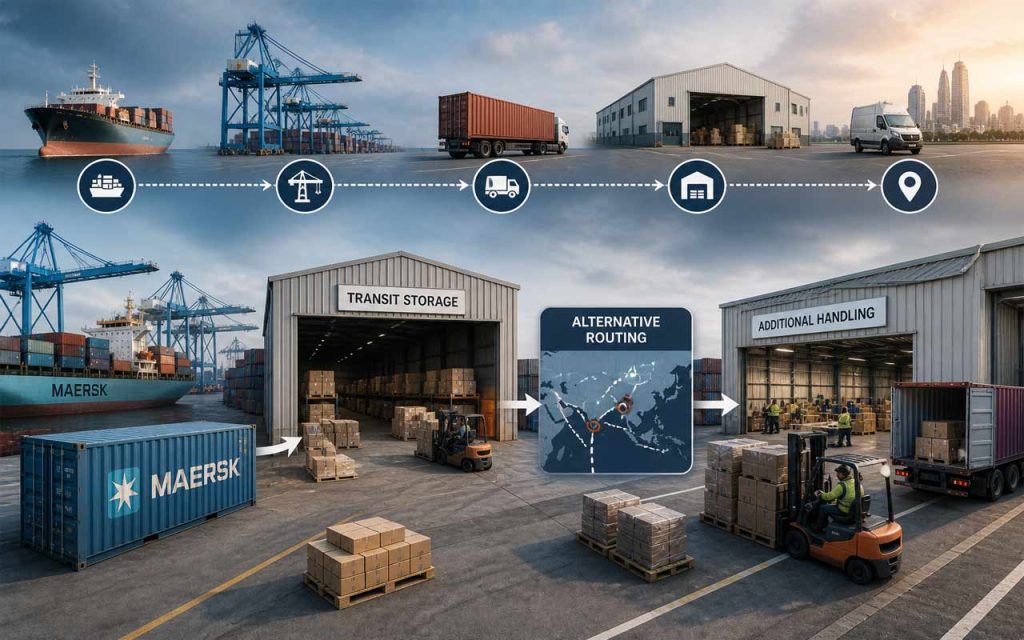
Maersk’s operational updates confirm that temporary storage, alternative routing, and additional handling steps have become standard responses to disruption. In some cases, shipments are held in transit storage before onward delivery can be arranged.
This aligns directly with what Korean operators are experiencing on the ground. A warehouse is no longer just a passive storage point. It has become part of the execution infrastructure that determines whether goods can continue moving or remain stuck.
When a warehouse operator exits or changes operations, the entire downstream process must be rebuilt.
Korean SME Data Shows Execution Problems Spreading Across Workflows
Recent Korean reporting adds further context.
As of late April, Korean authorities had received 733 reports of Middle East-related export damage or operational difficulty, with 547 cases confirmed as actual issues. Among these, contract cancellations or holds accounted for 187 cases, while business travel disruption and unpaid receivables were also reported.
These categories reflect more than cost pressure. They point to breakdowns in coordination, timing, and operational continuity.
Export activity itself has also become uneven. According to Korea’s Ministry of Trade, Industry and Energy, exports to the Middle East fell by 49.1 percent year-on-year in March 2026 to approximately USD 0.9 billion, even as overall Korean exports reached record levels globally.
The divergence suggests that the issue is not demand collapse across Korea’s export system. It is the difficulty of operating within specific regions under disrupted conditions.
Why Startups Are More Exposed at the Operator Layer
Large corporations manage disruption through redundancy. They can distribute inventory across multiple warehouses, work with several logistics providers, and maintain dedicated teams for customs, compliance, and local operations.
Startups rarely have that structure.
Many Korean export startups rely on a single distributor, one warehouse partner, or a limited set of logistics providers within a region. This concentration works under stable conditions. It becomes a vulnerability when any one node stops functioning.
Elvira Tur López noted that the operating environment has become more complex as logistics instability combines with disruptions in warehousing and distribution.
“The sharp increase in shipping costs, combined with route unpredictability and occasional disruptions in warehousing and distribution, has created a more complex environment to operate in.”
The complexity does not only come from cost. It also comes from the need to continuously realign multiple actors who are each responding to changing conditions.
The Shift from Logistics Problem to Execution Infrastructure Risk
The Middle East situation is often described through the lens of shipping routes and freight costs. But that only captures the early stage of disruption.
What is visible now is a transition into execution infrastructure risk.
KOTRA has begun providing daily updates on the operational status of 24 Middle Eastern ports while offering real-time guidance on alternative routes. The support has expanded to include local logistics arrangements and coordination with overseas logistics centers.
This reflects an institutional recognition that the problem extends beyond transportation. It sits in the coordination required after goods arrive, move between locations, and reach final partners.
For startups, this changes the definition of market entry. Entering a market is no longer only about shipping products and signing distribution agreements. It requires ensuring that the operational chain inside the market can continue functioning under stress.
What This Means for Global Startup Expansion
In the end, the Middle East remains a critical region for Korean startups seeking international growth. Demand for technology, infrastructure, and consumer products continues across major markets such as the UAE and Saudi Arabia.
The current situation does not remove that opportunity. But it does change the conditions under which it can be realized.
Execution now depends on the resilience of local operators, the flexibility of logistics networks, and the ability to coordinate across multiple stakeholders under uncertain conditions.
This is not unique to Korea. It reflects a broader shift in global startup expansion.
As cross-border operations become more complex, success will depend less on entering new markets quickly and more on maintaining operational continuity within them.
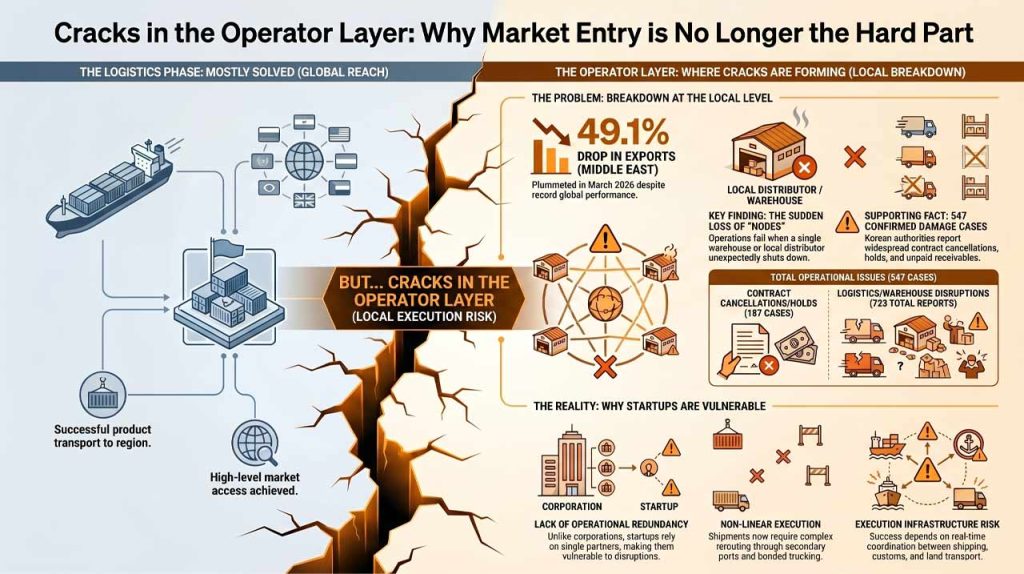
Key Takeaway for Global Startup Ecosystem
- Execution failure is shifting to the operator layer, where warehouses, distributors, and logistics partners must remain aligned
- A single operational breakdown, such as a warehouse shutdown, can halt market activity even after products arrive
- Public data shows rising coordination challenges, including contract holds, travel disruption, and uneven export performance
- Global logistics systems are adapting, but through multi-step processes involving rerouting, storage, and cross-border coordination
- Startups face higher exposure due to reliance on limited partners and lack of operational redundancy
- Cross-border expansion now requires execution infrastructure, not only market access and demand validation
– Stay Ahead in Korea’s Startup Scene –
Get real-time insights, funding updates, and policy shifts shaping Korea’s innovation ecosystem.
➡️ Follow KoreaTechDesk on LinkedIn, X (Twitter), Threads, Bluesky, Telegram, Facebook, and WhatsApp Channel.
🤝 Looking to connect with verified Korean companies building globally?
Explore curated company profiles and request direct introductions through beSUCCESS Connect.