
KoreaTechDesk | Korean Startup and Technology News

Mon, June 15, 2026

Sign in

Virtual Demo Day
Menu
  • Home
  • Startup News
    • AI & Big Data
    • AR & VR
    • Blockchain
    • Clean Technology
    • Content & Games
    • Cybersecurity
    • Enterprise & SaaS
    • FinTech
    • Gadgets & Electronics
    • Health & Bio
    • Manufacturing
    • Press Release
    • IoT
    • Marketplaces & E-commerce
    • Robotics
    • Transportation
    • Investments
    • Ecosystem & Lists
  • Governments
    • Artificial Intelligence Industry Cluster Agency
    • Daegu Technopark
    • GANGNAM-GU
    • Gyeonggido Business & Science Accelerator
    • Hwaseong Industry Promotion Agency
    • Invest Seoul
    • Korea Creative Content Agency
    • Korea Internet & Security Agency
    • Korea Information Security Industry Association
    • Korea Institute of Startup & Entrepreneurship Development
    • Korea Tourism Organization
    • Korea Trade-Investment Promotion Agency
    • Ministry of Culture, Sports and Tourism
    • Ministry of SMEs & Startups
    • National IT Industry Promotion Agency
    • Pangyo Techno Valley
    • Seoul Business Agency
    • Seoul FinTech Lab
    • South Gyeongsang Province
    • Seoul Metropolitan Government
  • Events
    • COMEUP
    • Korea Fintech Week
    • K-Content Expo
    • NextRise
    • Try Everything
  • Interviews
    • Investors’ interviews
    • Founders’ interviews
  • Programs
    • Asan Voyager
    • CAPA Global Program
    • Campus Town Program
    • SGSC Global Bootcamp
    • Gangnam-gu Global Roadshow
    • Global SaaS Marketplace Support Project
    • LAUNCHPAD
    • COMEUP STARS 120
    • K-Startup Grand Challenge
    • TIPS X beSUCCESS Global Project
    • SFL Global Program
    • KTO Global Showcase
    • Yonsei Univ Global Class
    • KOSME Global Program
  • Partner With Us
    • Press Release
    • Startup Scouting
    • Business Agencies
    • Global Mentorship Program
    • Investment Opportunities
    • K-Scouter Program
  • Lists
  • Home
  • Startup News
    • AI & Big Data
    • AR & VR
    • Blockchain
    • Clean Technology
    • Content & Games
    • Cybersecurity
    • Enterprise & SaaS
    • FinTech
    • Gadgets & Electronics
    • Health & Bio
    • Manufacturing
    • Press Release
    • IoT
    • Marketplaces & E-commerce
    • Robotics
    • Transportation
    • Investments
    • Ecosystem & Lists
  • Governments
    • Artificial Intelligence Industry Cluster Agency
    • Daegu Technopark
    • GANGNAM-GU
    • Gyeonggido Business & Science Accelerator
    • Hwaseong Industry Promotion Agency
    • Invest Seoul
    • Korea Creative Content Agency
    • Korea Internet & Security Agency
    • Korea Information Security Industry Association
    • Korea Institute of Startup & Entrepreneurship Development
    • Korea Tourism Organization
    • Korea Trade-Investment Promotion Agency
    • Ministry of Culture, Sports and Tourism
    • Ministry of SMEs & Startups
    • National IT Industry Promotion Agency
    • Pangyo Techno Valley
    • Seoul Business Agency
    • Seoul FinTech Lab
    • South Gyeongsang Province
    • Seoul Metropolitan Government
  • Events
    • COMEUP
    • Korea Fintech Week
    • K-Content Expo
    • NextRise
    • Try Everything
  • Interviews
    • Investors’ interviews
    • Founders’ interviews
  • Programs
    • Asan Voyager
    • CAPA Global Program
    • Campus Town Program
    • SGSC Global Bootcamp
    • Gangnam-gu Global Roadshow
    • Global SaaS Marketplace Support Project
    • LAUNCHPAD
    • COMEUP STARS 120
    • K-Startup Grand Challenge
    • TIPS X beSUCCESS Global Project
    • SFL Global Program
    • KTO Global Showcase
    • Yonsei Univ Global Class
    • KOSME Global Program
  • Partner With Us
    • Press Release
    • Startup Scouting
    • Business Agencies
    • Global Mentorship Program
    • Investment Opportunities
    • K-Scouter Program
  • Lists
2026-02-25_AIS 2026_Conference Banners_1920x480
Home Startup

Korean UAV Startups Are Rethinking ASEAN Expansion Through Local Execution Layers

by KoreaTechDesk Writer
May 3, 2026
in Startup
0

Export Growth Is Not the Same as Deployment — Korea’s drone industry is expanding beyond its domestic base. Export data shows clear momentum, but recent developments across Southeast Asia (ASEAN) suggest that entering new markets involves more than shipping hardware.

Airbility’s activities in Thailand, Vietnam, and the Philippines point to a different approach. Instead of treating ASEAN as a single expansion target, the company appears to be building operational layers across multiple countries.

Korea’s Drone Exports Are Rising, but Deployment Remains Uneven

South Korea’s Ministry of Land, Infrastructure and Transport reported that drone exports reached KRW 36.8 billion in 2025, marking a 58% increase year-on-year, with exports spanning 30 countries. Airframes accounted for 84% of total exports, and the industry recorded 59 memoranda of understanding and 20 overseas proof-of-concept projects during the year.

These figures reflect growing international activity and engagement around Korean UAV technology. At the same time, many of these initiatives are still progressing through early-stage development, pilot programs, or partnership structures rather than full operational deployment.

This context becomes increasingly relevant as Korean startups expand into Southeast Asia, where regulatory frameworks, institutional processes, and operational conditions vary across countries.
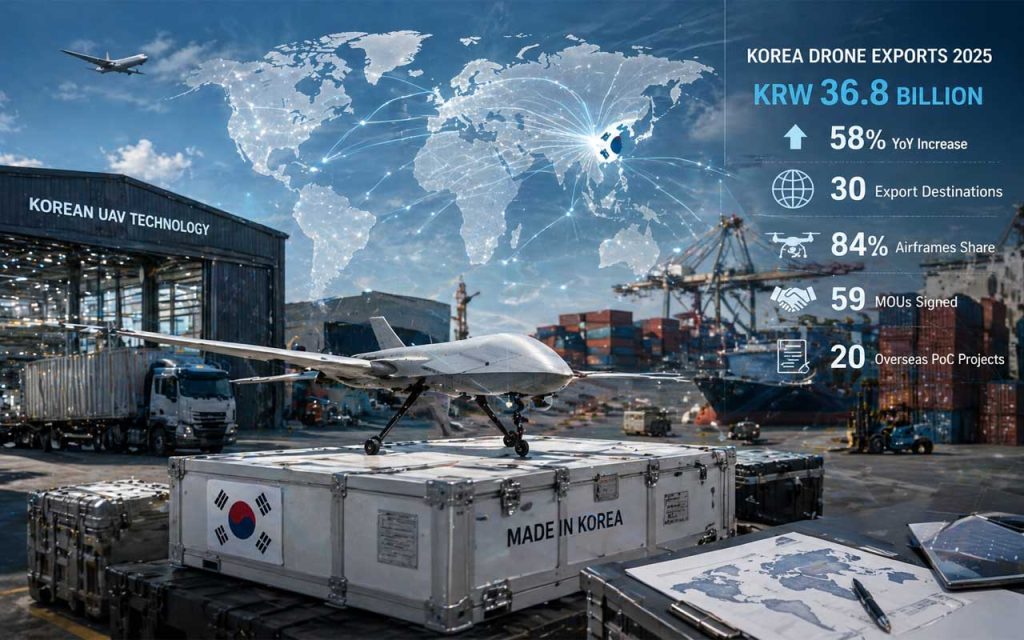
Korea drone export illustration. | AI generated

Airbility’s ASEAN Moves Suggest a Multi-Layer Expansion Model

Airbility’s recent partnerships across Southeast Asia offer a case study of how Korean UAV startups are adapting their approach.

As the discussion continues, Airbility’s Co-Founder and CPO Jaehyun Lee explained that each partnership serves a specific role:

“Each of our ASEAN partnerships serves a distinct strategic purpose. In Thailand, the focus is on integrating UAV operations with national telecom infrastructure and AI surveillance for public safety. In Vietnam, the partnership centers on manufacturing and commercial distribution. The Philippines program adds a third pillar — human capital development.”

Supported by KILSA Global as regional coordination and execution partner, Airbility’s expansion is being structured around complementary functions rather than replicated market entry strategies.

Thailand: Infrastructure and Public-Sector Access Define the Entry Point

Airbility’s Thailand partnership involves NT iBuzz alongside AI and coordination partners.

The collaboration focuses on integrating UAV operations with telecom infrastructure and public-sector systems, including secure communication networks and AI-based monitoring.

Thailand’s regulatory environment reinforces the importance of this approach. The Civil Aviation Authority of Thailand requires operators to obtain permissions for advanced operations, including flights above 90 meters, night operations, and activity in restricted areas.

An ICAO assessment of Thailand’s UAV framework further highlights structural challenges, including limited safety data, evolving technical standards, and gaps in operator training and traffic management systems.

These conditions mean that UAV deployment depends not only on aircraft capability but also on access to infrastructure and institutional pathways.

Vietnam: Manufacturing and Distribution Become Part of the Strategy

In Vietnam, Airbility has taken a different approach through its partnership with CT Group.

According to publicly reported details, the agreement includes plans for local OEM production of UAV platforms, including Airbility’s systems, with an initial target of 5,000 units. The partnership also covers distribution, sales, customer support, and maintenance.

Vietnam’s government media described the agreement as part of a broader effort to develop local UAV manufacturing capacity, noting that CT UAV has experience producing heavy-duty cargo drones with payload capacities ranging from 60 kg to 300 kg, with localization levels reaching 85%.

This positions Vietnam not only as a market but as a production and distribution base within the region.

The Philippines: Workforce Development as an Operational Layer

Airbility’s agreement with the Danao City Government introduces a third component: workforce development.

The program begins with a six-month trainer certification phase, followed by a twelve-month stage focused on technology delivery and field application, according to both company disclosures and local government confirmation.

The Civil Aviation Authority of the Philippines requires certification for commercial drone operators and for drones above 7 kilograms, with requirements that include training, flight experience, and both written and practical assessments. As of October 2025, CAAP reported 1,432 active certified operators nationwide.

This regulatory structure highlights the need for trained personnel as part of UAV deployment.

What This Means for Korean UAV Startups Expanding into Southeast Asia

Airbility’s activities point to a broader shift in how Korean UAV startups approach ASEAN expansion.

Rather than entering individual markets with a single model, the company is structuring its presence across different countries based on local strengths and constraints.

Thailand provides infrastructure and public-sector access. Vietnam contributes manufacturing and distribution capacity. The Philippines supports workforce development.

This approach reflects the diverse regulatory and operational landscape across Southeast Asia, where each market presents different requirements for enabling UAV deployment at scale.
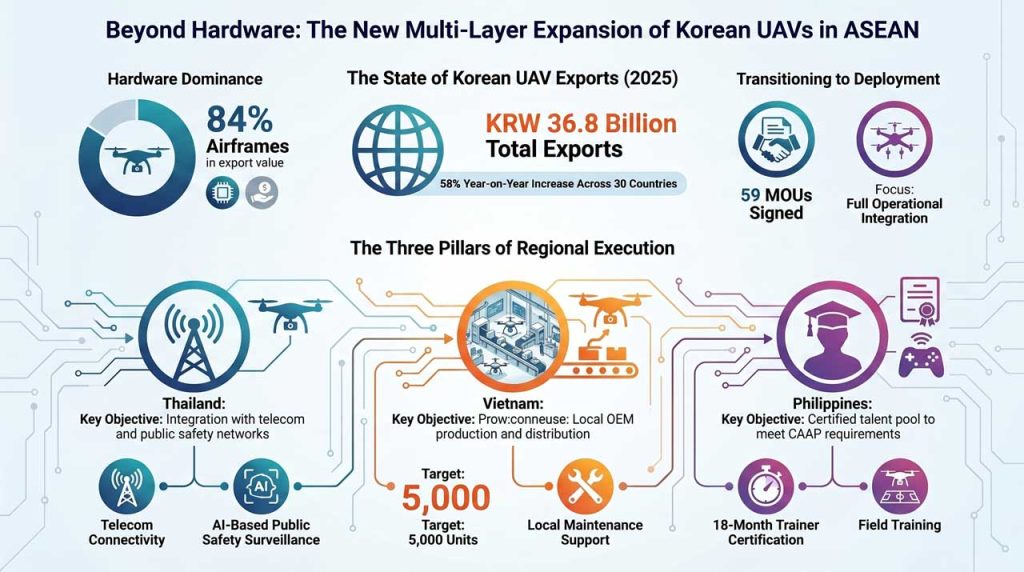
Airbility’s ASEAN moves show Korean UAV expansion now relies on infrastructure, local production, and training—not just exporting drone technology
AI infographic on ASEAN expansion strategy of Korean UAV startups

A System Approach Taking Shape Across ASEAN

For now, these partnerships are currently structured at the memorandum-of-understanding stage, with implementation expected to progress in phases depending on local conditions and stakeholder coordination.

Early activities are focused on areas such as demonstration, capability-building, and operational preparation. Production plans, training programs, and integration efforts are also being developed in alignment with each market’s requirements.

But at this stage, the structure itself offers a useful perspective on how Korean UAV startups are approaching regional expansion.

Rather than applying a single model across markets, companies appear to be aligning different components of deployment with the specific strengths and conditions of each location.

ASEAN Expansion Is Becoming a System Problem

Airbility’s ASEAN strategy highlights a broader reality for the global startup ecosystem.

Expanding into Southeast Asia is not only about entering new markets. It involves aligning with infrastructure, building local production capacity, and developing a workforce that can operate within regulatory frameworks.

For Korean UAV startups, this means that international growth is no longer defined solely by export performance.

It is increasingly shaped by how effectively companies can integrate into local systems that vary widely across the region.

Key Takeaway

  • Korean UAV startups ASEAN expansion is shifting beyond hardware exports toward system-level execution
  • Airbility ASEAN strategy shows three distinct layers: infrastructure (Thailand), manufacturing (Vietnam), workforce (Philippines)
  • Korean drone exports Southeast Asia reached KRW 36.8B in 2025 (+58%), but exports do not equal deployment
  • Thailand UAV public safety environment requires regulatory approval, telecom integration, and institutional access
  • UAV manufacturing Vietnam includes planned OEM production of 5,000 units with local distribution and support
  • Drone pilot training Philippines reflects regulatory need for certified operators, with 1,432 active licenses reported in 2025
  • KILSA Global ASEAN market entry appears as a recurring coordination layer across multiple partnerships
  • UAV deployment Southeast Asia depends on aligning infrastructure, production, and workforce, not just technology availability

🤝 Looking to connect with verified Korean companies building globally?
Explore curated company profiles and request direct introductions through beSUCCESS Connect.


– Stay Ahead in Korea’s Startup Scene –
Get real-time insights, funding updates, and policy shifts shaping Korea’s innovation ecosystem.
➡️ Follow KoreaTechDesk on LinkedIn, X (Twitter), Threads, Bluesky, Telegram, Facebook, and WhatsApp Channel.

Tags: AirbilityAirbility ASEAN expansionCT Group Vietnam UAVdrone pilot training PhilippinesKILSA Global ASEANKorean drone exports Southeast AsiaKorean UAV startupsKorean UAV startups ASEANNT iBuzz ThailandThailand UAV public safetyUAVUAV deployment Southeast AsiaUAV manufacturing VietnamUAV public safety
Previous Post

Korean Startups’ Middle East Expansion Is Breaking Inside the Operator Layer

Next Post

AI Is Rapidly Moving, But Overconfidence Is Repeating Old Mistakes

Next Post

AI Is Rapidly Moving, But Overconfidence Is Repeating Old Mistakes

MOST READ ARTICLE OF THE WEEK

1.
Korea Is Buying More GPUs. The Bigger Question Is How Many Are Actually Being Used
8 Jun 2026
2.
Why Sell-Through, Not Sell-In, Decides Korean Brand Survival in the Middle East
8 Jun 2026
3.
Why Korea Is Becoming a Stress Test for Context-Aware AI
9 Jun 2026
4.
The Real Challenge Behind Korea’s RMR Boom Is Not Taste but Translation
9 Jun 2026
5.
Razer AVA Mini Shows Why AI Cost May Decide Which Consumer Features Reach Users
10 Jun 2026
Register for Event

AIS-2026 Conference

AIS 2026 Conference

List Article

1.
Why Good Startups Still Fail the Venture Capital Test
10 Jun 2026
2.
The Hardest Part of Korea Market Entry: Staying in The Game
3 Jun 2026
3.
Why M&A Value Is Lost After the Deal Closes
30 May 2026
4.
Foreign Companies Budget for Korea Entry, but the Real Costs Start After Hiring
23 May 2026
5.
Why Fast Korea Entry Structures Can Become Expansion Traps
16 May 2026

Similar Articles

Startup

The Real Hardware Startup Killer Isn’t Technology, It’s Supply Chain Instability

More
Startup

Inside the Gap: Why Korea’s Collaboration Model Clashes with EU R&D Rules

More
Startup

Korea – France Startup Push Meets a “Traction Gap” After Market Entry

More

Topics

Menu
  • AI & Big Data
  • AR & VR
  • Blockchain
  • Clean Technology
  • Content & Games
  • Cybersecurity
  • Enterprise & SaaS
  • FinTech
  • Gadgets & Electronics
  • Health & Bio
  • IoT

Program

Menu
  • Asan Voyager
  • CAPA Global Program
  • SGSC Global Bootcamp
  • LAUNCHPAD
  • COMEUP STARS 120
  • K-Startup Grand Challenge
  • TIPS X beSUCCESS Global Project
  • SFL Global Program
  • KTO Global Showcase
  • Yonsei Univ Global Class
  • KOSME Global Program

About

Menu
  • About Us
  • all articles
  • Terms of Use
  • Privacy
  • Cookie-policy
  • twitter

Subscribe and be informed first hand about actual Korean startup news.

All the day’s headlines and highlights, direct to you every morning.

[mc4wp_form id="3766"]

Contact us : [email protected]

Topics

Menu
  • AI & Big Data
  • AR & VR
  • Blockchain
  • Clean Technology
  • Content & Games
  • Cybersecurity
  • Enterprise & SaaS
  • FinTech
  • Gadgets & Electronics
  • Health & Bio
  • IoT

Program

Menu
  • Asan Voyager
  • CAPA Global Program
  • SGSC Global Bootcamp
  • LAUNCHPAD
  • COMEUP STARS 120
  • K-Startup Grand Challenge
  • TIPS X beSUCCESS Global Project
  • SFL Global Program
  • KTO Global Showcase
  • Yonsei Univ Global Class
  • KOSME Global Program

About

Menu
  • About Us
  • all articles
  • Terms of Use
  • Privacy
  • Cookie-policy
  • twitter

Subscribe and be informed first hand about actual Korean startup news.

All the day’s headlines and highlights, direct to you every morning.

[mc4wp_form id="3766"]

© 2023 Koreantech News & Media Korea Zrt. All rights reserved.

Our Spring Sale Has Started

You can see how this popup was set up in our step-by-step guide: https://wppopupmaker.com/guides/auto-opening-announcement-popups/

Our Spring Sale Has Started

You can see how this popup was set up in our step-by-step guide: https://wppopupmaker.com/guides/auto-opening-announcement-popups/

We hope you enjoy our content, May you please give us Feedback regarding our website!

[gravityform id=”17″]

dgdfgfdgdf

What you think about Koreatechdesk, Share your idea with us!

[gravityform id=”16″]

Invitation submission has been closed