
Capital is moving into artificial intelligence at an unprecedented speed, backed by clear technological progress and expanding adoption. Yet beneath that momentum, a quieter imbalance is forming. Investment, expectations, and execution are advancing at different speeds. For founders, investors, and ecosystems like South Korea, the real question is no longer access to AI, but how accurately its value is being judged.
AI Has Moved Beyond Experimentation, but Judgment Has Not Caught Up
Artificial intelligence is no longer a speculative technology. It is being deployed across industries, backed by unprecedented capital and rapid adoption.
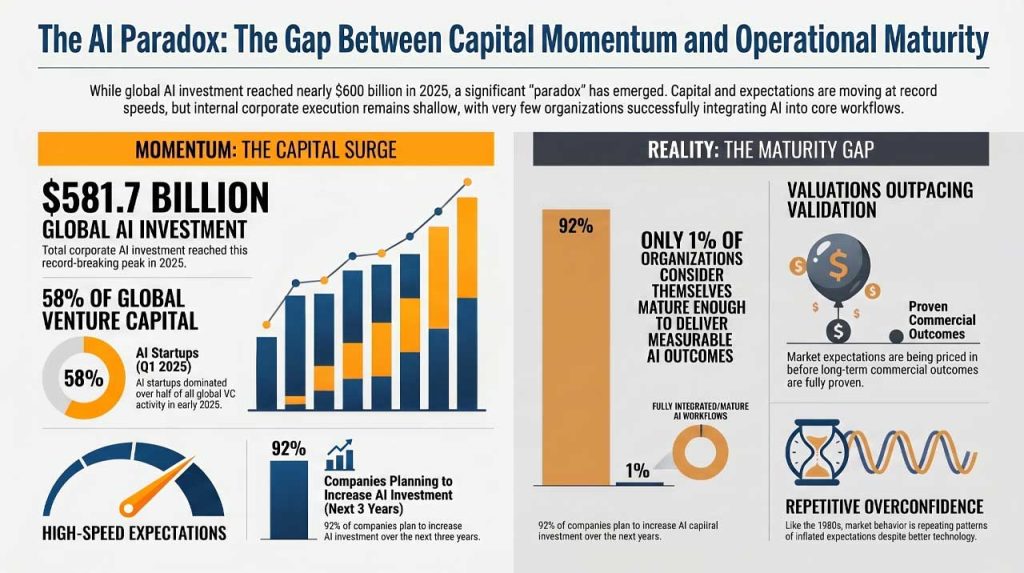
According to the Stanford Institute for Human-Centered Artificial Intelligence, global corporate AI investment reached USD 581.7 billion in 2025, while private investment rose to USD 344.7 billion. Adoption has also accelerated at record speed, with generative AI tools reaching mass usage within a few years.
At the same time, execution remains uneven. McKinsey 2025 research shows that 92% of companies plan to increase AI investment over the next three years, yet only 1% consider their organizations mature, meaning AI is fully integrated into workflows and delivering measurable outcomes.

This creates a structural tension. AI is working. But the systems built around it are still struggling to translate capability into consistent outcomes.
A Familiar Pattern in a Very Different Cycle
This is not the first time the market has faced this imbalance.
Steve Shwartz, an angel investor, award-winning author, and long-time AI operator, has seen multiple AI cycles unfold across decades. As discussion on global AI adoption continues with KoreaTechDesk, he points to a recurring dynamic.
“During high-momentum periods, founders and investors alike often fall prey to overconfidence.”
In earlier cycles, particularly in the 1980s, that overconfidence was driven by expectations that technology could not yet fulfill. Many early AI systems demonstrated promise but failed to deliver sustained commercial value.
Today, the situation is fundamentally different. AI systems are already generating real economic impact across industries. Yet the behavioral pattern has not changed.
Overconfidence has not disappeared. It has simply shifted into a new context, where real progress makes it harder to distinguish between sustainable growth and inflated expectations.
Where Overconfidence Is Showing Up in Today’s Market
Valuations Are Moving Faster Than Validation
Investor demand for AI exposure has intensified rapidly.
Reuters reported that AI startups attracted USD 73.1 billion in funding in the first quarter of 2025 alone, accounting for nearly 58% of global venture capital activity during that period. At the same time, market participants have begun raising concerns about valuations running ahead of execution.
Even at the highest levels, scrutiny is increasing. In 2026, Reuters noted that some investors were questioning the valuation assumptions behind leading AI companies as strategies evolved and enterprise monetization remained complex.
The signal is not that these companies lack potential. It is that expectations are being priced before long-term outcomes are fully proven.
Adoption Is Broad, but Deployment Remains Shallow
Corporate commitment to AI is clear, but operational maturity is still limited.
McKinsey’s findings highlight a widening gap between adoption intent and deployment capability. Many organizations are investing heavily, yet few have successfully integrated AI into core workflows at scale.
Policy research from Korea Information Society Development Institute reflects a similar concern. Analysis cited in recent reports indicates that a large majority of organizations globally are not yet generating meaningful returns from generative AI, despite rising investment.
This gap matters because it shapes how capital is deployed. When adoption is interpreted as success, investment decisions can move ahead of measurable performance.
Execution Timelines Are Compressing Under Market Pressure
The current cycle is also accelerating expectations around speed.
Companies are raising capital earlier, scaling faster, and entering competitive markets before product-market fit is fully established. Investors, in turn, face increasing difficulty in distinguishing between genuine technical advantage and well-presented narrative.
Shwartz highlights this challenge directly.
“Founders’ deep technical knowledge makes it difficult for investors to distinguish between achievable progress and speculative vision.”
This dynamic makes it harder for investors to separate real progress from narrative, especially in technically complex fields like AI.
As a result, the cycle compresses. Validation is expected sooner, and scaling often begins before foundational stability is established.
Korea Is Participating in the Same Momentum Cycle
South Korea is not isolated from these global dynamics. It is actively participating in the current AI expansion.
Government data shows that venture investment in Korea reached KRW 13.6 trillion in 2025, a 14% increase year-on-year. Fund formation also rose sharply, reflecting renewed capital availability across the ecosystem.
At the same time, policymakers are moving to support AI startups beyond domestic markets. In March 2026, the government launched initiatives to help AI companies secure overseas investment, connect with global investors, and strengthen commercialization pathways.
These efforts suggest a clear understanding of the challenge. Access to capital alone is not sufficient. Market validation and global competitiveness remain highly essential.
A Market That Is Expanding, but Still Testing Itself
The Korean startup ecosystem reflects the same tension seen globally.
Capital is returning. AI is a central focus. Startups are gaining visibility and support. Yet the emphasis on global fundraising and scaling indicates that the ecosystem is still in a phase of validation.
Recent developments also reflect this dynamic. Reuters reported that Korean AI chip startup DeepX is seeking more than KRW 600 billion in funding ahead of a potential IPO, while targeting around USD 40 million in revenue. The company is already working with partners such as Hyundai on AI-powered robotics systems.
The gap between capital ambition and current revenue scale illustrates a broader pattern. Strong technology and early partnerships are in place, but long-term commercial outcomes are still being established.
Why This Pattern Keeps Repeating
The repetition of overconfidence is not just accidental but more structural.
New technologies create visible breakthroughs. These breakthroughs attract capital. Capital accelerates expectations faster than execution can keep pace.
In earlier cycles, the mismatch was driven by technological limitations. In the current cycle, it is driven by the speed of capital and the scale of ambition.
The difference is important. The risk is no longer that AI will fail to deliver. The risk is that markets will misjudge how quickly and how broadly that delivery translates into sustainable value.
What This Means Across the Startup Ecosystem
The implications are spreading across the global startup landscape, reshaping how decisions are made at every level.
Investors are no longer limited by access to promising technology. The challenge now lies in judging execution under tighter timelines, while avoiding the tendency to assign long-term dominance before it is proven.
Founders are operating in a more complex environment. AI capability alone does not differentiate a company anymore. What matters is the ability to translate that capability into clear use cases, measurable outcomes, and advantages that can hold over time.
At the ecosystem level, the shift is just as significant. In Korea, participation in the AI cycle is already well established. What comes next depends on how effectively that momentum can be turned into companies that compete and sustain themselves at a global scale.
The Real Risk Is Not AI Failure, but Misreading Success
Finally, artificial intelligence has reached a point where its relevance is no longer in question.
Because the current challenge lies in interpretation.
Markets are responding to real progress, but they are also projecting outcomes that may take longer to materialize. This creates a cycle where capital, expectations, and execution move at different speeds.
Shwartz’s observation captures this precisely. Overconfidence has not disappeared. Instead, it has adapted to a stronger technological foundation.
For Korea and the broader global ecosystem, the question is no longer whether AI will scale. It is whether participants can maintain discipline as it does.
Key Takeaways
- AI adoption and investment are accelerating globally, with over $581 billion in corporate investment reported in 2025
- Despite strong momentum, only 1% of companies have reached full AI deployment maturity, highlighting a major execution gap
- Steve Shwartz identifies overconfidence as a recurring pattern across AI cycles, even when technology improves
- AI startup funding and valuations are rising rapidly, with investors increasingly questioning sustainability and execution timelines
- South Korea’s venture investment reached KRW 13.6 trillion in 2025, reflecting renewed capital momentum in AI and deep tech
- Korean policy is now focused on global scaling and commercialization, not just domestic development
- The current AI cycle differs from past ones in capability, but not in behavioral risk
- The key challenge for founders and investors is aligning expectations, execution, and long-term value creation
– Stay Ahead in Korea’s Startup Scene –
Get real-time insights, funding updates, and policy shifts shaping Korea’s innovation ecosystem.
➡️ Follow KoreaTechDesk on LinkedIn, X (Twitter), Threads, Bluesky, Telegram, Facebook, and WhatsApp Channel.
🤝 Looking to connect with verified Korean companies building globally?
Explore curated company profiles and request direct introductions through beSUCCESS Connect.