
Capital is pouring into artificial intelligence, but the returns are not spreading evenly across the ecosystem. A small group of players is capturing most of the value, while others are still searching for sustainable revenue. As South Korea accelerates its AI infrastructure ambitions, a more strategic question emerges for global founders and investors: not just where AI is growing, but where it actually pays.
AI Is Generating Real Revenue, But Not Across the Entire Market
With the recent massive development, artificial intelligence is no longer a speculative technology. It is now producing measurable revenue across multiple layers of the global economy.
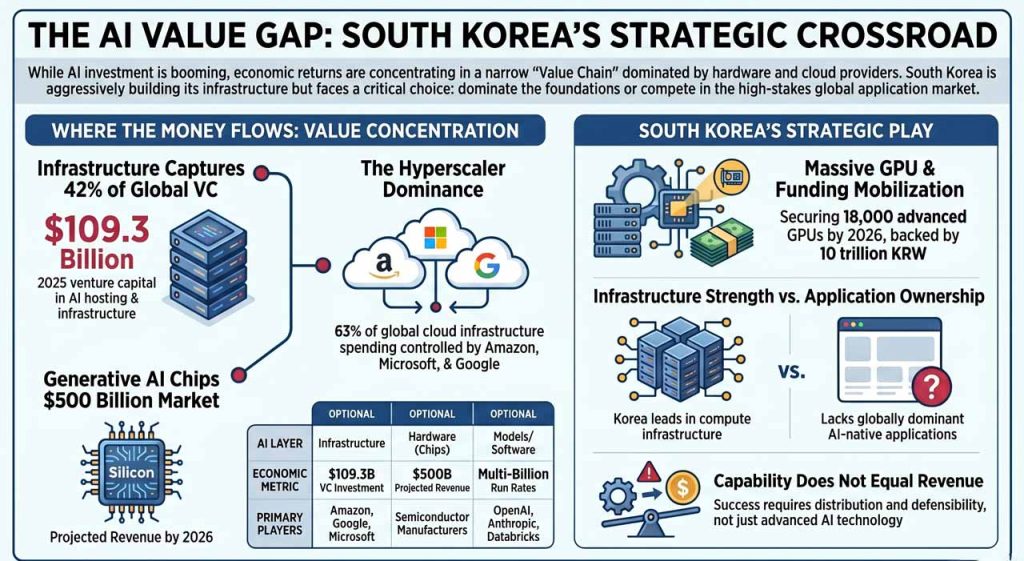
Recent data shows that capital and revenue are accelerating at scale. The OECD reports that AI-related firms in infrastructure and hosting attracted USD 109.3 billion in 2025, accounting for over 42% of total AI venture capital investment. At the same time, McKinsey finds that while AI adoption is expanding rapidly, only 1% of companies consider themselves fully mature in deployment.
This creates a structural gap, revealing that while investment is broad, value realization remains highly concentrated.
Yes, AI has proved to be working extremely well today. But really, where do we capture its economic value though?
The AI Value Chain Is Narrower Than It Appears
Insights from Steve Shwartz, an angel investor, award-winning author, and former AI operator across multiple generations of technology, help clarify this structure.
In correspondence with KoreaTechDesk, Shwartz described a clear pattern in the latest decades of AI development. Durable value is clustering around a limited number of layers. These include compute hardware, foundational models, infrastructure software, cloud platforms, and a smaller group of AI-native applications.
“Today’s AI companies are creating durable value by providing GPUs, models, infrastructure software, infrastructure services, and applications. The winners in these areas are generating sustainable revenue.”
In addition, the market data supports this concentration. Deloitte estimates that generative AI chips could approach USD 500 billion in revenue in 2026, representing a disproportionate share of the semiconductor market. At the infrastructure level, Synergy Research reports that Amazon, Microsoft, and Google together account for 63% of global enterprise cloud infrastructure spending.
At the model layer, companies such as OpenAI and Anthropic are already generating multi-billion-dollar annualized revenues, according to Reuters. Infrastructure software firms like Databricks have also reached multi-billion revenue run rates.
This distribution shows a clear pattern. A small number of layers are capturing a large share of the economic value, while the rest of the ecosystem is still in earlier stages of monetization.
AI Capability Does Not Guarantee Business Outcomes
Furthermore, the presence of strong technology does not automatically translate into sustainable revenue.
Shwartz emphasized that even in today’s AI cycle, core investment logic remains unchanged. In his view, application-layer companies are still evaluated based on traditional fundamentals.
“Application startups are still judged on time-tested criteria. Investors look for sustainable advantages, large markets, and experienced teams.”
This aligns with broader market observations. Despite strong interest in AI, many startups remain pre-revenue or are still validating product-market fit. Hence, it clearly implies that AI capability alone does not create value. Distribution, execution, and defensibility remain highly decisive.
Korea Is Building Aggressively Into AI Infrastructure
Now, South Korea is not on the sidelines of this shift. Instead, the country is actively investing in the infrastructure layer of the AI value chain.
Government policy reflects this direction. The country has announced plans to secure 10,000 advanced GPUs in 2025, followed by an additional 8,000 GPUs in 2026, as part of its National AI Computing Center strategy. In parallel, authorities have committed KRW 10 trillion in funding to AI and semiconductor development.
This momentum is also visible at corporate level. SK Telecom reported that its AI data center business exceeded KRW 100 billion in quarterly revenue, with continued double-digit growth. KT’s cloud division recorded 20.3% year-on-year growth, supported by demand for AI cloud services and GPU-based offerings. NAVER has also expanded its enterprise AI and cloud operations, with steady growth driven by business-to-business deployments.
And so, these developments show a consistent pattern that South Korea is strengthening its position in compute, infrastructure, and enterprise AI enablement.
The Missing Layer: Global Application-Level Dominance
Still, despite strong infrastructure progress, a different question emerges at the application layer.
Globally, AI-native application companies are beginning to establish themselves as category leaders. These firms operate in areas such as enterprise automation, vertical AI solutions, and workflow optimization.
In Korea, adoption is visible but leadership is less clear.
Data from the Korea Creative Content Agency indicates that generative AI usage in the content industry reached 20% in early 2025, with strong uptake in gaming and broadcasting. This confirms that AI is being integrated into production workflows.
However, large-scale, globally dominant AI-native application companies remain limited.
Major Korean platforms such as NAVER and Kakao continue to generate growth primarily through existing business lines, including commerce, fintech, and platform services. While AI is being integrated into these ecosystems, it has not yet produced standalone application-layer leaders at global scale.
This does not indicate a lack of capability. It reflects a different stage of value capture.
A Strategic Decision: Infrastructure Strength or Application Ownership
The current phase of AI development is forcing a strategic choice.
One path focuses on infrastructure. This includes semiconductors, data centers, and sovereign AI systems. Korea already has strong positioning here, supported by industrial capabilities and government backing.
The second path involves application-layer ownership. This requires global distribution, product differentiation, and sustained customer adoption. It also places companies in direct competition with established global leaders.
And each path presents trade-offs.
Infrastructure offers control over compute resources but may face margin pressure as capacity expands. Application layers offer higher potential returns but require stronger market execution.
As Shwartz noted,
“Application startups are still judged on time-tested criteria. Investors look for startups with clear, sustainable advantages, large markets, experienced teams, and disciplined deal terms.”
This suggests that even in AI, long-term success continues to depend on fundamentals rather than short-term momentum.
What This Means for Global Founders and Investors
The implications of this value concentration across the AI stack extend beyond Korea.
For investors, the AI market is becoming more segmented, and opportunities are not evenly distributed. Evaluating a company now requires understanding where it sits within the value chain and how it captures value over time.
As for founders, it is now critical to have strategic positioning. Building with AI is no longer a differentiator on its own. The key question is where the company fits within the broader ecosystem and whether it can sustain an advantage.
Korea offers a clear case study. It is investing heavily to secure infrastructure capabilities while still defining its position in the application layer.
The Real Challenge Is No Longer Participation
Finally, AI is scaling globally, and Korea is actively participating.
And yet, the challenge now has heavily shifted.
It is no longer about access to technology or initial adoption, but more about capturing value in a system where economic returns are already concentrating in specific layers.
As the global AI stack matures, the winners will not be defined by who builds the most, but by who captures the most durable value.
Key Takeaways
- AI revenue is concentrating in a narrow set of layers, including chips, models, cloud infrastructure, and select applications
- OECD data shows infrastructure-related AI firms captured over $109 billion in VC investment in 2025
- Hyperscalers such as Amazon, Microsoft, and Google control over 60% of global cloud infrastructure spending
- AI capability does not guarantee monetization, as most companies remain early in deployment maturity
- South Korea is investing heavily in AI infrastructure, including GPUs and national computing capacity
- Companies like SK Telecom, KT, and NAVER show strong growth in AI infrastructure and enterprise services
- Korea has strong AI adoption but fewer globally dominant AI-native application companies
- The strategic question for Korea is whether to focus on infrastructure strength or application-layer ownership
- For global founders and investors, success depends on positioning within the AI value chain, not just technology capability
– Stay Ahead in Korea’s Startup Scene –
Get real-time insights, funding updates, and policy shifts shaping Korea’s innovation ecosystem.
➡️ Follow KoreaTechDesk on LinkedIn, X (Twitter), Threads, Bluesky, Telegram, Facebook, and WhatsApp Channel.
🤝 Looking to connect with verified Korean companies building globally?
Explore curated company profiles and request direct introductions through beSUCCESS Connect.