

A design tool can deliver accurate results, pass validation tests, and still fail to become part of an OEM workflow. That gap is where many industrial AI efforts stall. In automotive engineering, adoption is not decided at the point of performance. It is determined by how well a tool fits into legacy systems, cross-team processes, and data governance structures that define how decisions are made.
What is the Real Bottleneck in Automotive AI Adoption?
Automotive companies are accelerating investment in AI, simulation, and digital engineering tools. Yet across the industry, a consistent gap remains between technical validation and real adoption inside OEM workflows.
The challenge is no longer proving that a tool works. The harder problem is on embedding it into how decisions are actually made.
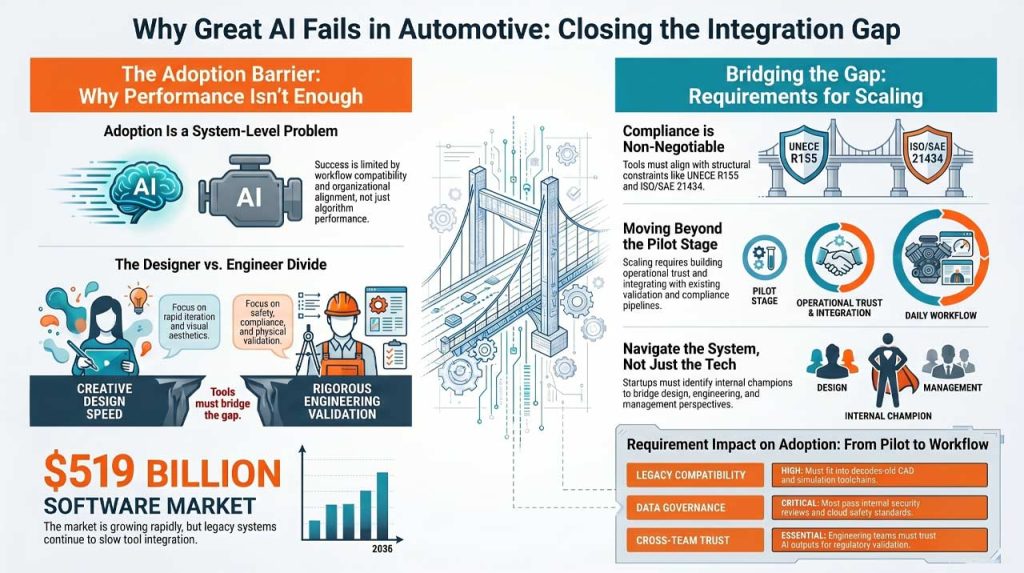
This gap is becoming more visible as software takes a larger role in automotive development. According to McKinsey & Company, the global automotive software and electronics market is projected to reach around USD 519 billion by 2035, growing significantly faster than the overall vehicle market. At the same time, legacy systems and processes continue to slow down how new tools are integrated into existing workflows.
This clearly shows that platform adoption in automotive engineering is not driven by performance alone. It is also shaped by how well a tool fits into deeply established systems.

Automotive Workflows Are Built on Systems, Not Individual Tools
To understand why new tools struggle, it is important to look at how OEM workflows are structured.
Vehicle development involves large, interconnected systems. Engineering teams rely on CAD platforms, simulation tools, validation pipelines, and manufacturing systems that have evolved over decades. These are not isolated tools. They are embedded in approval processes, regulatory compliance, and institutional knowledge.
As noted by Dassault Systèmes, automotive programs typically involve thousands of engineers working across multiple digital systems. Even with advanced simulation, design iteration cycles can still take weeks due to model building, validation, and cross-team coordination.
In this environment, introducing a new design tool is not simply a matter of technical evaluation. It requires integration into a system that is already optimized for consistency, traceability, and compliance.

When Technology Works but Still Faces Resistance
This dynamic is reflected in how startups approach OEM adoption.
Korean startup ADRO, which is developing an aerodynamic design platform AOX, provides a useful case example. In a written interview with KoreaTechDesk, founder and CEO Seunghyun Yoon explained that the main challenge is not convincing OEMs of the tool’s value.
“The primary barrier is workflow integration, not technology skepticism.”
And this is a critical distinction because it shows that adoption does not fail because tools lack capability. It fails because they do not yet fit into how organizations operate.
Yoon also noted that existing engineering tools are deeply embedded within OEM processes.
“These are not just software tools; they are embedded in validation standards, regulatory compliance processes, and institutional knowledge.”
This explains why even proven tools face resistance. They must align with systems that extend beyond engineering performance.
The Divide Between Design and Engineering
Another layer of friction comes from how responsibilities are divided inside OEMs.
Design teams and engineering teams operate with different priorities. Designers focus on speed, iteration, and creative direction. Engineers focus on validation, accuracy, and compliance.
New tools that target early-stage design often introduce capabilities for designers. But those outputs still need to be accepted by engineering teams responsible for validation.
Yoon highlighted this challenge directly when explaining about ADRO’s aerodynamic design platform AOX.
“AOX is designed for designers, a different user group within the OEM. Bridging that organizational divide requires champions on the client side who understand both design and engineering workflows.”
And so, the problem is no longer just in technical aspects, but also the organizational.
Adoption requires alignment between teams that traditionally operate with different tools, timelines, and decision criteria. Without that alignment, even useful tools remain isolated.
Data Security Is a Structural Constraint, Not a Secondary Concern
In automotive development, data is not only valuable. It is highly sensitive.
Design tools often require access to vehicle geometry, performance data, or simulation outputs. For OEMs, this introduces security considerations that extend beyond typical software evaluation.
This is reinforced by regulatory frameworks such as UNECE Regulation No. 155, which requires manufacturers to implement cybersecurity management systems across the vehicle lifecycle. Standards such as ISO/SAE 21434 further define how cybersecurity must be integrated into automotive engineering processes.
In practical terms, this means that any new tool interacting with design data must pass internal security reviews, align with compliance frameworks, and fit within established governance structures.
In Korea, this trend is becoming more visible. Reports from The Elec show that major automotive groups are strengthening cloud security operations as part of broader digital transformation efforts.
For startups, this introduces a critical constraint. Technical capability alone is no longer enough. Data handling and security alignment have become part of the adoption process.
Why Many Tools Stall at the Pilot Stage
Across industrial AI, a recurring pattern is emerging. Many tools succeed in pilot programs but fail to scale.
Research from Boston Consulting Group indicates that organizations often struggle to realize full value from AI because adoption requires changes across platforms, processes, and talent, not just technology deployment.
This aligns with observations from Korea’s manufacturing sector. According to ZDNet Korea report, AI adoption in industrial environments is often slowed by safety considerations, responsibility, and the need for real-world validation before scaling.
The result is a gap between proof and practice.
A tool may demonstrate clear benefits in controlled environments. But to become part of daily workflows, it must:
- integrate with existing systems
- align with validation and compliance requirements
- gain internal trust across teams
- be supported by operational processes
Without these conditions, adoption remains limited to pilot use.
What This Means for Industrial AI Startups
Korea’s startup ecosystem has a strong foundation in manufacturing and hardware. This provides proximity to real-world deployment environments, which can support data generation and technical validation.
However, entering global OEM workflows requires more than proving performance.
Industrial AI startups must design their products with integration in mind. This includes compatibility with existing toolchains, awareness of regulatory constraints, and an understanding of how decisions are made across different teams.
It also requires identifying internal champions within OEMs who can bridge design, engineering, and management perspectives.
Because today, the competitive challenge is not only to build better tools. It is to navigate complex systems.
Adoption Is a System-Level Problem
As automotive AI continues to expand, tools will become more capable and more accessible. Simulation, optimization, and digital validation are already widely used across the industry.
What is changing is where the real constraint sits.
Adoption is no longer limited by compute or algorithm performance. It is limited by workflow compatibility, organizational alignment, and system integration.
So for global startup ecosystems, including Korea, this shifts how success should be measured.
Technical validation opens the door.
Integration into real workflows determines whether the tool becomes part of the system.
Key Takeaway
- Automotive AI adoption is constrained by workflows, not just performance, as legacy systems and processes shape how tools are evaluated and integrated.
- OEM workflows are complex systems, involving thousands of engineers, multiple toolchains, and strict validation and compliance requirements.
- Integration is the primary barrier, with startups facing challenges in fitting into established engineering pipelines and decision processes.
- Organizational silos between design and engineering slow adoption, requiring internal alignment and cross-functional champions.
- Data security and regulation are structural constraints, reinforced by frameworks such as UNECE R155 and ISO/SAE 21434.
- Pilot success does not guarantee scale, as real adoption depends on process integration, governance, and operational trust.
- For industrial AI startups, competitive advantage lies in system navigation, not only in product performance.
– Stay Ahead in Korea’s Startup Scene –
Get real-time insights, funding updates, and policy shifts shaping Korea’s innovation ecosystem.
➡️ Follow KoreaTechDesk on LinkedIn, X (Twitter), Threads, Bluesky, Telegram, Facebook, and WhatsApp Channel.
🤝 Looking to connect with verified Korean companies building globally?
Explore curated company profiles and request direct introductions through beSUCCESS Connect.