
AI’s next phase is no longer defined by breakthroughs in model capability, but by whether those systems can function reliably in real-world conditions. As governments and industries shift focus toward deployment, a deeper question is emerging: what does it actually take for AI to operate as part of a live system, rather than remain an isolated technical achievement?
AI Performance Is Rising, Deployment Still Lags
AI capability continues to improve at the model level. Benchmarks, multimodal systems, and large-scale training dominate headlines.
Yet in practice, deployment remains uneven.
Recent work by National Institute of Standards and Technology highlights that post-deployment monitoring and operational consistency are still unresolved challenges in AI systems. At the same time, Organization for Economic Co-operation and Development notes that real-world environments impose latency sensitivity and unpredictable conditions that differ sharply from controlled testing environments.
The gap is no longer about whether AI can perform tasks. It is about whether it can operate reliably in the field.
Where AI Breaks Down: The Gap Between Controlled Performance and Real-World Operation
The most common explanation for AI underperformance points to model limitations. That explanation is increasingly incomplete.
In correspondence with KoreaTechDesk, Byungjoon Kim, founder and CEO of H’ Intelligence, frames the issue differently,
“AI systems most often fail in the field not because of raw model capability itself, but because the model was never designed as an operational system.”

This distinction is crucial because it means that most AI systems are commonly optimized for detection or classification, while real environments actually require more than that.
Real-world operation AI requires continuity across time, understanding of spatial relationships, and the ability to maintain stable outputs under degraded conditions. That is why systems that treat first-pass detections as final truth often break down once deployed.
This is where the bottleneck shifts. It moves away from intelligence in isolation and toward how that intelligence behaves inside a system.
From Detection to Decision: The Missing Layer in Operational AI
The failure of AI deployment in real-world environments is not only technical, but structural. In these settings, AI outputs cannot remain as raw detections; they must be translated into forms that operators can interpret and act on.
And this requires a critical layer between detection and decision, where outputs are validated, contextualized, and aligned with operational workflows.
Kim describes this shift as the need to convert physical environments into “trustworthy states and events” that can be acted upon.
“The critical issue is not only what the AI detected, but whether it can convert that into trustworthy states and events, and into a usable decision context for people.”
That is why AI deployment is increasingly a systems problem rather than a question of model performance alone. Recognition by itself does not create value. That value only emerges when outputs are validated, contextualized, and integrated into real operational workflows.
This perspective is consistent with the National Institute of Standards and Technology definition of trustworthy AI, which emphasizes reliability, accountability, and consistency in operation alongside predictive accuracy.
Real Environments Are Not Controlled Systems
The challenge becomes clearer once AI moves beyond controlled environments.
OECD research shows that real-world settings are dynamic and unpredictable, shaped by spatial complexity and constant change. Inputs can degrade, objects overlap or disappear, and network conditions fluctuate.
In this context, the real requirement is not just accuracy, but the ability for systems to maintain consistent and reliable responses under shifting conditions.
NIST further emphasizes that deployed AI must maintain consistent service across infrastructure. This introduces a new requirement. AI must not only perform, but also remain stable under stress.
Kim points to continuity as a critical factor.
“Continuity collapses under occlusion, overlap, or degraded input.”
This challenge extends beyond model performance alone. It actually reflects a deeper issue in the system design.
When AI Meets Reality: A Live Deployment Case
The gap between demonstration and real-world operation becomes most visible in live environments.
One example comes from H’ Intelligence’s deployment with the K LEAGUE AI Voice Relay, where an AI system delivers real-time audio commentary for visually impaired spectators using spatial interpretation of live gameplay.

Unlike controlled pilots, this system operates continuously in a stadium setting shaped by high object density, rapid movement, fluctuating network conditions, and immediate user expectations.
As Byungjoon Kim explains, this was not simply a technical showcase but a public-facing service under real constraints. The challenge here is not model capability in isolation, but whether the system can sustain reliable performance as conditions change.
“What matters is that this was not just a demo. It was real users under real constraints.”
This deployment was later recognized with a Silver Award at the 2026 Edison Awards. The Edison Awards are evaluated by a global panel of executives, academics, and innovation leaders.
Now, the recognition is not simply about the award itself, but about what the award validates.
It reflects that the system was able to operate continuously in a live environment and deliver outputs that users could rely on under real-world conditions.
Why Operational Reliability Defines AI Value
In physical environments, success is no longer defined by benchmark performance, but by whether AI systems can deliver consistent and usable outcomes in real operations.
As Kim puts it,
“Customers do not buy benchmark scores. They buy trustworthy operational outcomes.”
In practice, this means systems must maintain stable behavior over time, produce consistent outputs under changing conditions, reduce reliance on manual verification, and integrate cleanly into existing workflows.
This view is consistent with OECD findings that many industries still struggle to adopt AI due to legacy systems, limited connectivity, and integration complexity.
Even when models perform well, deployment often fails because systems cannot fit into existing operational structures.
Korea’s Shift Toward Deployment-Centric AI
South Korea is beginning to reflect this shift at the policy level.
The government’s AI action plan outlines 98 tasks and sets a target of becoming a global leader in physical AI by 2030. Public data from the Ministry of Economy and Finance shows AI-related investment rising to KRW 10.1 trillion, including a KRW 500 billion (~ USD 350–380 million) program focused on physical AI.
Additional initiatives include:
- expansion toward 500 AI factories by 2030
- public-sector pilots for on-device AI systems
- deployment-focused testbeds in manufacturing and infrastructure
These signals do not suggest that Korea has already achieved leadership. Instead, they point to a deliberate shift in how AI progress is being defined, with greater emphasis on deployment, integration, and the ability to operate reliably in real-world environments.
The Emerging Divide in AI
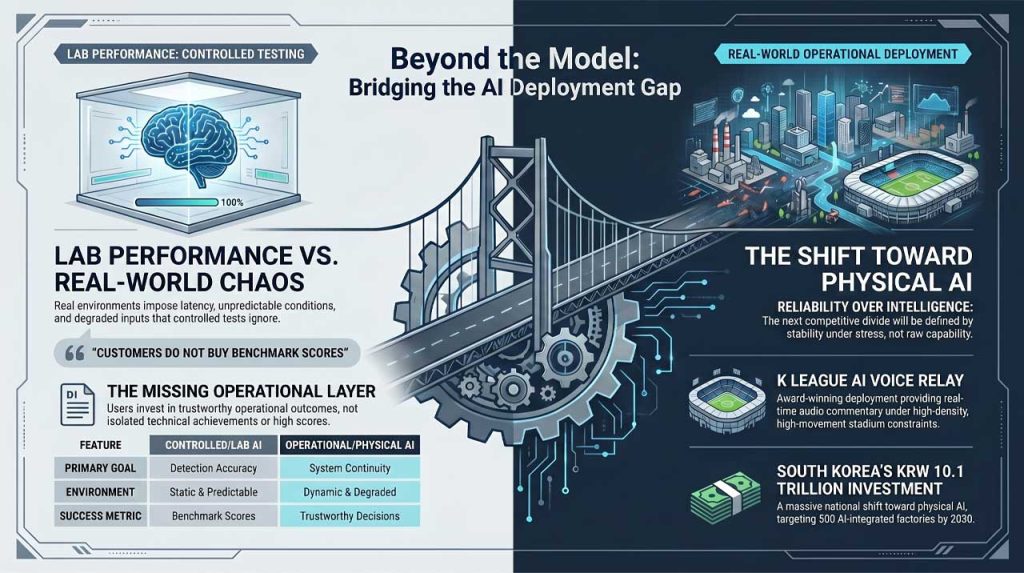
A clear divide is beginning to take shape across the AI landscape. Systems that perform well in controlled environments are no longer the same systems that succeed in real-world deployment. The difference is not simply capability, but reliability under constraint.
In controlled settings, AI can optimize for accuracy and benchmark performance. But in real environments, it must withstand variability, maintain continuity, and operate under real-time pressure.
This is where many systems begin to break, and where the next phase of competition is forming.
The Future of AI Is Operational
Finally, the direction of AI is shifting. It is moving beyond a model-centric phase toward one defined by operational performance.
Success will depend less on isolated model capability and more on whether systems can function consistently under real conditions, integrate into existing environments, and produce outputs that can be trusted over time. In this context, perception alone is not enough. The real objective is to translate physical environments into forms that can be reliably understood and acted upon.
The companies that solve this will not just improve AI performance. They will define how AI becomes part of real-world operations.
Key Takeaway
- AI deployment in real-world environments is limited not by model capability, but by operational system design
- National Institute of Standards and Technology identifies post-deployment monitoring and operational consistency as key unresolved challenges
- Organization for Economic Co-operation and Development highlights latency sensitivity and unpredictability in real-world AI environments
- Byungjoon Kim emphasizes that AI must convert physical environments into “trustworthy operational states” to be usable
- Live deployments, such as the K LEAGUE AI Voice Relay system recognized at the 2026 Edison Awards, demonstrate operational viability under real constraints
- South Korea’s policy direction, including KRW 10.1 trillion AI investment and physical AI programs, reflects a shift toward deployment-focused AI
- The future of AI will be defined by reliability, integration, and operational consistency, not benchmark performance alone
– Stay Ahead in Korea’s Startup Scene –
Get real-time insights, funding updates, and policy shifts shaping Korea’s innovation ecosystem.
➡️ Follow KoreaTechDesk on LinkedIn, X (Twitter), Threads, Bluesky, Telegram, Facebook, and WhatsApp Channel.
🤝 Looking to connect with verified Korean companies building globally?
Explore curated company profiles and request direct introductions through beSUCCESS Connect.