Aerodynamic performance in automotive design is often decided late, after core styling decisions are already fixed. That structure limits iteration and can force trade-offs between engineering performance and design intent. A Korean startup, ADRO, is approaching the problem differently by introducing aerodynamic feedback earlier in the process, using data built from real-world component deployment rather than simulation alone.
Why Aerodynamic Decisions Still Happen Too Late
Usually, in most OEM workflows, design and aerodynamics operate in sequence rather than in parallel.
Design teams first define the vehicle shape based on styling and brand direction. Only after that does the geometry move to engineering teams for computational fluid dynamics (CFD) analysis. Each iteration can take days or weeks and requires specialized engineers and significant computing resources.
This structure means that early design decisions are often made without aerodynamic visibility. When performance issues are identified later, teams must either revise the design or accept compromises.
That is why for global OEMs, the issue is not the availability of advanced tools. High-fidelity systems like ANSYS and Altair are already standard. The constraint is when they enter the process. By the time they are used, key design decisions have often been made, leaving limited room for meaningful iteration.
ADRO: A Hardware-First Starting Point
Korean startup ADRO did not begin as a software company. Founded in 2020 in Yongin, South Korea, the company initially focused on designing and manufacturing aftermarket aerodynamic components.
That business has now scaled into a global operation, with 2025 revenue reaching KRW 16.5 billion (~ USD 10 million), up about 50 percent year-on-year, and roughly 90 percent generated overseas across 22 countries, including a strong presence in the United States.
The company also raised KRW 10 billion (approximately USD 6.85 million) in a Series B round in October 2025 led by Stonebridge Ventures, as it prepares to launch its aerodynamic design platform AOX in June 2026 following a beta preview at CES 2026.
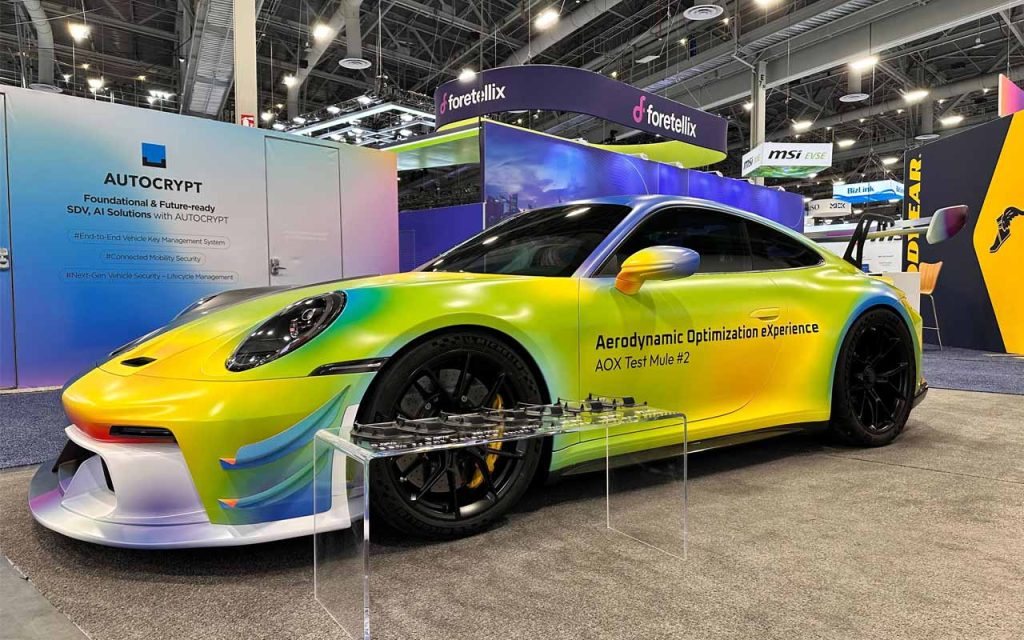
Yet, what most important is the fact that ADRO has developed more than 230 aerodynamic parts across 12 global automotive brands, including Porsche, BMW, Tesla, and Toyota. Around 90 percent of its revenue comes from overseas markets, spanning more than 20 countries.
Each component follows a full lifecycle: parametric design, CFD simulation, carbon fiber fabrication, installation on production vehicles, and real-world testing on roads and tracks.
In a written interview with KoreaTechDesk, ADRO’s founder and CEO Seunghyun Yoon explained that this process creates a dataset built on matched pairs of simulation predictions and physical outcomes.
“This creates matched pairs of simulation predictions and physical outcomes—data that captures what simulation models typically miss, such as manufacturing tolerances, material behavior, and the gap between digital geometry and what is actually mounted on a car.”

The difference lies in the origin of the data. Traditional CFD relies on simulated environments, while ADRO’s dataset is built through physical deployment and real-world validation, allowing it to capture factors that simulations often simplify or miss.
From Validation Data to Design Input
The value of that dataset becomes visible when simulation results are compared against real-world performance.
In one example shared by the company, a Tesla Model Y rear bumper optimized through its system achieved approximately 4.1 percent drag reduction and around 4 to 5 percent improvement in energy efficiency, based on testing verified by Korea’s transportation authority.
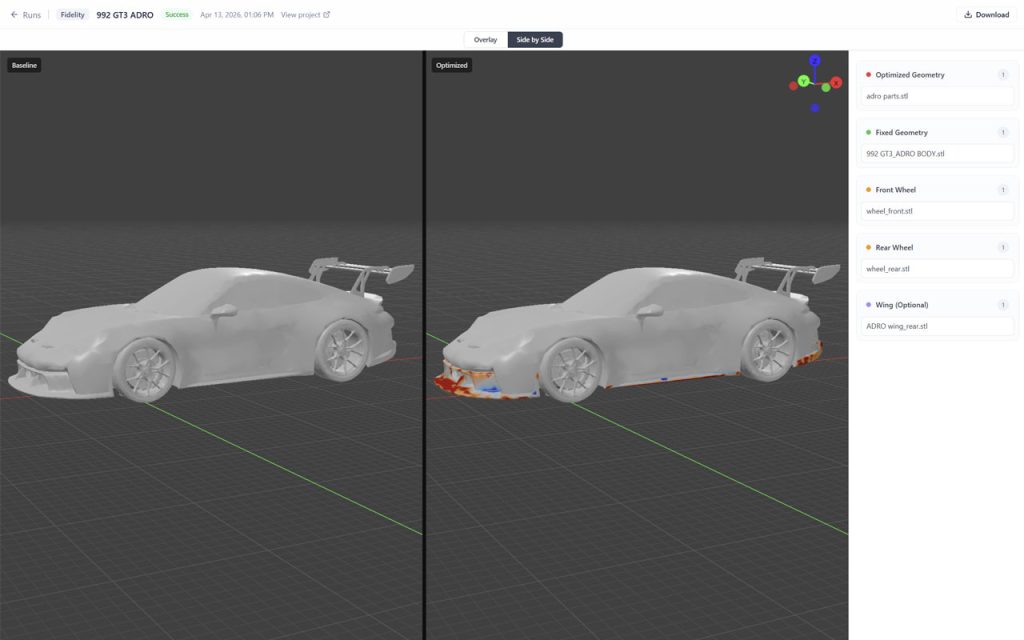
ADRO also referenced a Porsche 992 GT3 project, where aerodynamic improvements aligned with measurable gains in track performance during testing.
These cases are presented as validation rather than proof of universal accuracy. The company notes that discrepancies still occur in complex flow environments, including crosswind conditions, underbody interactions, and extreme geometries.
Yoon noted that these limitations are not treated as weaknesses, but as part of how the system is intended to be used.
“AOX is designed to be a decision-support tool at the early design stage, not a replacement for final-stage engineering validation.”
In practice, this places AOX earlier in the workflow, where teams are deciding direction rather than confirming compliance. Instead of delivering final, certifiable outputs, the platform helps narrow down viable design paths before full CFD analysis begins.
Shifting Aerodynamics into the Design Phase
ADRO’s platform, AOX, is built to operate earlier in the workflow.
Instead of waiting for full CFD analysis, designers can evaluate aerodynamic implications during the conceptual stage. This allows teams to explore trade-offs between drag, downforce, and design intent before geometry is locked.
In traditional workflows, that type of iteration would require repeated CFD cycles over several weeks. According to ADRO, AOX can explore multiple design variations within hours.
Yoon described this shift as a change in when aerodynamic decisions enter the process. Instead of waiting for engineering validation after design is finalized, teams can now assess performance earlier, while key design choices are still flexible.
“AOX allows designers to evaluate aerodynamic implications during the conceptual phase, before geometry is locked and before full-scale CFD resources are committed.”
It doesn’t mean that AOX completely replaces engineering analysis. The platform strategically introduces aerodynamic feedback at the point where design intent is formed, allowing teams to align styling and performance before costly iteration cycles begin.
ADRO: Defining the Boundary with Established Tools
Additionally, ADRO’s positioning is deliberately defined in relation to existing engineering tools, rather than against them.
High-fidelity CFD platforms remain essential for detailed analysis, regulatory compliance, and safety validation, and the company does not attempt to replicate those functions. Instead, AOX is introduced at an earlier stage, where aerodynamic considerations are typically absent.
As Seunghyun Yoon explained in the interview,
“ANSYS gives you the definitive answer after weeks of work. AOX provides a highly informed starting direction in minutes.”
This distinction clarifies the role AOX is intended to play. It supports early-stage decision-making without replacing the deeper analysis required later in development.
And for OEMs, this positioning reduces the need to overhaul existing systems. The practical question shifts toward how a tool like AOX can be integrated into current workflows, rather than whether it can replace established infrastructure.
From Component Supplier to Workflow Participant
Now, the more significant shift lies in ADRO’s position within the value chain.
As a component supplier, the company operated at the execution layer, delivering finished products. Moving into a platform role requires influencing earlier decisions.
Internally, this transition has required changes in how teams operate. Hardware development focuses on materials, manufacturing, and product delivery. Platform development involves data architecture, user experience, and integration into client workflows.
Yoon described the challenge as aligning these different perspectives within a single organization.
“The shift to a platform company requires a fundamentally different mindset. You are no longer selling a finished product; you are building infrastructure that other people build on.”
Externally, the challenge is integrating into OEM processes that are already well established. According to ADRO, barriers include workflow integration, data security concerns, and coordination between design and engineering teams.
What It Means to Become Part of the Design Layer
Becoming part of the design layer is not defined by capability alone. It depends on whether a tool is consistently used inside real workflows.
ADRO frames this transition through three practical signals. The platform needs to move beyond pilot use and become part of regular design processes. Its outputs must begin to influence decisions across teams, not just within isolated projects. Over time, its data also needs to function as a shared reference between design and engineering groups.
The company indicates that discussions with several global OEMs are progressing in that direction, though they remain at an early stage.
This gap between technical potential and actual workflow adoption is where many tools stall. Integration into daily decision-making, not performance alone, determines whether a system becomes part of the design process.
A Shift in Where Value Is Created
Finally, ADRO is not attempting to replace existing engineering tools. The company is positioning itself earlier in the design process, where key aerodynamic decisions are often made without sufficient feedback.
By building its dataset through real-world deployment, ADRO is moving beyond component execution and into a role that can influence how design choices are evaluated from the start. This shift changes where value is created, not by improving final validation, but by shaping the direction before it is locked.
For global startup ecosystems, this reflects a broader opportunity. This means that companies that combine physical execution with data generation may be able to move closer to decision-making layers, even in industries where workflows are deeply established.
In the end, ADRO remains in the early stages of this transition. Its long-term position will depend less on technical capability alone, and more on whether it can integrate into OEM workflows where design, engineering, and validation already operate under established systems.
Key Takeaways
- ADRO built its aerodynamic dataset through real-world component deployment, not simulation alone, creating a structurally different data foundation.
- The company’s AOX platform introduces aerodynamic feedback during the conceptual design stage, before traditional CFD analysis begins.
- Verified examples, including Tesla Model Y testing, show alignment between predicted and measured performance, though limitations remain in complex conditions.
- AOX is positioned as a decision-support tool, not a replacement for established CFD systems such as ANSYS or Altair.
- The company is transitioning from a component supplier to a participant in OEM design workflows, aiming to influence early-stage decisions.
- This approach reflects a broader opportunity in industrial AI, where data generated through physical execution can enable upstream positioning within established industries.
🤝 Looking to connect with verified Korean companies building globally?
Explore curated company profiles and request direct introductions through beSUCCESS Connect.
– Stay Ahead in Korea’s Startup Scene –
Get real-time insights, funding updates, and policy shifts shaping Korea’s innovation ecosystem.
➡️ Follow KoreaTechDesk on LinkedIn, X (Twitter), Threads, Bluesky, Telegram, Facebook, and WhatsApp Channel.