
Robotics Does Not Scale on Software Timelines — Autonomous robotics is often compared to software. The assumption is that better models will translate into faster deployment. In practice, timelines continue to stretch. Even as investment and technical progress accelerate, commercialization still depends on something less visible: years of real-world validation and accumulated operational data.
“There Is No Substitute for Time” in Autonomous Robotic Systems
The gap between development and deployment is not accidental. It reflects how robotics systems actually mature.
As discussion on the deployment challenges in autonomous robotics continues, Vivek Burhanpurkar, CEO of Cyberworks Robotics, connected this timeline to accumulated experience, not only technical design. He believed that time is irreplaceable, especially for collecting and analyzing real-world edge cases.
“Our advantage is that we started our journey in the 1980s… So, we have more experience in solving edge-cases than anyone else.”
That statement matters because real-world robotics knowledge compounds slowly. Edge-case data is gathered across years of testing, deployment, failure analysis, and system refinement.
The deeper point is not that every robotics company must spend decades before reaching market. It is that reliable autonomy depends on experience that cannot be fully compressed into short development cycles.
Progress is cumulative. And each deployment adds information that engineers cannot fully predict in advance.
Why Real-World Data Cannot Be Compressed
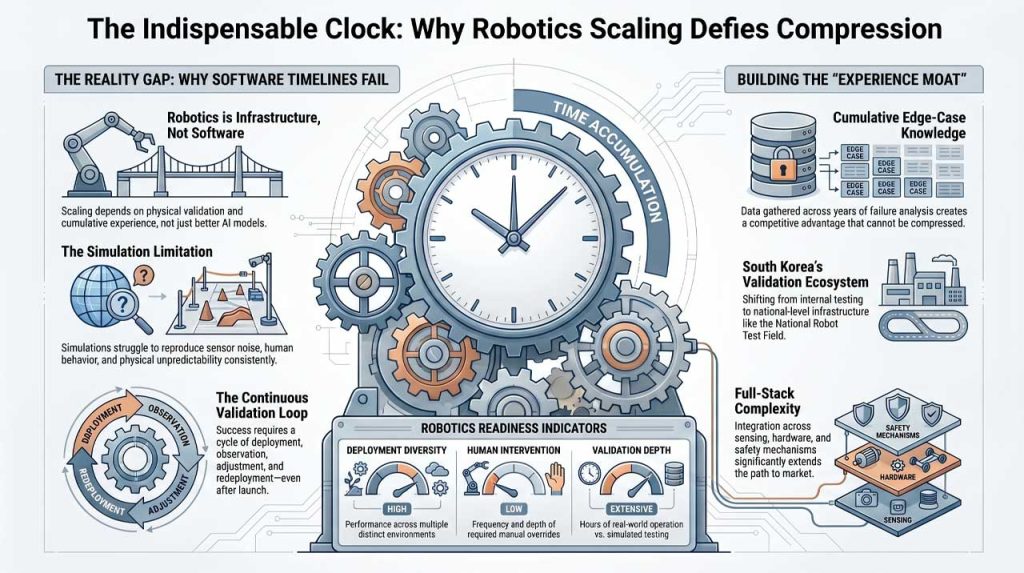
Simulation has become a core tool in robotics development. It accelerates testing and allows teams to explore scenarios that would be costly or unsafe in the physical world.
However, research shows a persistent gap between simulation and deployment. A 2026 study on autonomous mobile robot path planning found that only a minority of algorithms have been validated through real-world experiments, with most tested primarily in simulated environments.
This finding reflects a broader limitation. It shows that real environments introduce variables that are difficult to reproduce consistently, including sensor noise, human behavior, and physical unpredictability.
Data gathered during real-world operation captures conditions that cannot be fully replicated in controlled environments. That data becomes the basis for system refinement, but it builds gradually across repeated deployments and diverse operating contexts.
Field Testing Is Becoming Infrastructure, Not a Phase
In software, testing is often a defined stage. But in robotics, testing becomes part of the system itself.
Autonomous robots must meet safety and performance standards before commercial deployment. International frameworks such as ISO standards for driverless industrial vehicles define requirements not only for functionality, but also for verification and validation.
This creates a continuous loop:
- deployment
- observation
- adjustment
- redeployment
And this process does not end at product launch. Autonomous systems continue to be monitored, adjusted, and validated in operation, which extends development timelines even after the core technology is in place.
South Korea Is Building a Validation Ecosystem
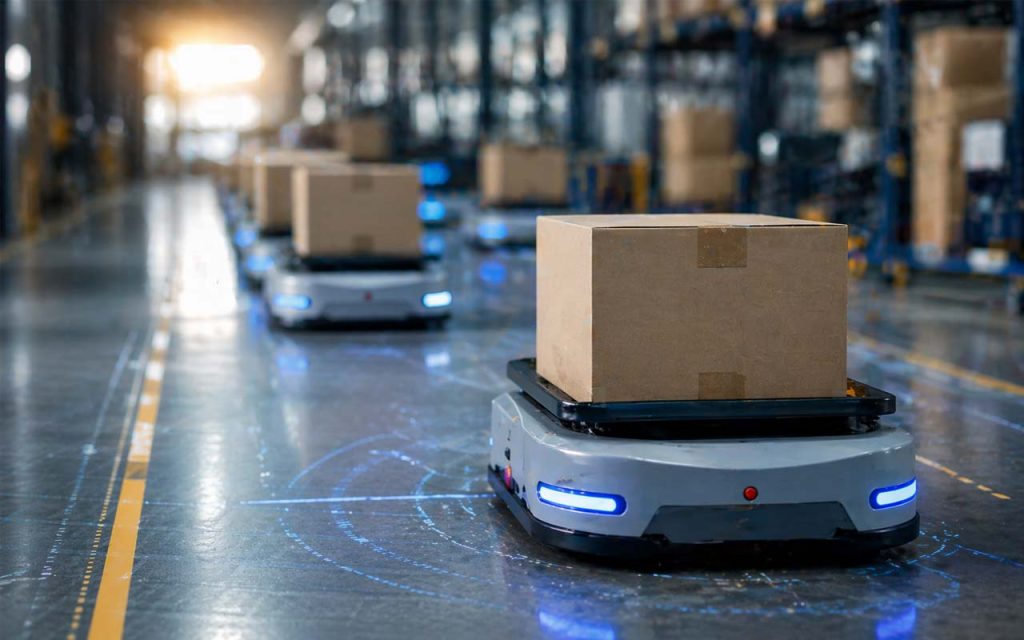
South Korea’s robotics strategy reflects this shift. The country already leads in industrial robot density, yet policy attention is moving toward validation and commercialization infrastructure.
Government initiatives include the development of a National Robot Test Field, designed to support development, demonstration, and certification across real and simulated environments. The program, scheduled through 2028, is intended to accelerate commercialization by enabling systematic testing.
At the same time, regulatory frameworks are evolving. Recent policy updates indicate efforts to expand autonomous testing zones and streamline safety certification processes for mobile robots operating outside controlled environments.
These developments suggest that validation is no longer treated as an internal engineering task. It is now becoming part of national-level ecosystem design.
Full-Stack Integration Extends Timelines Further
Still, even with sufficient data, deployment depends on integration.
Autonomous robotics systems require coordination across:
- sensing and perception
- navigation and control
- hardware components
- safety mechanisms
Korea’s recent push toward “physical AI” reflects this requirement, with government-backed programs linking semiconductors, software, and industrial applications across companies such as Hyundai Motor, LG Electronics, and Doosan Robotics.
This integration moves robotics beyond isolated components into fully coordinated systems, where performance depends on how these layers operate together in real environments.
As a result, validating reliability becomes more complex and time-intensive, extending the path to commercial deployment.
Real-World Data Is Emerging as a Competitive Moat
As validation cycles lengthen, the nature of competitive advantage is also shifting.
Operational data is not only used to fix existing systems. It feeds into future development through simulation and training processes. Industry analysis points to the growing importance of feedback loops between real-world deployment and simulated environments.
This then creates a compounding effect. Companies with longer deployment histories build deeper real-world datasets that steadily improve performance and reduce uncertainty.
Over time, that experience becomes a competitive advantage that cannot be replicated quickly, because it depends on sustained exposure to real operating conditions rather than short development cycles.
What Founders and Investors Often Misread
The persistence of long timelines continues to create systematic misjudgment in the robotics market. Early pilot success is often interpreted as readiness to scale, yet real-world deployment demands validation across multiple environments and use cases.
This gap also affects how progress is evaluated. Technical milestones alone are not sufficient. In practice, more telling indicators include deployment diversity, frequency of human intervention, and the depth of validation processes.
These factors reflect whether a system can operate consistently in real conditions, not just perform under controlled scenarios.
As a result, robotics development follows a different trajectory. It behaves less like software scaling and more like infrastructure buildout, where reliability is established gradually through time and repeated operation.
Korea’s Strategic Position in the Next Phase
Now, South Korea enters this phase with several structural advantages. The country combines high industrial robot adoption, strong manufacturing capability, and growing investment in robotics and AI integration, while also expanding public infrastructure for testing and validation.
This creates an opportunity to move beyond adoption and into commercialization leadership. The key lies in turning validation processes into repeatable systems that can support OEM deployment at scale.
The outcome is not predetermined. It will depend on how effectively the ecosystem connects development, testing, certification, and system integration.
Time Is the Hidden Layer of Robotics Scale
Finally, autonomous robotics has reached a stage where technical capability alone no longer determines success. Systems can perform well in controlled environments, but commercial viability depends on consistent performance in unpredictable real-world conditions.
That transition does not happen through faster iteration cycles. It depends on time, repeated deployment, and continuous validation across diverse environments.
So, for founders, investors, and policymakers, this means that the pace of robotics commercialization will be defined less by how quickly systems are built, and more by how effectively real-world experience is accumulated, tested, and applied.
Key Takeaway
- Autonomous robotics scaling requires years of real-world validation, not just AI model improvement
- Operational data accumulates over time and cannot be fully generated through simulation alone
- Field testing is an ongoing system requirement, not a final development stage
- Safety certification standards demand verified real-world performance, extending deployment timelines
- South Korea is investing in robot testbeds and regulatory frameworks to support validation at scale
- Full-stack integration across hardware and software increases system complexity and time-to-market
- Real-world deployment data is becoming a competitive moat for robotics startups and OEMs
- Investors should evaluate deployment history and validation depth, not only technical milestones
- Robotics commercialization follows infrastructure-like timelines, not software scaling patterns
– Stay Ahead in Korea’s Startup Scene –
Get real-time insights, funding updates, and policy shifts shaping Korea’s innovation ecosystem.
➡️ Follow KoreaTechDesk on LinkedIn, X (Twitter), Threads, Bluesky, Telegram, Facebook, and WhatsApp Channel.
🤝 Looking to connect with verified Korean companies building globally?
Explore curated company profiles and request direct introductions through beSUCCESS Connect.