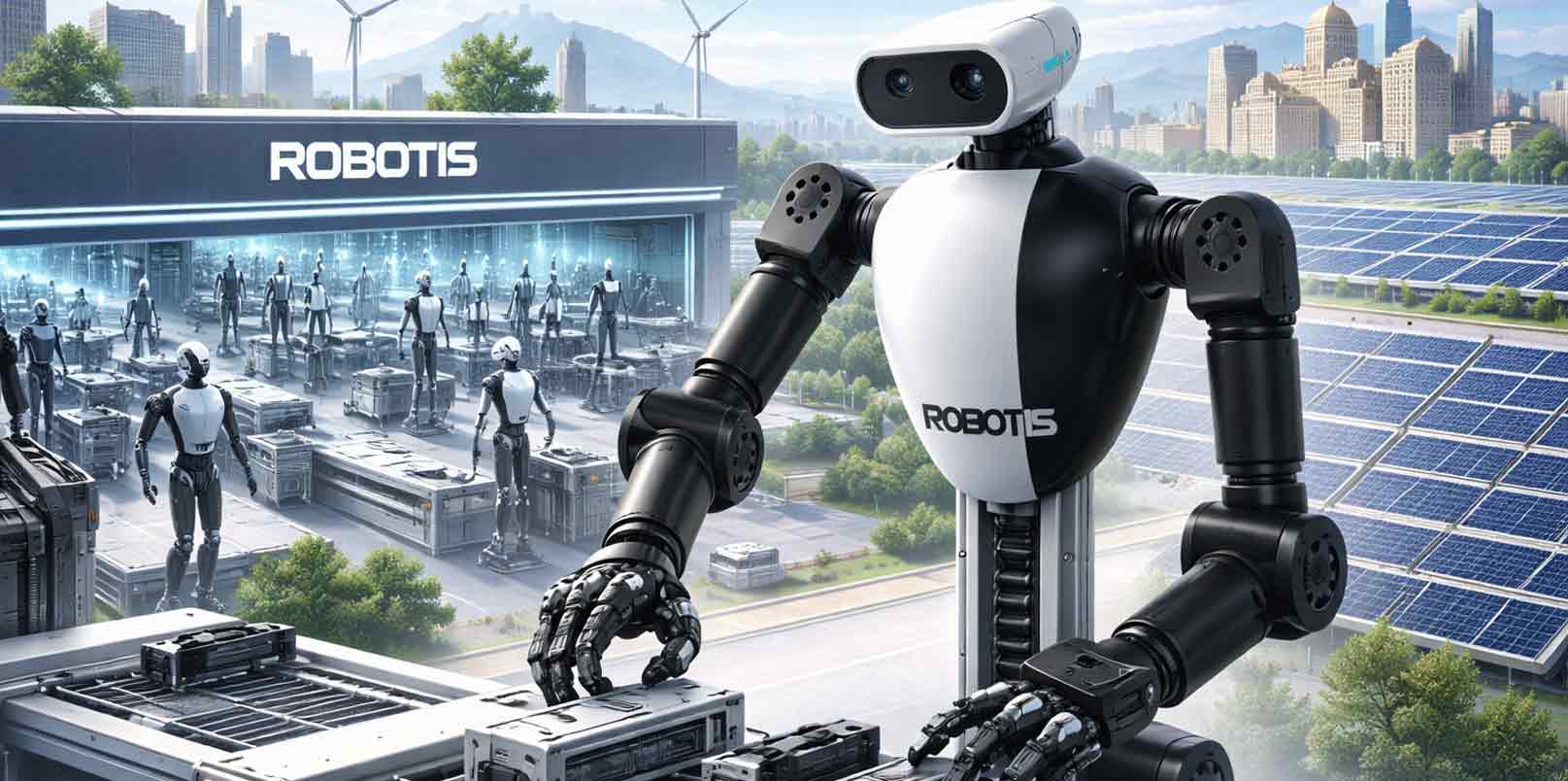
The global race to build humanoid robots is quietly shifting toward a less visible asset: training data. As companies search for ways to teach machines how to operate in real environments, the ability to collect large volumes of physical interaction data is becoming increasingly strategic. Robotis’ plan to build a large robotics data facility in Uzbekistan reflects how parts of Korea’s robotics industry are beginning to respond to this emerging competition.
Robotis Builds Uzbekistan Data Factory to Scale Humanoid Robot Training Data
South Korean robotics company Robotis is preparing to build a large data factory in Uzbekistan designed to collect large volumes of robot motion data. The project reflects a growing focus in the robotics industry on real-world training data needed to develop humanoid robots and physical AI systems.
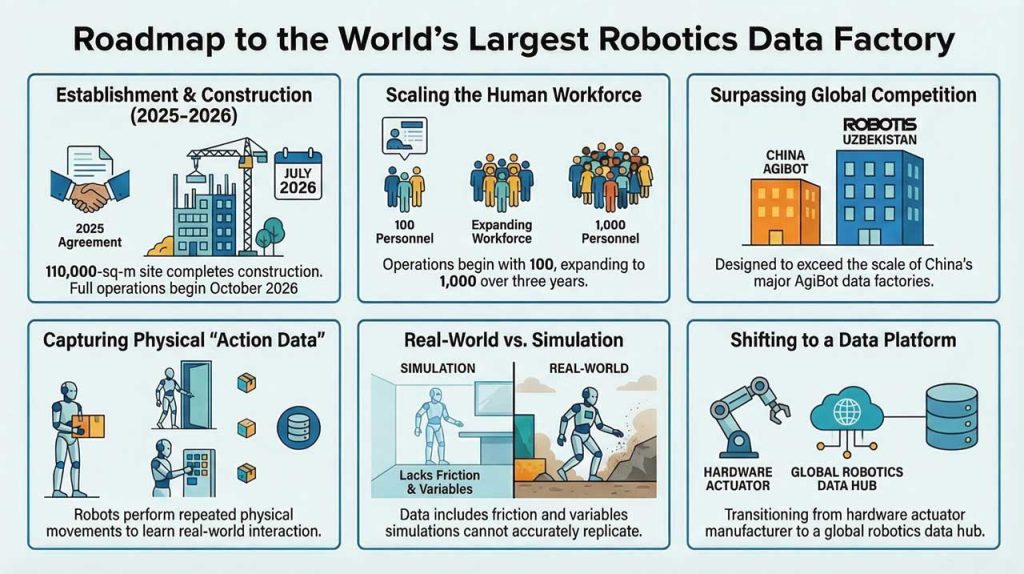
According to industry sources cited in Korean media, Robotis established a local subsidiary in Uzbekistan in January 2026. The company plans to complete the data factory in July, with full operations expected to begin in October.
The project will scale gradually. About 100 workers are currently involved in early setup and construction, with the workforce expected to expand to around 1,000 personnel over the next two to three years.
The facility will operate on a site measuring roughly 110,000 square meters, expanded through cooperation with the Uzbek government. Officials previously agreed to provide land, tax incentives, and other support to attract the robotics investment.
Robotis intends to use the site to collect robot “action data,” generated by repeatedly performing physical movements so robots can learn how to interact with objects and environments.
Industry observers cited in Korean reports say that if the project proceeds as planned, the facility could exceed the scale of similar data collection environments built by Chinese humanoid robotics company AgiBot.
Uzbekistan Backs Robotis Project with Land, Incentives, and Industrial Support
The Uzbekistan project follows a cooperation agreement signed between Robotis and the Uzbek government in December 2025.
Initially, the government offered approximately 66,000 square meters of land for a robotics facility. Subsequent negotiations expanded the project area to around 33,275 pyeong (110,000 square meters), with a large portion expected to be used for the data factory.
Robotis selected Uzbekistan partly because robotics data collection requires repeated physical experiments conducted over long periods. Lower labor costs and industrial support make such operations more feasible at scale.
Robot training data often involves running robots through the same movement patterns repeatedly while human operators monitor performance and record results. These processes can require large teams and extended operating hours.
The Robotics Data Race Is Intensifying as Physical AI Demands Real-World Training
The Robotis project highlights a shift in how robotics companies are approaching humanoid AI development.
Unlike generative AI models trained largely on internet-scale text or images, robots must learn through physical interaction with the real world. Training datasets often require experiments involving motion, contact with objects, and environmental variation.
Experts cited in Korean reports say several structural challenges make robotics data difficult to gather.
Robot data collection is significantly more expensive than collecting video or image data. Experiments must be repeated many times, often under carefully controlled conditions. Safety risks also arise when robots operate in real environments.
Another limitation is the lack of standardized data structures. Because robots interact with the physical world in complex ways, collecting diverse datasets requires many different environments and tasks.
As a result, companies capable of building large-scale robotics data infrastructure may gain a competitive advantage in humanoid robot development.
China’s AgiBot Shows How Robotics Data Factories Accelerate Humanoid AI
China has moved early to expand robotics data infrastructure.
Korean industry reports note that the country currently operates seven robotics data factories nationwide as part of broader efforts to advance artificial intelligence and humanoid robotics.
One example is AgiBot, a Shanghai-based robotics company. The firm built a facility exceeding 4,000 square meters where environments such as homes, restaurants, shopping malls, offices, and industrial spaces are recreated for data collection.
Within these spaces, robots observe and replicate human behavior. The collected data is then used to train robotics AI models.
AgiBot released a robot AI model as open source in December 2024 and has emerged as a fast-growing participant in the humanoid robotics sector.
The example illustrates how large-scale data collection environments are becoming a key part of robotics development strategies.
Robotis Moves Beyond Actuators Toward a Data-Driven Robotics Platform
Robotis historically generated most of its revenue through actuators, the core components that drive robotic movement.
The company now appears to be expanding its focus toward data infrastructure and platform capabilities.
CEO Kim Byung-soo emphasized the role of training data in robotics development in remarks reported by Korean media,
“High-quality data is essential to improve robot proficiency. The key role of the data factory being built in Uzbekistan is to accumulate action data.
We are actively pursuing global expansion by expanding data factory operations beyond Korea into Uzbekistan. Once completed, the scale and functionality will surpass facilities such as China’s AgiBot and challenge the position of the world’s largest.”
Kim also noted that expanding data factory operations outside Korea is part of the company’s global strategy.
Robotis intends to use the Uzbekistan site as an “action data hub” that supports both hardware development and robotics software systems.
Founded in 1999, Robotis remains known for actuator technology used in research robots and industrial applications. LG Electronics holds approximately 7.36 percent of the company’s shares, according to public filings cited in Korean reports.
Why Korea’s Manufacturing Ecosystem Could Shape the Robotics Data Race
Industry experts in Korea argue that the country may have a potential advantage in robotics data collection due to its manufacturing ecosystem.
Officials at the Ministry of Trade, Industry and Energy have discussed strengthening robotics collaboration through initiatives linking manufacturing capability with artificial intelligence development.
One such framework is the M.AX Alliance, which promotes cooperation between industry participants in manufacturing and AI transformation.
Researchers also emphasize the importance of real-world operational environments.
Kim Ik-jae, head of the AI and Robotics Research Institute at the Korea Institute of Science and Technology (KIST), noted,
“Simulation and generated data are important, but acquiring real-world data from actual environments remains essential.”
Friction, unexpected interactions, and human involvement all affect how robots perform tasks. These factors mean that real industrial environments can produce valuable training data that complements simulation and synthetic datasets.
Robotics Data Infrastructure Is Emerging as the Industry’s New Competitive Layer
For global robotics startups and investors, the Robotis project signals a broader shift.
Competition in robotics is no longer limited to hardware performance or AI models. Access to large volumes of structured real-world training data is becoming another critical layer of development.
China has pursued large-scale data infrastructure through national initiatives and company-built facilities. The United States maintains strong research capabilities in AI and robotics software.
Korean companies appear to be exploring how manufacturing environments and industrial ecosystems can generate valuable robotics datasets.
The Uzbekistan facility therefore reflects an emerging strategy focused on building robotics data infrastructure, not only producing robots themselves.
The Next Question in Humanoid Robotics: Who Controls the Training Data?
The robotics industry is entering a stage where hardware engineering, artificial intelligence models, and training data pipelines are increasingly interconnected.
Robotis’ data factory project suggests that some companies are investing early in infrastructure needed to collect large-scale robot motion data.
If humanoid robotics development continues to rely heavily on real-world training environments, access to such data could become a defining factor in future competition.
For founders, investors, and policymakers watching the sector, the key question may shift beyond who builds the most advanced robots.
It may also depend on who can gather and organize the largest and most diverse robotics datasets.
Robotics Data Factory Snapshot
Company: Robotis
Project: Robotics data factory for humanoid robot training
Location: Uzbekistan
Planned completion: July 2026
Operations start: October 2026
Site size: ~110,000 square meters
Workforce target: Up to 1,000 personnel
Primary purpose:
Large-scale collection of robot “action data” used to train humanoid robots and physical AI systems through repeated real-world motion experiments.
Industry context:
China has already developed several robotics data factories. Companies such as AgiBot use simulated environments like homes, restaurants, and industrial spaces to collect robot training data.
Strategic implication:
Access to large volumes of real-world robotics training data is becoming a key factor in the development of humanoid robots and physical AI systems.
Key Takeaways for Founders, Investors, and Robotics Ecosystem Builders
- Robotis is building a robotics data factory in Uzbekistan scheduled for completion in 2026, with operations expected to begin later in the year.
- The facility aims to collect robot action data generated through repeated physical movement experiments.
- The workforce is expected to scale from about 100 workers during setup to roughly 1,000 personnel in the coming years.
- China has already developed multiple robotics data factories, including environments operated by humanoid robotics company AgiBot.
- Experts say robotics training data is difficult and expensive to collect because robots must learn through real-world interactions.
- The development highlights a growing shift in the robotics industry toward data infrastructure as a competitive resource for physical AI and humanoid robotics.
– Stay Ahead in Korea’s Startup Scene –
Get real-time insights, funding updates, and policy shifts shaping Korea’s innovation ecosystem.
➡️ Follow KoreaTechDesk on LinkedIn, X (Twitter), Threads, Bluesky, Telegram, Facebook, and WhatsApp Channel.
🤝 Looking to connect with verified Korean companies building globally?
Explore curated company profiles and request direct introductions through beSUCCESS Connect.