
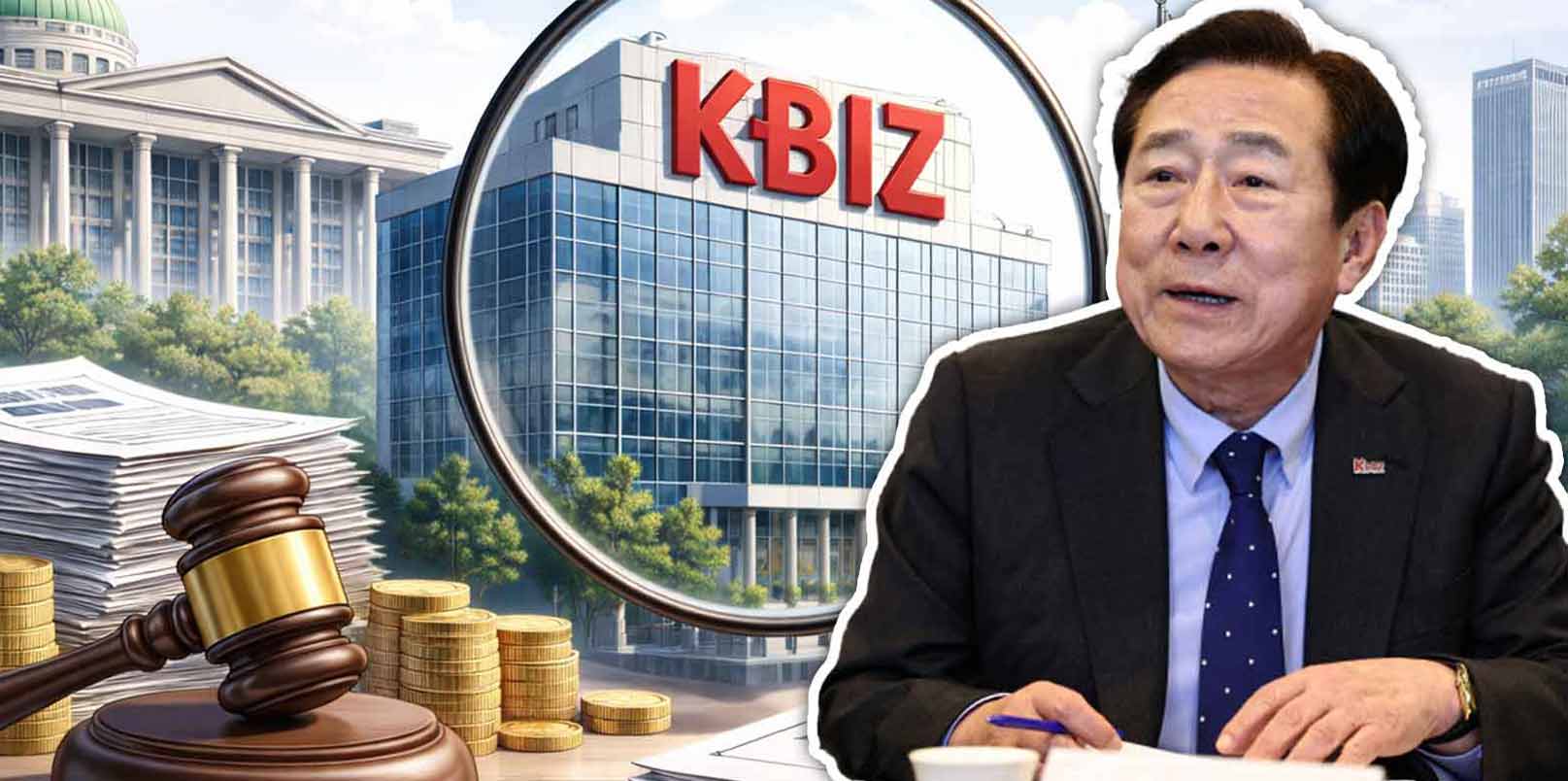
A policy debate inside one of South Korea’s most influential SME institutions has moved beyond internal governance and into the national policy arena. What began as a legislative proposal affecting leadership rules at the country’s largest SME federation, KBIZ, is now drawing scrutiny from government regulators, labor representatives, and former industry leaders. For global observers of Korea’s innovation ecosystem, the episode raises a deeper question about how institutional credibility is maintained inside organizations that shape the environment for startups and small businesses.
Government Review Challenges Proposal to Ease KBIZ Leadership Term Limits
South Korea’s Ministry of SMEs and Startups has urged caution over a proposed amendment to the Small and Medium Enterprise Cooperatives Act that would remove limits on leadership reappointments at the Korea Federation of SMEs.
According to a legislative review report submitted to the National Assembly’s Trade, Industry, Energy, SMEs and Startups Committee, the ministry argued that the proposal requires careful examination because the current rules were originally introduced to prevent organizational problems arising from prolonged leadership tenure.
Officials warned that extended incumbency by specific executives could lead to internal closedness or concentration of authority. The ministry also pointed to a broader policy trend in cooperative governance, noting that other related laws in South Korea have recently strengthened limits on leadership reappointments rather than weakening them.
An amendment to the Agricultural Cooperatives Act passed earlier this year, for example, tightened rules so that even non-standing cooperative chairpersons may only serve two terms, matching limits applied to full-time leadership positions.
The ministry further emphasized that KBIZ carries a public institutional role. Unlike many private industry associations, the federation is designated as a public-service-related organization under South Korea’s Public Service Ethics Act, which imposes obligations such as asset registration and disclosure on executives and employees.
Considering these factors, the ministry concluded that any attempt to ease or abolish leadership reappointment limits should undergo “sufficient discussion and review.”
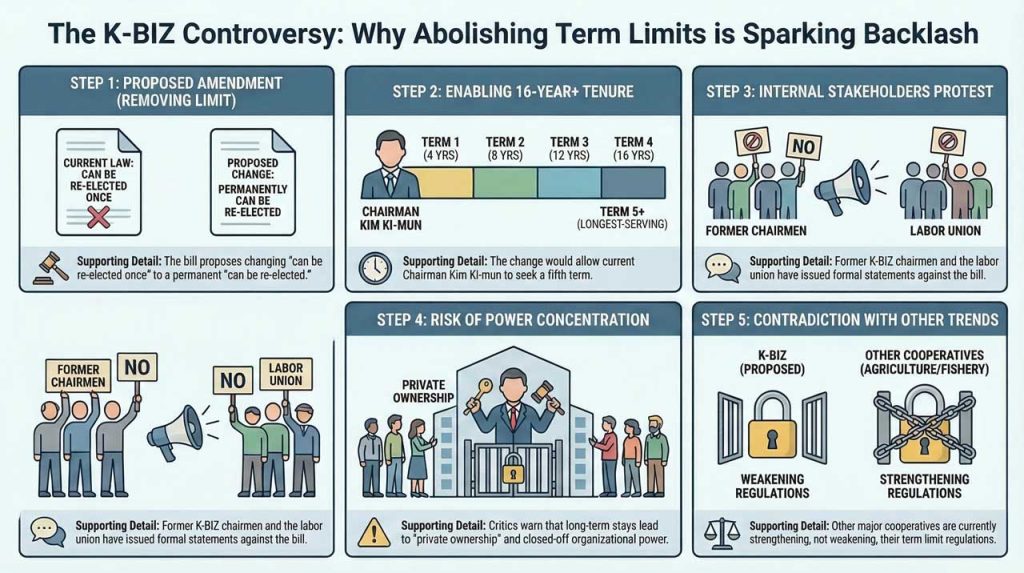
The legislative proposal that triggered the debate was introduced in late 2025 by Democratic Party lawmaker Jung Jin-wook. The bill would remove the current rule limiting the KBIZ chairman to one additional term and instead allow the federation to determine leadership rules through its internal bylaws.
If the law were revised, current KBIZ chairman Kim Ki-mun could potentially seek another term after his current mandate ends in February 2027.
Why the KBIZ Leadership Debate Is Drawing National Attention
The controversy surrounding the proposed amendment has expanded beyond the legislative process itself.
Former KBIZ chairmen and the federation’s labor union have both publicly opposed the proposal, arguing that removing leadership limits could undermine democratic governance inside the organization.
In a joint statement, several former federation leaders warned that the bill could weaken the public character and representative legitimacy of the institution. They emphasized that the federation is not simply a private industry association but a national body representing millions of small and medium-sized enterprises and participating in government economic policy processes.
Union representatives have raised similar concerns. A survey conducted among union members found that 97 percent of respondents opposed removing the leadership limit. The union also submitted a written opinion to the National Assembly committee reviewing the bill, warning that prolonged leadership tenure could create a risk that the organization becomes effectively privatized.
The debate has therefore become less about a technical governance change and more about the institutional role KBIZ plays within South Korea’s broader SME policy framework.
Institutional Governance Tensions Surface Inside Korea’s SME Representation System
The friction surrounding the proposed amendment highlights a longstanding tension within cooperative governance structures.
Supporters of the legislative change have argued that some sectoral cooperatives struggle to recruit leadership candidates, making strict term limits difficult to manage in practice. In those cases, relaxing leadership rules could provide operational continuity.
Critics, however, see term limits as a fundamental safeguard against concentration of authority.
Current rules limiting the KBIZ chairman’s reappointment were first introduced through a legislative amendment in 2006. At the time, lawmakers explained that restricting leadership tenure could reduce internal conflicts during elections and encourage more accountable management.
Additional restrictions on cooperative chairpersons were introduced in 2018 as part of broader efforts to prevent extended incumbency among cooperative executives.
Within this framework, the current leadership structure of KBIZ already reflects a complex balance between continuity and rotation. Chairman Kim previously served two terms between 2007 and 2015 before returning to the role in 2019 and winning reappointment in 2023.
If his current term runs through February 2027, his cumulative time in office would reach sixteen years across non-consecutive mandates.
The proposed legal amendment would remove the remaining barrier preventing him from running again.
What the Legislative Debate Could Change — and What It May Not
Even if the proposed amendment were ultimately adopted, the practical impact would depend on how KBIZ chooses to structure its internal governance rules.
Under the current proposal, decisions about leadership reappointment limits would be delegated to the federation’s internal bylaws rather than specified in national legislation.
In theory, this would increase organizational autonomy in selecting leadership structures.
In practice, however, the shift would also move a key governance safeguard from statutory law into internal rulemaking — a change that critics argue could weaken institutional checks.
The government’s intervention suggests that policymakers remain cautious about altering the governance framework of a federation that operates partly within the public policy sphere.
For now, the bill remains under review in the National Assembly, and its final legislative trajectory remains uncertain.
What the KBIZ Governance Debate Signals for Global Startup Stakeholders
For international founders and investors watching South Korea’s startup environment, the KBIZ episode offers a reminder that institutional governance debates can shape the broader policy climate.
Although KBIZ primarily represents traditional small and medium-sized enterprises, it plays a significant role in national discussions on SME policy, regulatory reform, and industrial support programs.
These policy processes intersect with startup ecosystems in areas such as technology commercialization, export promotion, and industrial innovation programs coordinated with the government.
Institutional credibility inside major industry bodies therefore affects how effectively public-private policy frameworks function.
For foreign founders considering expansion into Korea or investors evaluating partnerships with SME networks, governance stability inside representative institutions is one of the quieter signals that influences long-term ecosystem confidence.
Governance Questions That Reach Beyond One Federation
The current controversy around KBIZ leadership rules ultimately reflects a broader institutional challenge.
Organizations representing large segments of the economy must balance continuity with accountability, operational stability with leadership renewal. When those balances are tested, the resulting debate often extends beyond a single institution.
In South Korea’s case, the outcome will help determine how governance expectations evolve inside the country’s SME representation system — and how those institutions position themselves within an increasingly globalized innovation economy.
Key Takeaway on KBIZ Chairman Term Limit Controversy
- South Korea’s SME ministry has urged caution over a proposed amendment that would remove leadership reappointment limits at the Korea Federation of SMEs.
- Officials warned that prolonged leadership tenure could lead to power concentration and internal governance problems.
- The proposal was introduced by Democratic Party lawmaker Jung Jin-wook and would allow KBIZ to set leadership rules through internal bylaws.
- Former KBIZ chairmen and the federation’s labor union have publicly opposed the amendment, citing risks to democratic governance and institutional credibility.
- The debate highlights broader questions about governance standards inside organizations that influence South Korea’s SME and startup policy environment.
– Stay Ahead in Korea’s Startup Scene –
Get real-time insights, funding updates, and policy shifts shaping Korea’s innovation ecosystem.
➡️ Follow KoreaTechDesk on LinkedIn, X (Twitter), Threads, Bluesky, Telegram, Facebook, and WhatsApp Channel.
🤝 Looking to connect with verified Korean companies building globally?
Explore curated company profiles and request direct introductions through beSUCCESS Connect.