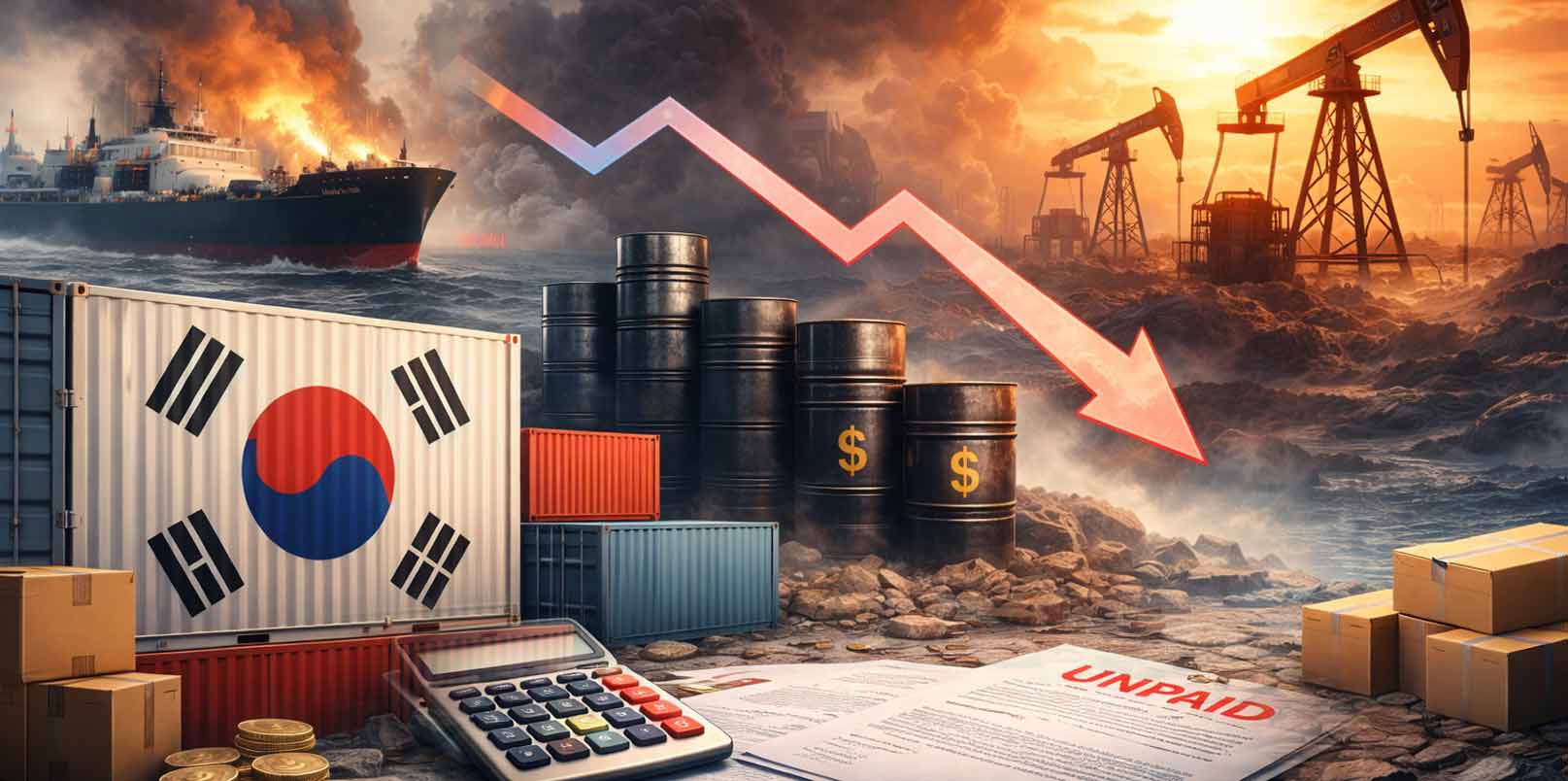
A geopolitical shock rarely arrives through a single channel. For Korean startups and export-oriented SMEs tied to the Middle East, the current crisis is unfolding across several layers at once. Shipping routes are unstable, buyers are disappearing, and now macroeconomic pressure is entering the picture. As oil prices surge and the Korean currency weakens, a regional conflict is beginning to test the financial resilience behind Korea’s outward-looking startup growth model.
Oil Above $100 and Weak KRW Add New Pressure on Korea’s Export SMEs
International oil prices surged past $100 per barrel in early March as tensions escalated across the Middle East.
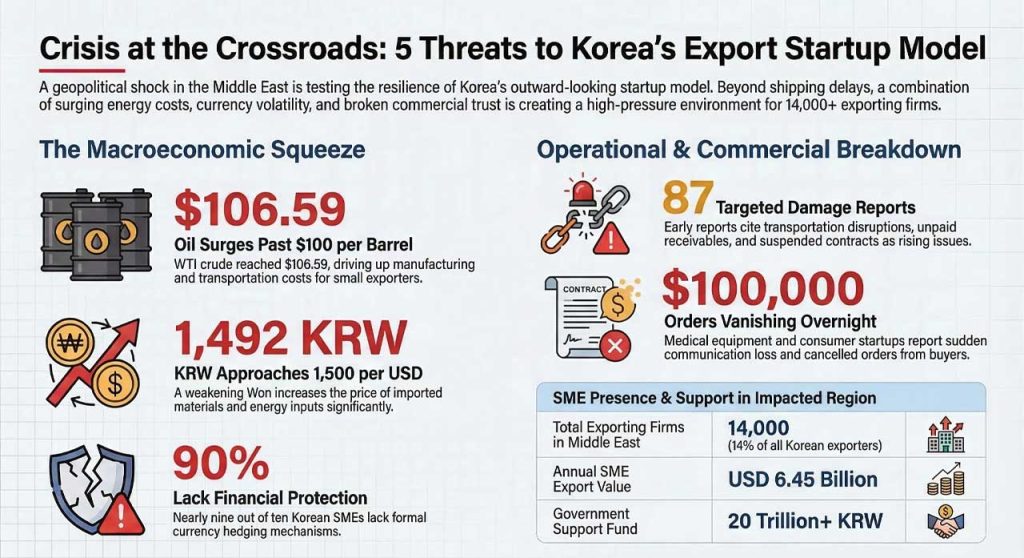
According to market data cited in Korean financial coverage, West Texas Intermediate (WTI) crude futures for April delivery jumped to $106.59 per barrel on March 9, marking the first time oil prices have crossed the $100 threshold since Russia’s invasion of Ukraine in 2022.
At the same time, currency markets have moved sharply. The Korean won–U.S. dollar exchange rate opened at 1,492 won per dollar on March 9 in Seoul’s foreign exchange market, with analysts expecting the rate to fluctuate near the 1,500 level.
For export-oriented companies, the combination is particularly difficult to absorb. Rising oil prices increase manufacturing and transportation costs simultaneously, while a weaker currency raises the price of imported materials and energy inputs.
Industry participants say the situation is quickly translating into operational pressure. One SME export manager cited in domestic coverage noted that when oil prices and exchange rates climb together, “cost burdens inevitably increase,” warning that logistics disruptions could soon make delivery deadlines harder to meet.
The shock is already visible in early damage reports collected by South Korea’s Ministry of SMEs and Startups. Between February 28 and March 5, companies reported 22 cases of transportation disruption, 12 cases of unpaid export receivables, nine cases of increased logistics costs, five cases of disrupted business travel, and four cases of suspended contracts.
Government monitoring suggests the number of incidents is rising. As of March 8, authorities had received 87 reports of export-related damage linked to the Middle East situation, with transportation disruption accounting for the majority of cases.
Why Currency and Energy Volatility Now Matter for Korea’s Startup Export Model
The new pressure matters because Korea’s export ecosystem is unusually dependent on smaller firms. While the Middle East represents only about 3 percent of Korea’s total export value, roughly 14,000 Korean companies export to the region, representing about 14 percent of the country’s exporting firms.
Many of those companies fall into the SME and emerging technology category. For years, the Middle East has offered relatively accessible market entry compared with Europe or the United States. Regulatory barriers are lower, certification requirements are less complex, and governments across the Gulf have been actively seeking new technologies.
That combination made the region attractive for early-stage global expansion.
Official data from the Ministry of SMEs and Startups shows Korean SME exports to the Middle East reached USD 6.45 billion last year, accounting for 5.4 percent of total SME exports.
Yet the same structure that made the region attractive now exposes vulnerability. Smaller exporters often operate with thinner capital buffers and limited financial risk management.
Research cited by the Korea SMEs and Startups Institute shows that a 1 percent increase in the won–dollar exchange rate increases foreign exchange losses for SMEs by about 0.36 percent. At the same time, surveys indicate that nearly nine out of ten Korean SMEs lack formal currency hedging mechanisms.
When energy prices, exchange rates, and logistics costs move simultaneously, those firms have few tools to stabilize margins.
Logistics Disruption Is Only One Layer of the Crisis
Early reporting on the Middle East crisis focused on shipping routes and transportation interruptions. But the latest field reports suggest the disruption is evolving into a broader commercial breakdown.
Companies are beginning to report cancelled orders and lost communication with buyers.
Layun Korea, a company exporting aesthetic medical equipment to the Middle East, recently saw a USD 100,000 order from an Iraqi buyer cancelled after production was completed. The firm had already manufactured the products and was waiting for payment when the transaction collapsed amid the regional conflict.
Orders from Saudi Arabia were also cancelled, while communication with a Kuwaiti buyer stopped entirely.
CEO Yoon Ji-hye described the immediate consequence in stark terms, saying:
“Transactions with Middle Eastern customers are being suspended one after another. Right now we are worried about how to cover production costs and employee salaries.”
Other exporters report similar disruptions. Daily Chai, a Korean SME exporting shower filtration products to the UAE and Saudi Arabia, had been expecting a large order after local testing and factory inspections were completed. Communication with the buyer recently stopped.
In sectors tied to physical logistics, the disruption spreads quickly.
Used vehicle exporters provide one example. Roughly 35 percent of Korea’s used car exports are shipped to Middle Eastern markets. Shipping delays linked to tensions around the Strait of Hormuz are now causing vehicles that have already been sold to accumulate in storage yards while exporters wait for vessels.
Policy Support Can Cushion Costs but Cannot Restore Market Confidence
The Korean government has begun preparing financial and logistical support for affected exporters.
Authorities are considering emergency logistics vouchers, expanded financial support programs, and tax relief measures for companies facing operational disruption. Export support funds totaling more than 20 trillion KRW have been mobilized across multiple state financial institutions.
The Ministry of SMEs and Startups is also reviewing a one-year extension for principal repayment on certain policy loans.
These measures are designed to stabilize liquidity while trade routes remain uncertain.
But financial support cannot address every form of disruption appearing in the field.
When buyers disappear, orders are cancelled, or payments remain unpaid, the problem shifts from transportation to commercial trust. Smaller exporters often rely on a limited number of overseas partners, making them particularly sensitive to sudden breakdowns in those relationships.
In that sense, the challenge extends beyond shipping capacity or freight costs.
It touches the underlying structure of cross-border business.
What Global Founders and Investors Should Watch in Korea’s Export Ecosystem
For global investors and founders watching Korea’s startup ecosystem, the current situation highlights a structural dynamic that is easy to overlook during growth phases.
International expansion strategies often focus on market demand, government partnerships, and investment flows. The less visible layer lies in operational resilience.
Korean startups expanded into the Middle East partly because the region offered strong technology demand and ambitious government-led development programs. Those opportunities remain real.
But the present disruption shows how tightly export-driven innovation ecosystems remain connected to geopolitical logistics and currency markets.
Energy price shocks influence manufacturing costs. Currency movements reshape margins overnight. And local business relationships can collapse quickly when conflict spreads across a region.
For startups whose global growth depends on hardware deployment, manufacturing supply chains, or physical distribution, those risks compound quickly.
Korea’s Global Startup Strategy Now Faces a Different Kind of Stress Test
Korea has spent years encouraging startups and SMEs to pursue global markets as a path to growth beyond the domestic economy.
The Middle East became one of the most visible destinations for that strategy.
Now the same region is revealing a different side of global expansion.
Shipping disruptions exposed operational dependence on mobility. Currency volatility is testing financial resilience. And buyer uncertainty is challenging the durability of commercial relationships.
Taken together, the situation offers a reminder that global expansion is rarely disrupted by a single variable.
More often, pressure arrives in layers.
Key Takeaway on Middle East Tension Impact on Korea’s SMEs
- International oil prices surpassed USD 100 per barrel for the first time since 2022 as Middle East tensions escalated.
- The Korean won approached 1,500 per U.S. dollar, raising import and production costs for export-oriented SMEs.
- South Korea’s Ministry of SMEs and Startups received 87 reports of Middle East-related export damage as of March 8.
- Reported cases include transportation disruption, unpaid receivables, rising logistics costs, travel disruptions, and contract suspensions.
- Approximately 14,000 Korean SMEs export to the Middle East, with annual shipments totaling about USD 6.45 billion.
- Surveys indicate nearly 90 percent of Korean SMEs lack formal currency risk management tools, increasing vulnerability to exchange rate volatility.
- Government support programs including logistics vouchers and financial assistance are being prepared to help affected exporters stabilize operations.
– Stay Ahead in Korea’s Startup Scene –
Get real-time insights, funding updates, and policy shifts shaping Korea’s innovation ecosystem.
➡️ Follow KoreaTechDesk on LinkedIn, X (Twitter), Threads, Bluesky, Telegram, Facebook, and WhatsApp Channel.
🤝 Looking to connect with verified Korean companies building globally?
Explore curated company profiles and request direct introductions through beSUCCESS Connect.