A global expansion strategy can unravel in ways spreadsheets rarely predict. For Korean startups that recently turned to the Middle East as a growth frontier, the sudden collapse of air and sea access to the region has exposed a fragile truth. Market entry plans built around partnerships, pilot programs, and new subsidiaries now depend on something far more basic: whether founders and engineers can physically reach the markets they chose to bet on.
Korean Startups Report Middle East Expansion Disruptions as Flights and Shipping Routes Halt
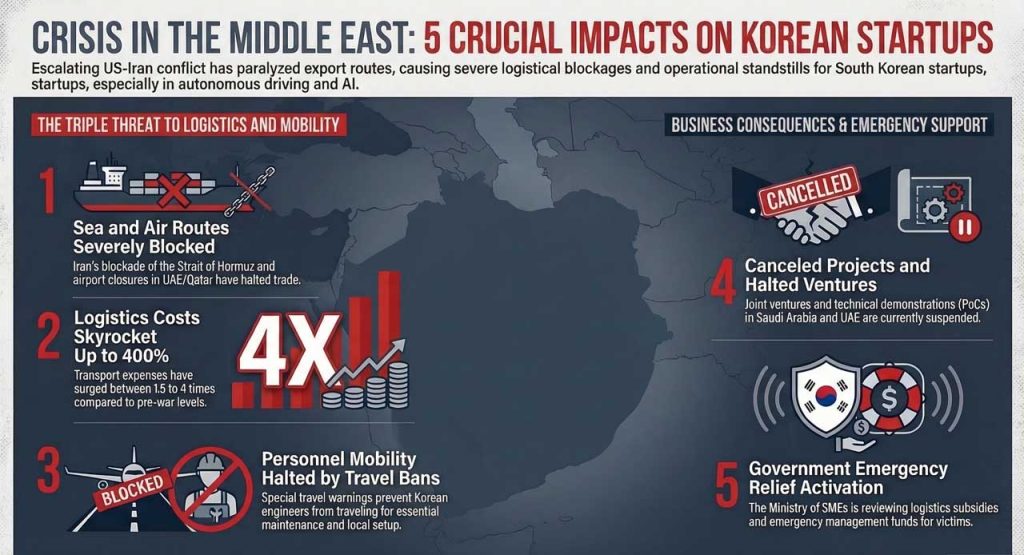
South Korean startups expanding into the Middle East are beginning to report operational disruptions as regional conflict between the United States and Iran blocks both air and maritime routes to the region.
According to venture industry sources cited on March 5, autonomous driving startup Autonomous A2Z recently reported export-related difficulties to South Korea’s Ministry of SMEs and Startups (MSS) linked to the escalating conflict.
The company explained that its plan to establish a joint venture in the United Arab Emirates (UAE) has stalled after airports in the country effectively shut down. Without the ability to send Korean employees to the UAE, the company now faces operational challenges in launching the venture’s initial activities.
Autonomous A2Z also warned that Iran’s closure of the Strait of Hormuz has created obstacles for exporting its autonomous vehicle platform, known as “Roi.” Even if logistics routes reopen, the absence of Korean engineers needed to supervise unloading, vehicle setup, and testing would make it difficult to operate or maintain the vehicles locally.
Logistics costs are also expected to surge. Industry estimates suggest transportation expenses for shipments to the Middle East could increase 1.5 to four times compared with pre-war levels.
More Startup Project Delays as Travel Advisories and Flight Suspensions Spread
Other startups with regional ambitions are encountering similar uncertainty.
AI semiconductor startup Rebellions, which established a Saudi Arabian subsidiary in July 2025, had been preparing to strengthen its local operations. However, the South Korean government’s special travel advisory for Saudi Arabia has temporarily prevented direct personnel deployment.
Industry sources say the company’s participation in semiconductor events scheduled in Saudi Arabia this month and next month is now uncertain. In another case, a Korean startup reportedly cancelled a proof-of-concept (PoC) technology project in Riyadh after the local collaboration became impossible under current conditions.
A venture industry official noted,
“Most companies that have submitted damage reports are struggling with aviation and maritime transport issues.”
Iran has staged military demonstrations that effectively restrict passage through the Persian Gulf, while countries including the UAE and Qatar halted flight operations shortly after the conflict began. With routes for both personnel and equipment cut off, many startup operations tied to the region have effectively paused.
The Ministry of SMEs and Startups is currently assessing the scale of damage through its regional export support centers. Officials are preparing emergency management stabilization funds to address potential liquidity stress while also reviewing possible support measures to help companies cope with sharply rising logistics costs.
An MSS official said,
“As it has not been long since the damage began to occur, we are still in the stage of determining the precise scale of the impact. Once the damage situation and its scope become clearer, we will begin providing support.”
Why Physical Access Is Becoming the Hidden Bottleneck in Korea–Middle East Startup Expansion
The emerging disruptions highlight a structural reality that is easy to overlook in global startup narratives: international expansion depends not only on demand but also on the ability to operate physically inside a market.
Over the past two years, Korean startups increasingly targeted Saudi Arabia and the UAE as expansion destinations. Government policy encouraged this shift as founders searched for new demand outside a cooling domestic venture environment and intensifying trade tensions elsewhere.
The Middle East offered something attractive: government-backed infrastructure programs, aggressive technology investment strategies, and large-scale projects tied to national transformation agendas.
For Korean startups in sectors such as autonomous mobility, semiconductors, and industrial technology, the region promised pilot programs and partnerships that could accelerate global credibility.
Yet the operational model underlying those opportunities often assumes continuous mobility. Engineers must travel. Equipment must be shipped. Demonstration vehicles must be assembled on site. Founders must meet regulators and partners.
When those channels disappear, expansion strategies designed around physical collaboration quickly lose traction.
Startup Globalization Meets the Hard Limits of Logistics and Travel Restrictions
The current disruptions also reveal a deeper friction between policy-driven global expansion and the practical mechanics of running a startup abroad.
Government initiatives have encouraged Korean companies to explore Middle Eastern markets as part of broader global diversification strategies. The narrative has largely focused on new investment opportunities, strategic partnerships, and technology demand.
But the operational layer beneath those ambitions receives far less attention.
Launching a joint venture requires more than paperwork. Engineers must set up systems. Hardware must pass through ports and customs. Demonstration equipment must be assembled and maintained by trained teams.
The situation described by Autonomous A2Z illustrates that dependency clearly. Even if vehicles can eventually reach the UAE, the inability to send Korean staff to supervise unloading and operation could render the technology unusable.
Events, technology demonstrations, and pilot programs are equally sensitive to mobility constraints. When travel advisories restrict personnel deployment, even well-funded partnerships can stall before meaningful testing begins.
The friction is systemic rather than company-specific. Hardware-focused startups and infrastructure technologies are especially vulnerable because they rely heavily on cross-border physical operations.
What the Crisis Enables — and What It Still Cannot Solve for Korean Export Startups
The government’s response will likely focus first on financial stabilization and logistics support.
Emergency management stabilization funds can provide short-term liquidity relief for companies whose export revenue or project timelines are suddenly disrupted. Additional support for rising shipping costs may also reduce some financial pressure if transport routes reopen.
Those measures address part of the problem.
They cannot, however, immediately restore the operational conditions required for technology deployment abroad. When airports close and maritime corridors become unstable, financial assistance alone cannot replace the physical presence required to operate vehicles, install equipment, or run demonstrations.
For startups with Middle East expansion strategies tied to on-site pilots or infrastructure projects, the situation becomes a waiting game shaped by geopolitical timelines beyond their control.
Companies whose business models rely more on software, data services, or remote collaboration may experience less immediate disruption.
Hardware and deep-tech startups do not have that flexibility.
What the Middle East Disruption Signals for Global Founders and Investors
For international investors and partners observing Korea’s startup ecosystem, the current disruption illustrates how geopolitical shocks increasingly intersect with venture growth strategies.
Korean startups expanded aggressively into the Middle East partly because the region appeared insulated from certain market slowdowns elsewhere. Major government-led development programs in the Gulf created demand for advanced technology across sectors including mobility, AI infrastructure, robotics, and smart city systems.
Yet the same geography that enabled those opportunities also anchors them to global logistics networks.
When air travel halts and maritime routes become unstable, the friction spreads beyond trade statistics. It reaches product testing, partnership execution, and talent mobility.
For global founders considering expansion into the region, the episode reinforces a lesson often overlooked during growth phases: geopolitical resilience is becoming as important as market opportunity.
Investors may also begin evaluating cross-border expansion plans through a different lens, paying closer attention to logistics dependencies and operational redundancy in international strategies.
The Quiet Reality Behind Korea’s Global Startup Push
The current disruption does not invalidate the strategic logic behind Korea’s push toward the Middle East. The region remains one of the few global markets actively investing in large-scale infrastructure and emerging technologies.
But the events unfolding now reveal a quieter reality about international startup growth.
Expansion strategies often focus on capital, partnerships, and policy frameworks. The less visible foundations—air routes, shipping corridors, and the movement of engineers—rarely enter the conversation.
Until they disappear.
Key Takeaway on Middle East Conflict Impact on Korean Startups
- Several Korean startups expanding into the Middle East are reporting operational disruptions as regional conflict halts flights and shipping routes.
- Autonomous driving startup Autonomous A2Z said its planned UAE joint venture launch has stalled because Korean staff cannot travel to the country.
- Iran’s closure of the Strait of Hormuz has also created obstacles for exporting the company’s autonomous vehicle platform.
- Logistics costs for shipments to the Middle East are estimated to rise 1.5–4 times compared with pre-war levels.
- AI semiconductor startup Rebellions and other companies are also facing uncertainty due to travel advisories and cancelled technology pilot projects.
- South Korea’s Ministry of SMEs and Startups is assessing the scale of damage through export support centers while reviewing financial stabilization funds and logistics cost support measures.
- The disruption highlights a structural constraint in global startup expansion: international market entry depends heavily on physical mobility and stable logistics networks.
– Stay Ahead in Korea’s Startup Scene –
Get real-time insights, funding updates, and policy shifts shaping Korea’s innovation ecosystem.
➡️ Follow KoreaTechDesk on LinkedIn, X (Twitter), Threads, Bluesky, Telegram, Facebook, and WhatsApp Channel.
🤝 Looking to connect with verified Korean companies building globally?
Explore curated company profiles and request direct introductions through beSUCCESS Connect.