
South Korea’s startup ecosystem is undergoing a painful but necessary evolution. While headline figures show a fifth consecutive year of declining entrepreneurship, a closer look at the 2025 Ministry of SMEs and Startups (MSS) data reveals a sophisticated structural pivot. As low-barrier “lifestyle” businesses vanish under economic pressure, high-tech ventures are capturing record market share, signaling a transition from quantity-driven growth to deep-tech resilience.
MSS Data Confirms Five-Year Downward Trend in Startup Volume
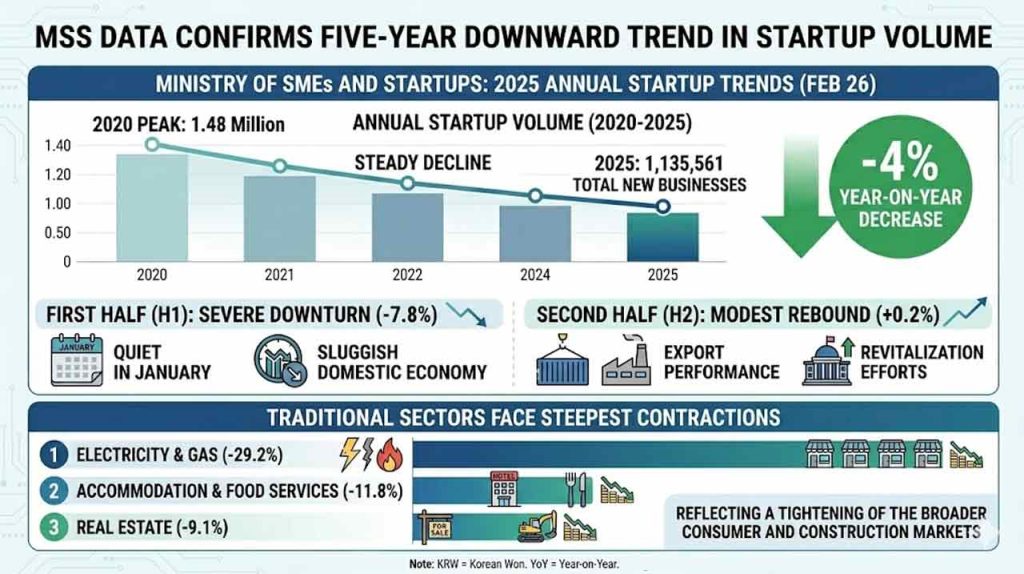
The Ministry of SMEs and Startups released the “2025 Annual Startup Trends” on February 26, reporting a total of 1,135,561 new businesses. This represents a 4% year-on-year decrease, marking a steady decline from the 2020 peak of 1.48 million.
The downturn was most severe in the first half of the year, falling 7.8% due to a quiet January and a sluggish domestic economy. However, the second half saw a modest 0.2% rebound, buoyed by stronger export performance and government efforts to revitalize domestic demand.
Traditional sectors faced the steepest contractions. Substantial drops were recorded in electricity and gas (-29.2%), accommodation and food services (-11.8%), and real estate (-9.1%), reflecting a tightening of the broader consumer and construction markets.
Infrastructure and Economy: The Forces Thinning the Herd
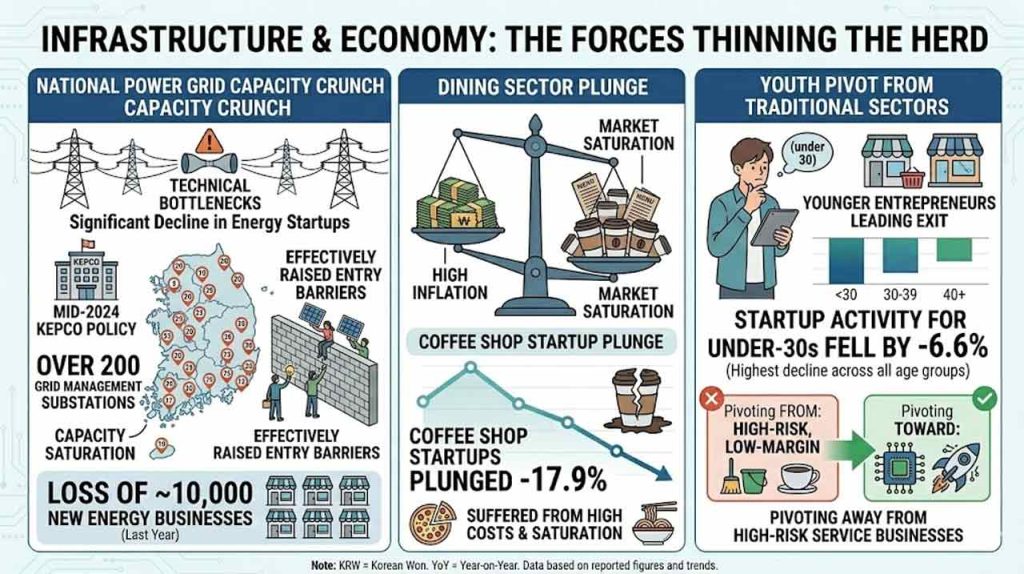
The significant decline in energy startups is largely attributed to technical bottlenecks within the national power grid. In mid-2024, Korea Electric Power Corporation (KEPCO) designated over 200 substations as “grid management substations” due to capacity saturation.
This policy effectively raised the entry barrier for solar power entrepreneurs, leading to a loss of approximately 10,000 new energy businesses last year. Similarly, the dining sector suffered from a combination of high inflation and extreme market saturation, with coffee shop startups alone plunging 17.9%.
Younger entrepreneurs are leading the exit from these traditional sectors. Startup activity among individuals under 30 fell by 6.6%, the highest decline across all age groups, as the younger generation pivots away from high-risk, low-margin service businesses.
Tech-Base Ventures Reach Record 19.5% Share Amid AI Surge
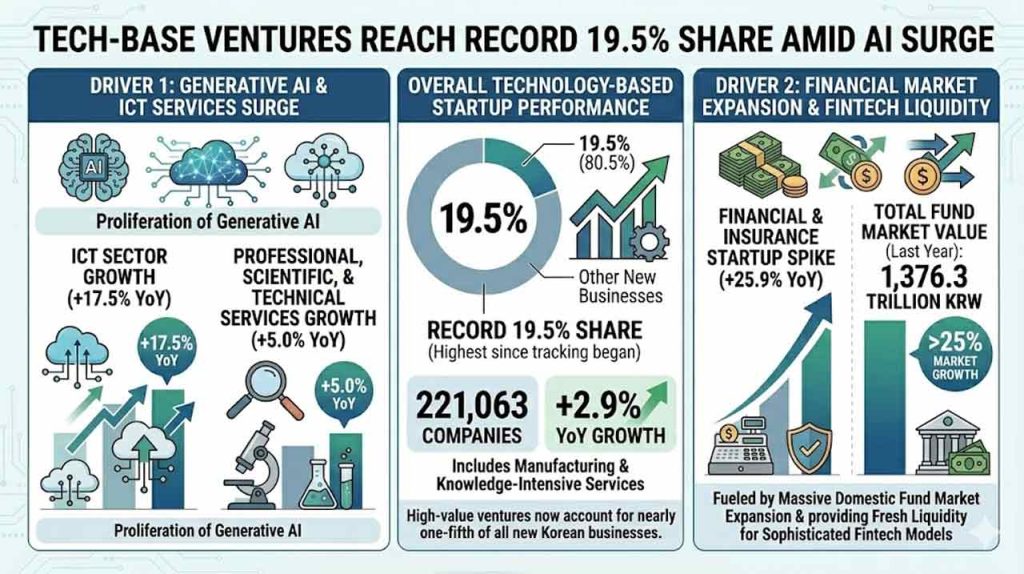
Despite the overall decline, “technology-based startups”—which include manufacturing and knowledge-intensive services—rose by 2.9% to reach 221,063 companies. These high-value ventures now account for nearly one-fifth of all new Korean businesses, the highest proportion since the government began tracking this data.
The surge is primarily driven by the proliferation of generative AI. Startups in the information and communications technology (ICT) sector grew by 17.5%, while professional, scientific, and technical services increased by 5.0%.
Financial and insurance startups also saw a 25.9% spike, fueled by a massive expansion in the domestic fund market. Total fund market value grew by over 25% last year, reaching 1,376.3 trillion KRW and providing fresh liquidity for sophisticated fintech models.
Strategic Implications for Global Investors and Founders
For the global venture ecosystem, Korea’s “startup slump” is less a sign of weakness and more a signal of market professionalization. The ecosystem is shedding “noise”—the repetitive, low-tech small businesses—to make room for a “signal” dominated by AI and specialized services.
This shift aligns with global deep-tech trends where investors prioritize defensible intellectual property over sheer scale. The rise in corporate-led financial startups and AI-driven content production indicates that the “K-Startup” brand is moving toward a more mature, institutionally-backed model.
The grid-related decline in solar startups serves as a warning for ESG investors regarding infrastructure readiness. However, the resilience of tech-base ventures in the face of high interest rates suggests that Korea’s core innovation engine remains robust and increasingly specialized.
Future Outlook: A Leaner, More Competitive Ecosystem
The 2025 data suggests that the era of “mass-entrepreneurship” in Korea is being replaced by “precision-entrepreneurship.” As the government continues to focus on technology-led growth, the friction in traditional sectors will likely persist, pushing talent toward the high-tech core.
Market participants should watch for further integration of AI across traditional industries as a survival mechanism. The slight rebound in late 2025 hints at a potential stabilization, provided that global export conditions remain favorable and domestic consumption begins to recover.
Key Takeaway on Korea’s Startup Growth Trends in 2025
- Total Decline: South Korea recorded 1,135,561 startups in 2025, a 4% decrease and the fifth consecutive annual drop.
- Record Tech Share: Technology-based startups reached an all-time high of 19.5% of total startups, highlighting a shift toward high-value industries.
- AI Growth Catalyst: ICT startups grew by 17.5%, driven largely by generative AI services and audio/video production.
- Sectoral Friction: Solar power startups crashed by 29.2% due to KEPCO’s grid capacity limits, while coffee shops dropped 17.9% due to saturation.
- Demographic Shift: The under-30 demographic saw the largest decline (-6.6%), suggesting a move away from low-barrier service businesses.
- Investment Liquidity: The finance and insurance sector rose 25.9%, supported by a 25.3% growth in the national fund market.
🤝 Looking to connect with verified Korean companies building globally?
Explore curated company profiles and request direct introductions through beSUCCESS Connect.
– Stay Ahead in Korea’s Startup Scene –
Get real-time insights, funding updates, and policy shifts shaping Korea’s innovation ecosystem.
➡️ Follow KoreaTechDesk on LinkedIn, X (Twitter), Threads, Bluesky, Telegram, Facebook, and WhatsApp Channel.